I-65 Bridge Repairs to Begin Following May Tanker Truck Fire
Repairs to the General W.K. Wilson Jr. Bridge on I-65 in Mobile County were set to begin in June 2014 after a fiery tanker crash.
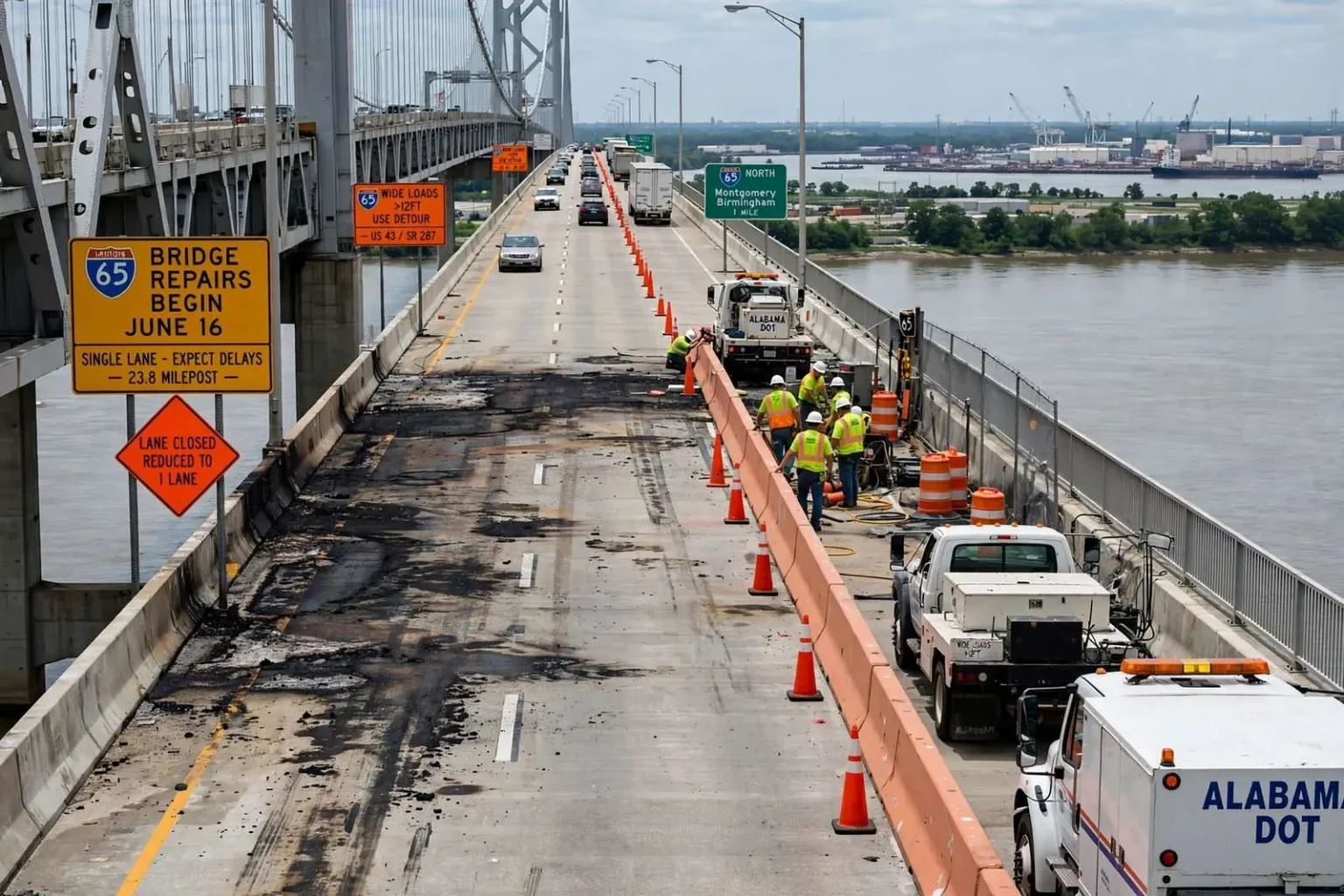
Crews were preparing to begin repair work in mid-June 2014 on the General W.K. Wilson Jr. Bridge, a key span carrying Interstate 65 traffic north of Mobile that had been damaged nearly a month earlier in a fiery tanker truck crash. State transportation officials said repairs were expected to begin the week of June 16 and be substantially complete by mid-July.
The timeline gave the region a four-week window of disruption on one of south Alabama’s most important freight corridors, and it reflected the urgency with which the Alabama Department of Transportation treated the damage. Interstate 65 is the spine of the state’s highway network, running from Mobile north through Montgomery, Birmingham, and Huntsville, and any impairment of the bridge — formally known to locals as the Cochrane-Africatown USA Bridge — resonated far beyond the immediate detour routes.
Lane Closures and the Barrier Installation
During that first week of work, crews planned to install a temporary barrier rail along the southbound side of the bridge near the 23.8 milepost on I-65. Officials said the barrier installation could take up to five days, during which traffic in both directions would be reduced to a single lane. The barrier served a double purpose: it protected the repair zone from live traffic, and it separated workers from the stream of trucks and commuters that crosses the span daily even under the best of conditions.
Single-lane operation on a bridge of that size is a delicate exercise. The Wilson Bridge carries four lanes of interstate traffic over the Mobile River, and squeezing both directions into half the deck meant delays that rippled for miles during peak hours. Motorists approaching from Baldwin County on I-10 and from the Eastern Shore felt the backups as far south as the junction, while northbound commuters out of Mobile confronted the bottleneck from the first day. Transportation officials urged drivers to allow extra time, use alternate routes where possible, and expect the tightest conditions during morning and evening rush periods.
Wide loads faced a stricter restriction. While repairs were underway, trucks hauling loads wider than 12 feet were advised to avoid the bridge entirely, with state officials recommending a detour using U.S. Highway 43 and State Route 287 to State Route 59 instead. The detour routed oversized freight through the corridor of small towns north and east of the bridge — Saraland, Creola, and the communities along US 43 — shifting the burden of the closure onto two-lane roads unaccustomed to heavy industrial traffic. Trucking companies hauling steel, machinery, and construction equipment across the region had to rebuild routes and schedules around the restriction for the duration.
The May 22 Crash That Started It
The bridge had been temporarily shut down after a semi-trailer hauling petroleum collided with another vehicle on May 22, and both vehicles burst into flames. The resulting fire burned for hours, scorching roughly 250 feet of the bridge deck and damaging about 50 feet of structural steel girder underneath. Fire crews from departments across the northern Mobile County area responded to a blaze that combined the hazards of a fuel tanker fire with a structure fire on a river crossing — burning petroleum spreading across the deck, black smoke visible for miles, and the constant question of how deep the heat had penetrated the steel below.
Engineers faced a diagnosis problem familiar from highway bridge fires nationwide: modern steel retains strength unless it is heated past critical temperatures, but determining exactly how hot the girders got requires inspection, testing, and sometimes destructive analysis of the affected sections. Until that assessment was complete, the span stayed closed entirely — an extraordinary step for a corridor carrying interstate traffic, but the only defensible one while the structural condition of the girders under a quarter-mile stretch of burned deck remained unknown.
State crews reopened one of the bridge’s northbound lanes two days after the crash, on May 24, once engineers had assessed how much damage the fire caused to the structure. The partial reopening allowed some traffic flow to resume on the vital north-south corridor while the full extent of repairs was planned. Even a single lane restored made an immediate difference for northbound commuters and freight, though southbound traffic remained squeezed and the full repair work — deck resurfacing and girder replacement on the burned sections — still lay ahead.
A Critical Corridor for South Alabama
The General W.K. Wilson Jr. Bridge carries I-65 traffic over the Mobile River in Mobile County, an essential route for commuters, freight haulers, and visitors moving between the Mobile area and points north. Any prolonged disruption to the bridge carried consequences for regional traffic patterns, underscoring why state officials moved to schedule repairs quickly after the crash. The span links Mobile’s industrial core — the port, the chemical plants, the paper mill corridor — to the interstate system that carries those industries’ freight to Montgomery, Birmingham, and beyond, and it sits near the junction where I-65 meets I-10, one of the busiest interchanges on the Gulf Coast.
The bridge is named for General W.K. Wilson Jr., a Mobile-area engineer and civic leader, and locals have long used both names interchangeably. Its stretch of the Mobile River below — the Three Mile Creek and Spanish River complexes nearby, the working waterfronts of Africatown and the industrial banks of the river — makes it one of the region’s most recognizable crossings, carrying drivers between the older neighborhoods north of the city and the fast-growing suburbs along the interstate toward Saraland and Satsuma.
The economic stakes of a bridge closure scale quickly. The Port of Mobile’s freight flows depend on interstate access; retailers in Baldwin County restock through the I-65 corridor; and the thousands of commuters who cross the river daily represent wages that stop flowing when the trip doubles in length. A full month of single-lane operation was costly, but engineers and officials judged it far cheaper than the alternative — a structural failure on a span that size, with the indefinite closure that would follow.
How the Repair Plan Worked
The repair sequence reflected standard practice for fire-damaged steel bridges: protect the work zone, remove and replace compromised sections, rebuild the damaged deck, and restore full traffic in stages as each element comes back to strength. The temporary barrier rail installed in the first week created a protected envelope for crews working above and below the deck; girder repairs proceeded beneath the roadway while resurfacing followed above; and the mid-July substantial-completion target allowed for inspection and cleanup before the barrier came down and normal traffic patterns resumed.
Scheduling the work in June also dodged the worst of two hazards: hurricane season’s early months and the peak of summer heat that strains both asphalt work and the crews performing it. A mid-July substantial completion date left margin before the height of the Atlantic hurricane season, when the region’s highway network becomes a critical evacuation and response asset — a consideration that weighs on every major bridge repair along the Gulf Coast.
Bridge and infrastructure incidents like this one were a recurring reminder of how much south Alabama’s economy depends on a handful of major highway arteries, particularly the stretch of I-65 connecting Mobile County to the rest of the state. When a single tanker fire can close the region’s primary north-south link, every detour plan, detour sign, and state highway between US 43 and SR 59 becomes part of the region’s economic infrastructure. The June repair work on the Wilson Bridge was, in that sense, about more than one span: it was the region restoring a redundancy it cannot afford to lose, and a preview of the conversations about bridge capacity, freight routing, and infrastructure investment that follow every such closure on the Gulf Coast.
What Drivers Should Expect During the Work
For the month of repair work, drivers crossing the Wilson Bridge needed to plan around three realities: reduced lanes in both directions, the potential for incidents anywhere near the narrowed footprint to back up traffic for miles, and the wide-load detour pushing oversized trucks onto US 43. Transportation officials coordinated with local law enforcement to manage the intersections along the truck detour, and message boards on the approaches to the bridge warned motorists of the lane restrictions well before the crossing. Commuters with flexibility shifted departure times; businesses that depend on scheduled freight adjusted delivery windows to early morning, when the single-lane configuration flowed most smoothly.
The crash and repair also tested the region’s detour capacity in a way that planners had long warned about. With I-65 compromised, the alternatives — US 43 to the north of the river, the Causeway and US 90 corridor to the south, and the winding two-lane roads of north Mobile County — absorbed traffic they were never designed to carry at interstate volumes. The episode renewed attention to long-standing proposals for additional river crossings and for improving the secondary network that serves as the region’s safety valve when its main arteries fail.
Fire Damage and Bridge Engineering in Brief
Fires rank among the most serious threats to steel bridges precisely because the damage is not always visible. A tanker fire on a deck can scorch concrete surfacing that is relatively simple to replace, while heat conducted into the steel below can weaken connections, distort girders out of alignment, or compromise welds in ways that require testing to detect. That is why engineers kept the entire bridge closed for two days after the May 22 crash — not because the visible damage demanded it, but because the invisible damage had to be ruled out before interstate traffic could cross again.
The distinction between the damaged sections and the rest of the span shaped the repair plan. Roughly 250 feet of deck and about 50 feet of girder damage, out of a bridge that crosses the full width of the Mobile River, meant most of the structure was sound; the work concentrated on the burned zone near the 23.8 milepost. Staging materials — steel girders of the right specification, deck panels, barrier rail — takes time, which is why nearly a month passed between the crash and the start of repairs despite round-the-clock assessment work in between.
The substantial-completion target of mid-July represented roughly eight weeks from crash to restored bridge — a demanding pace for structural repair work, and one that reflected both the corridor’s importance and the department’s experience with emergency highway repair. Every week of single-lane operation carried costs that accumulated across the regional economy, and every week of rushed work carried safety risks that crews and inspectors refused to accept; the schedule split the difference with phased inspections as each repair step finished.
By mid-July, the plan called for the Wilson Bridge back to full operation — four lanes of I-65 crossing the Mobile River, wide loads permitted again, and the detour routes through Saraland, Creola, and the US 43 corridor released back to their ordinary traffic. For the drivers, truckers, and businesses that had routed around the damaged span for a month, the reopening would be quiet but consequential: the region’s primary north-south artery restored, its lesson about infrastructure vulnerability absorbed, and its next chapter in the long-running story of Gulf Coast growth and mobility just beginning.