Inside Fort Conde Inn: How a Crumbling Mobile Landmark Became a Boutique Getaway
Fort Conde Inn in downtown Mobile turned a decaying 1836 mansion into a boutique bed-and-breakfast in the historic village.
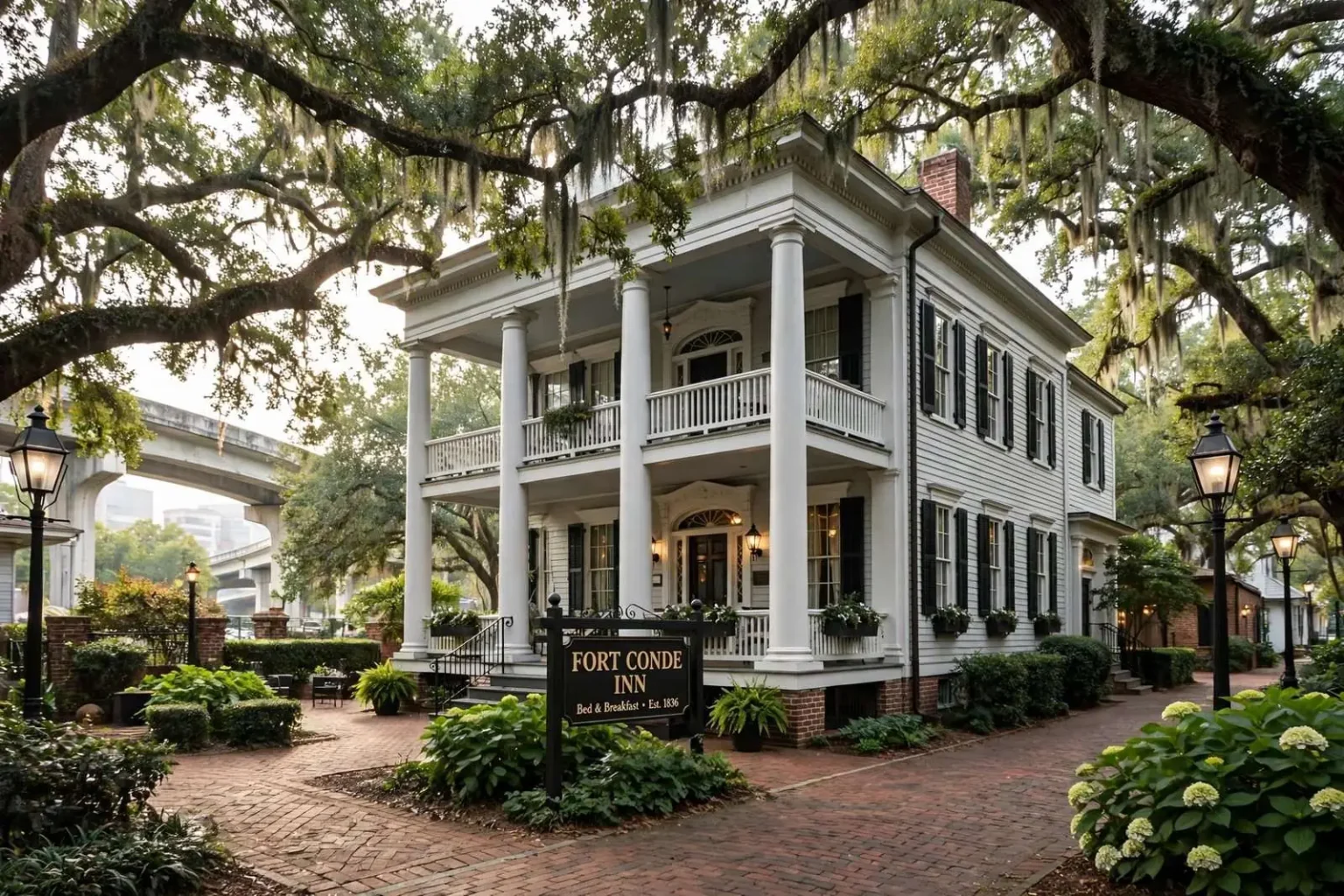
MOBILE, Alabama — Tucked inside the loop of the Interstate 10 on-ramp that curves toward the Wallace Tunnel sits a small, quiet pocket of downtown Mobile known as Fort Conde Village, a cluster of historic buildings that survived demolition, decades of neglect and the roar of the highway built around them. Each morning, guests staying at Fort Conde Inn gather around an eight-seat dining table for coffee, fresh fruit and dishes like seafood eggs benedict, prepared to order by executive chef Robbie Dickson, before wandering a short walk up Royal Street to the reconstructed Fort Conde, the Museum of Mobile and the Gulf Coast Exploreum.
The contrast is part of the place’s charm. Thousands of motorists pass the village daily without noticing it, funneling toward the tunnel that carries I-10 beneath the Mobile River, while inside the loop a handful of restored structures hold bed-and-breakfast rooms, offices and gardens that feel a world away from the interstate’s concrete curves. Urban planners call such places surviving fragments; Mobile’s visitors call it the neighborhood they didn’t know existed ten minutes from the cruise terminal.
The inn’s location places its guests within easy walking distance of the city’s historic core — the reconstructed 18th-century fort that gives the village its name, the museum that interprets three centuries of colonial and American Mobile, the science center on Government Street, and the restaurants and shops of the lower Dauphin Street district. For a bed-and-breakfast, that geography is the entire business plan: a guest who parks the car on arrival may not need it again until departure.
A mansion built in 1836
The inn occupies the Hall-Ford House, one of Mobile’s oldest surviving homes, built in 1836 by Edward Hall, a cotton broker who had come to the city from Philadelphia and later served as Mobile’s mayor. Hall belonged to the generation of merchants who turned a Gulf Coast town into the cotton shipping capital of the region, and the house he built reflected both his Northern origins and his adopted city’s tastes — substantial, city-house-formal and built for a port elite that entertained on a grand scale.
The Ford family owned the house for most of the 20th century before the city acquired it in the 1980s, after which it sat vacant and deteriorating for years. The pattern was common enough in downtown Mobile during those decades: grand old houses outlived the families who could maintain them, passed briefly into institutional ownership, and waited while the city decided what they were worth saving. Hall-Ford House waited longer than most, and its condition when restoration finally began reflected the delay.
Architect Nick Holmes Jr., who helped restore the Hall-Ford House and several of its neighbors, calls it a raised Greek Revival structure with Caribbean and Federal-style influences and describes it as one of the most distinguished homes in Mobile. The description is a compact lesson in Gulf Coast architectural history: the raised main floor lifted living spaces above the humidity and flooding of a port town, the Greek Revival columns announced wealth in the antebellum style, and the Federal and Caribbean details recorded the trade routes and immigrant craftsmen that shaped Mobile’s building traditions more than any other Alabama city’s.
A developer from New York takes a chance
Ahead of the nation’s bicentennial in 1976, the streets of the village were repaved with red brick and fitted with gas lamps, but the 13 historic buildings remained largely abandoned. The improvements dressed a ghost town: the city had invested in the streetscape of a historic district it had not yet found a use for, and for two decades the village existed as a curiosity, brick-paved and lamplit, its buildings empty while downtown Mobile’s revival remained somewhere in the future.
The turnaround came when developer Larry Posner, based in Woodstock, New York, who had previously invested in Mobile and Pensacola apartments, leased the entire cluster of buildings from the city in 1998 under then-mayor Mike Dow, agreeing to pay rent based on a share of future leasing revenue. The structure of the deal mattered as much as its signatories: by tying the city’s rent to revenue that did not yet exist, Mobile effectively made Posner a partner in the village’s revival rather than a tenant speculating on it, and accepted that its compensation would arrive only if his gamble succeeded.
Posner has since restored 11 of the 13 structures, calling the Hall-Ford House the hardest project and the crown jewel of the village. The economics of historic restoration at this scale are unforgiving — small buildings, expensive crafts, tenants who expect modern systems behind old walls — and the pace of the work reflected the reality of a developer restoring one structure at a time as leases and financing allowed, rather than the single dramatic construction project a new building would have permitted.
Crews had to dig out the original floor and brick subfloor, replace it with reclaimed heart-pine wood from Mississippi and rebuild six columns across the home’s double front porch. The heart-pine, dense enough to be nearly indestructible and milled from old-growth timber no longer available commercially, is the material that gives restored antebellum interiors their depth, and finding enough reclaimed stock to fill a house of this size is a salvage operation in its own right. The porch columns, rebuilt to period profile, restored the facade that had defined the house since Hall built it.
What guests find today
The restored Hall-Ford House now functions as the heart of the inn, its parlors and porch serving guests the way they once served the cotton broker who built them. The rooms carry the proportions of a 19th-century town house — high ceilings, tall windows, transoms over the doors — while the systems behind the plaster are entirely modern, a combination that defines the best of historic hospitality: atmosphere without the drafty discomforts that once came standard in antebellum buildings.
The eight-seat breakfast table is an institution of its own. A single communal table turns the morning meal into conversation among strangers — traveling nurses and consultants, couples touring the historic districts, parents visiting university students — and the made-to-order kitchen, anchored by an executive chef preparing dishes like seafood eggs benedict with Gulf ingredients, gives the inn a culinary reputation that many larger hotels cannot match. Guests who arrive as reservations frequently leave as repeat bookings.
The village around the inn has quietly become one of downtown Mobile’s more distinctive addresses, its restored buildings housing offices and small businesses that wanted a presence in the historic core without the glass-and-steel anonymity of an office park. Preservation professionals hold up Fort Conde Village as an example of adaptive reuse done at neighborhood scale — not a single marquee building rescued for show, but a whole block of modest historic structures returned to daily use.
The inn’s guest accommodations occupy the house’s upper and rear rooms, each arranged to preserve the flow of the original floor plan rather than carve it into standardized hotel rooms. Guests descend for breakfast past the double front porch and its rebuilt columns, and the house’s siting — raised, shaded by live oaks, oriented to catch the Gulf breeze — explains itself on the first warm morning, exactly as antebellum builders intended.
A lesson in patience
The story the village tells is one of near-losses and second chances. The Hall-Ford House survived because the city acquired it; it decayed because acquisition came without a plan; it was saved because an outside developer accepted a deal whose returns depended on a revival nobody in 1998 could guarantee. Along the way, the 1976 brick streets and gas lamps — improvements that once seemed decorative folly around empty buildings — turned out to be infrastructure waiting for a neighborhood to grow into.
Downtown Mobile’s broader renaissance — the cruise terminal, the convention center, the restaurants along Dauphin Street — supplied the environment in which that bet could pay off. But the village’s revival ran on the particular economics of historic preservation: buildings that cannot be replaced cheaply, restored expensively, over a long enough horizon, by someone patient enough to see the work through structure by structure.
For guests at Fort Conde Inn, the history arrives without a lecture. They sleep in a mayor’s mansion, eat at a table set beneath original heart pine, and walk a brick street lit by gas lamps to a fort built by the French, a museum and a science center — all inside a highway loop that nearly consumed the whole ensemble. The village’s survival is Mobile’s history in miniature: a port city that has repeatedly let its oldest treasures slip toward the brink, and then, at the last workable moment, found someone willing to restore them.