Mobile Church Fire Sends Daycare Children Walking Past Flames on Azalea Road
A Mobile church fire on Azalea Road forced daycare buses to reroute, leaving young children to walk past the flames.
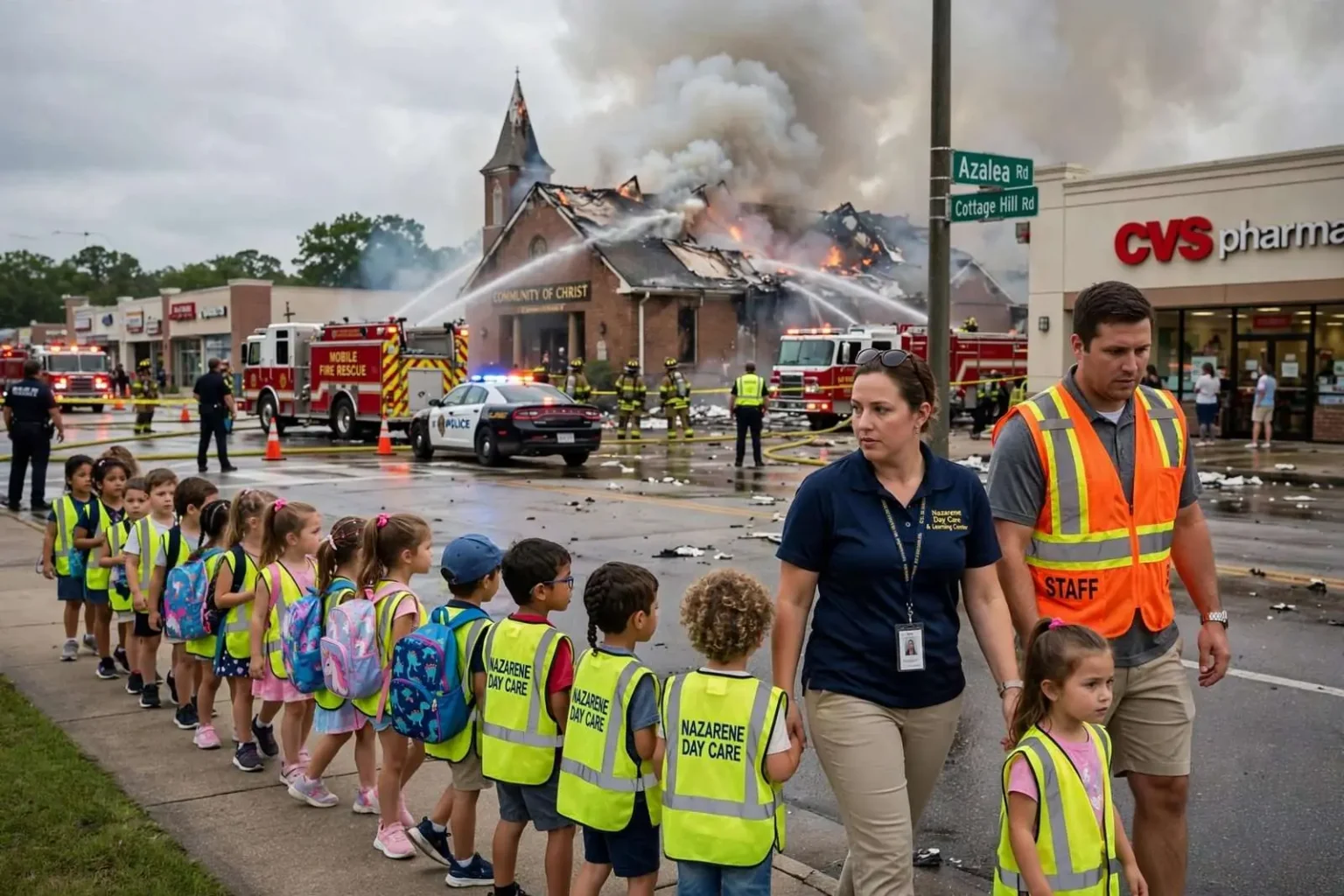
MOBILE, Alabama — A midweek fire tore through the roof of the Community of Christ church on Azalea Road in Mobile, sending a plume of smoke into the sky and forcing police to shut down a stretch of the busy corridor near the Cottage Hill Road intersection.
The fire drew firefighters and emergency crews to one of the busiest stretches of Azalea Road, where a steady flow of afternoon traffic meets cross-streets lined with businesses, offices and congregations. As smoke rose from the church roof, officers moved to close the roadway near the Cottage Hill Road intersection, rerouting drivers and transforming a routine commute into a slow crawl of diverted vehicles.
Road closures of that kind are standard procedure when a structure fire breaks out along a major commercial corridor. Fire apparatus need unobstructed access to hydrants and to the building itself, and police establish a perimeter to keep onlookers at a safe distance. But on a thoroughfare as heavily traveled as Azalea Road, the closure reaches far beyond the block that is burning, snarling traffic across a wide swath of the surrounding area.
Children Caught in the Disruption
The closure had an unexpected side effect just across the street, where the Nazarene Day Care and Learning Center operates behind the First Church of the Nazarene. Two 15-passenger daycare buses returning from a field trip to the Wet ‘n Wild water park could not reach the center because officers had blocked the road.
The drivers pulled over near a CVS pharmacy on Azalea Road, and roughly nineteen children, ranging from about 5 years old and up, along with their supervisors, had to walk the rest of the way to the daycare while the church burned nearby.
The timing could hardly have been more striking. The buses had been bringing the children back from a day of swimming and play at the water park, a routine summer outing, only to end the trip on foot past an active fire scene. Police officers controlling the perimeter helped the group make its way through, while daycare staff kept the children together on the short walk back to the center.
For the supervisors responsible for nineteen young children, the detour required quick judgment. A blocked road with a fire burning across the street is not a situation any field trip plan anticipates, and the decision to walk the final stretch — rather than wait indefinitely in the parked buses — got the children back to the familiar surroundings of the daycare while emergency crews worked.
A Pastor Watches From Across the Street
Spencer Baggott, pastor of the First Church of the Nazarene, watched in disbelief as smoke poured from the roof of the Community of Christ building. He said it was difficult to see a church go up in flames, and he found himself thinking about how the children walking past would process what they were seeing.
He said he hoped the daycare’s teachers were attentive enough to reassure the kids and help them make sense of the scene. For a pastor, the sight of a neighboring congregation’s building burning carries its own weight, whatever the denominational differences — the building represents years of worship, weddings, funerals and weekly gatherings.
Daycare coordinator Lisa Ray said the children mostly talked about the smell of smoke drifting from the church as they made the short walk. Children often register a fire scene through senses rather than full understanding, and the odor of smoke hanging in the air became the detail that stuck with the group.
Baggott said the kids appeared to be in good spirits despite the disruption and that he did not believe they were seriously shaken by the experience. Young children, watched over by familiar caregivers and moving through what appeared to be an orderly procession, took the detour largely in stride even as adults on both sides of the street followed the fire with far more apprehension.
The proximity of the two congregations made the afternoon unusually personal for the First Church of the Nazarene. The Community of Christ building stands directly across Azalea Road from the daycare property, close enough that the fire was impossible to ignore and close enough that smoke and emergency activity reached the daycare’s doorstep.
Daycare operations depend on routines that families rely on every weekday — arrival windows, meal times, nap schedules and carefully planned outings. A single road closure can upend all of it, which is why the quick coordination between the bus drivers, the daycare staff and the police officers on the scene mattered so much that afternoon.
Field trips to water parks are among the highlights of a daycare summer, and Wet ‘n Wild had long been a popular destination for Mobile-area daycares and families looking to beat the heat. The return trip is usually the quiet part of the day, with tired children dozing on the ride back to the center. Instead, this group returned to sirens and smoke.
The walk from the CVS parking lot to the daycare took the group past businesses that had emptied onto sidewalks to watch the fire, past police tape and past the edge of the perimeter officers had established. Supervisors kept the line moving while steering the children’s attention away from the flames and toward the simple task of getting back to the center.
Parents arriving later for pickup found their children safe and largely unbothered, with staff able to recount an afternoon that could have been frightening but, by all accounts, was handled without injury or panic. In the accounting of a daycare’s day, that outcome is the one that matters most.
For the firefighters, meanwhile, the arrival of a group of young children near the scene was one more consideration in an already complicated response. Keeping sidewalks clear, managing the crowd of onlookers and maintaining access for apparatus all competed for attention along a corridor that never truly empties of traffic.
Uncertainty Over Evening Services
With firefighters and emergency crews still working the scene into the afternoon, Baggott said he was unsure whether his own congregation’s regular 6:30 p.m. Wednesday service would need to be canceled. The extent of the damage to the Community of Christ building was still being assessed as crews continued to respond.
Wednesday evening services are a fixture of weekly life for many Mobile congregations, and the possibility that a nearby fire would force a cancellation underscored how completely the emergency had taken over the corridor. Members arriving for the service would have encountered roadblocks, fire apparatus and the lingering smell of smoke rather than an open parking lot.
Fires in church buildings pose particular challenges for firefighters. Roof structures can hide fire that has spread through attic spaces, and sanctuary interiors hold open expanses that allow flames to move quickly once they break through. Crews on Azalea Road faced the additional complication of a commercial corridor, with adjacent properties to protect and heavy traffic pressing against the closure.
Until crews could fully examine the structure, the question of how badly the building was damaged remained open. What was clear from the street was that the roof had been compromised and that the response would extend well beyond the initial alarm, with apparatus remaining on scene through the afternoon.
A Corridor Under Strain
Azalea Road is one of the main north-south routes through west Mobile, carrying commuter traffic between Cottage Hill Road and the commercial districts to the north. Closing even a short stretch of it near the Cottage Hill Road intersection pushes vehicles onto parallel streets and multiplies delays across the surrounding neighborhoods, a reality anyone who regularly drives the corridor knows well.
The Cottage Hill Road intersection itself is a major crossroads, surrounded by shopping centers, restaurants, medical offices and schools. An emergency closure there during the middle of the day affects deliveries, appointments and school pickups alike, which is why police work to reopen such corridors as quickly as conditions allow.
For the businesses along that stretch, including the CVS pharmacy where the daycare buses paused, the afternoon brought sirens, smoke and a steady stream of rubbernecking drivers. Emergencies like the church fire briefly turn an ordinary commercial strip into the center of the city’s attention.
The incident highlighted how closely the two congregations’ properties sit to one another on Azalea Road, a heavily traveled route through the area, and how quickly a single emergency can ripple outward to affect nearby schools, daycares and daily traffic patterns in the neighborhood.
It also demonstrated the practical web that connects institutions in a busy urban corridor. A fire at one church interrupted the operations of a daycare across the street, rerouted the traffic of an entire district and left two congregations — one dealing with losses, the other weighing whether it could hold its midweek service — watching the same smoke from the same stretch of sidewalk.
After the Smoke Cleared
In the hours after the fire broke out, the immediate concerns were the safety of everyone near the scene and the assessment of damage to the Community of Christ building. The children were back at the daycare, the buses recovered their route once the roads allowed, and the congregation across the street waited for word on the building it had watched burn.
For the daycare’s staff, the afternoon became one of those stories that families hear about for years afterward — the day nineteen children walked past a fire on the way back from the water park. For the neighborhood, it was a reminder of how quickly an ordinary Wednesday on Azalea Road can change course.
Fire investigators and church members alike would spend the days that followed sorting through cause and consequence. The congregation on the other side of Azalea Road, meanwhile, had already experienced the event the way small communities often do: close enough to help, close enough to worry, and close enough to remember.