Might Kindergartners Return to Barton Academy?
With the school system's administration finally out of the building, talk around Mobile turned to sending children back into Barton Academy, possibly as the new home of a performing arts magnet program.
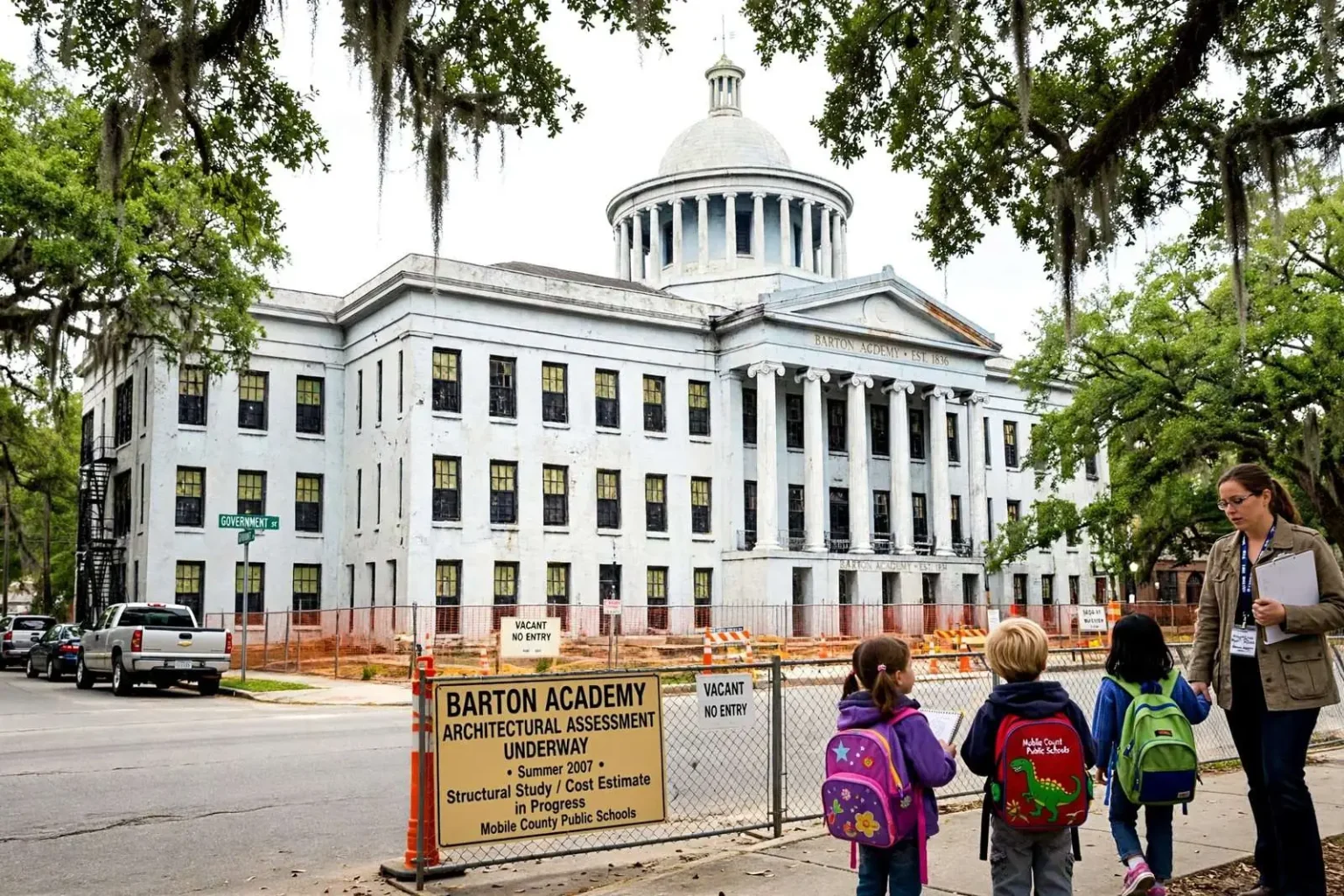
For most of living memory, Barton Academy on Government Street was not a school. It was an address. It was where the Mobile County school board met, where the system’s administration sat, and where, accordingly, every controversy that attached to public education in Mobile County was understood to originate. Parents angry over a rezoning, teachers aggrieved over a transfer policy, taxpayers questioning a budget — all of it played out, physically, in and around the columned building downtown.
By the spring of 2007, the administration was gone from the building, and the question hanging over the columned landmark was blunt: would Barton now flourish, or would it collapse? The system had moved its offices elsewhere, and for the first time in generations the state’s most historic school building stood empty of even the paperwork that had kept it alive.
The Rumor
The talk around town was that Barton might return to what it was built to be. Word circulating among people close to the school system was that the building could become the new home of a kindergarten-through-third-grade performing arts magnet program then housed at Old Shell Road. A source close to the situation confirmed only that the rumor was in the air.
“Sworn to secrecy, but I can confirm that it is a rumor I have heard around town more than once,” the source said. “Realistically it’s too early really to say. We are getting an architectural assessment done this summer on the facility’s condition and cost of renovation. I don’t expect it will be cheap.”
The final note was the operative one: “With all of the positive momentum I feel real good we can make it happen.” Momentum was real — the school system had made headlines nationally for its reforms, and civic pride in downtown’s revival was building — but the caution was just as real. A rumor about an 1830s building is always one architectural report away from dying.
Why the Building Matters
Barton Academy is not simply an old building in downtown Mobile. Completed in the 1830s, it is widely regarded as the first public school building in Alabama, a Greek Revival landmark erected at a moment when the very idea of publicly funded education was contested in the state. Its dome and columns have watched over Government Street through the entire history of Mobile’s public schools.
The school that bears the name of banker and philanthropist Willoughby Barton was the product of a decade-long fight by Mobilians who believed a city owed its children schooling at public expense. In the Alabama of that era, that was a minority position, and the building’s very existence was an argument made in brick and stucco — proof that the idea had won, at least locally, and permanently.
The irony of its 20th-century use was not lost on anyone. A building constructed as a monument to the education of children spent decades as an office for adults who administered the education of children elsewhere. Every time the school board drew fire, the fire landed on Barton. The building became, in the public mind, shorthand for the system itself — its bureaucracies, its budgets, its battles.
The cost of restoring it, as the source acknowledged, would be considerable. A building of that age requires more than paint. Structural work, systems, accessibility and historic-fabric preservation all had to be assessed before any commitment to reoccupy it could be taken seriously, which is why the architectural study that summer mattered more than the rumor.
An Unresolved Question
What made the moment genuinely uncertain was that a vacated Barton Academy could go either way. Empty historic buildings in downtown American cities have a way of deteriorating quietly for decades until they are past saving. Roofs do not announce their failures; a season of water getting in behind the walls of an 1830s landmark can do the work of a decade of neglect. Every year of vacancy added to the eventual bill and subtracted from the arguments for paying it.
The most likely path to preservation was to give the building a purpose, and the most fitting purpose was the original one. Owned by a school system, located in the middle of a resurgent downtown, and architecturally a school to its bones, Barton’s best advocates were always students — a building with children in it does not wait passively for grants and goodwill.
The performing arts magnet idea had a certain elegance to it: small children, in the oldest public school building in the state, in a downtown that was then in the early stages of trying to draw families back. A K-through-third program filled the building’s modest-scale rooms rather than fighting them, and a performing arts focus gave a modern use to a building whose grand central hall had always demanded an audience.
It would also have served the system’s broader strategy. Magnet programs were the engine of Mobile County’s reform-era momentum, drawing families back into public schools with offerings the private academies could not match. Putting one of them in Barton would have been both a program and a statement — the system anchoring its revival in the building where its history began.
How It Turned Out
The specific proposal discussed in 2007 did not come to pass on that timeline. But the underlying instinct did. After a lengthy campaign to raise money and a major restoration, Barton Academy reopened as a working public school in 2021, welcoming students into the building for the first time in generations as a magnet school within the Mobile County Public School System.
The reopening was the product of years of work that the 2007 conversation could only gesture at: feasibility studies, stabilization, a fundraising campaign that enlisted the city’s philanthropic community, and construction that had to modernize a landmark without sanding away what made it one. The dome that had watched over Government Street through the whole history of Mobile’s public schools went back to doing what it was built to watch over.
The rumor, in other words, was right about the destination and wrong only about the schedule. It took fourteen years, an architectural assessment considerably more thorough than the one contemplated that summer, and a great deal more money than anyone in 2007 wanted to name out loud. The “I don’t expect it will be cheap” of that spring turned out to be an understatement measured in years as well as dollars.
What the 2007 episode preserved, in hindsight, was the moment the turnaround began. The building was vacant, the idea was in the air, the assessment was commissioned, and someone close to the decisions was willing to say — off the record, sworn to secrecy — that with all the positive momentum, it could happen. It happened. It just took a decade and a half longer than anyone in that spring’s conversation imagined.
A Building as a Civic Argument
Downtown Mobile in 2007 was a place of returning ambitions. The convention center and the revitalized Dauphin Street corridor had given the central business district an evening population it had lacked for decades, and civic leaders talked openly about adding residents — loft conversions, infill housing, the amenities young families weigh. Into that conversation, the question of Barton’s future was not merely architectural. An empty landmark at the head of Government Street read as a symbol of unfinished business; a school there would read as proof that downtown was becoming a neighborhood again.
The building’s history gave that symbolism unusual depth. Public education in Alabama is, in a real sense, traceable to the campaign that produced Barton, and no other structure in the state carries that claim. When Mobilians argued about what to do with it, they were arguing about which chapter of the city’s story they wanted to tell the next generation — the era when it housed administrators, or the era when it taught children.
The performing arts magnet at Old Shell Road had its own constituency. Families had enrolled children in the program for its music and drama focus, and moving it downtown would trade a residential neighborhood campus for a landmark one — with all the questions of car lines, security and play space that such a move always raises. Those practical worries were part of why the 2007 rumor stayed a rumor: relocations of successful programs create as many opponents as celebrations.
The Long Middle Years
Between the spring 2007 assessment and the eventual reopening, Barton passed through the familiar trials of a vacant landmark: leaking episodes, fence-line neglect, competing proposals, and the slow accumulation of an engineering case for doing something. Preservationists kept the building in the public eye, and the school system retained ownership of both the property and the problem — an institution with finite construction dollars holding the state’s most significant school building at the top of its needs list.
What ultimately unlocked the project was the same combination the 2007 source described: momentum and money, arriving years apart. The restoration campaign that followed enlisted foundations, corporations and individual donors who understood that Barton was a civic identity as much as a facility, and the work that resulted treated the building as the exhibit — restoring rather than replacing wherever the fabric allowed.
When students finally walked in, in 2021, the circle closed on the building’s own terms: public schoolchildren, in Alabama’s first public school building, attending a public school named for the system’s past and organized for its future. The source who said, back in 2007, that he felt real good about making it happen had the direction right all along. Only the calendar was against him.