Mississippi Angler Ferries Burn Victims to Safety After Boat Fire Near Dauphin Island
A Mississippi fisherman used his boat to rush three burn victims to the Coast Guard after a vessel fire south of Dauphin Island in June 2014.
Day of Fishing Turns Into a Rescue Mission
A day of red snapper fishing in the Gulf of Mexico turned into an emergency rescue in early June 2014, after a Mississippi angler answered a distress call and ferried three burn victims toward help near the mouth of Mobile Bay. The fisherman, a 41-year-old Hattiesburg, Mississippi, resident, was preparing to head back to shore aboard his 36-foot boat when he heard a request broadcast from overhead: the U.S. Coast Guard needed a vessel to reach a boat that had briefly caught fire somewhere south of Petit Bois Island, Mississippi, and to help move its passengers to safety. His boat was the one within range to respond, so he turned back west toward the scene. What began as the end of a routine fishing trip became roughly an hour of emergency care on the open water.
The broadcast the angler heard is a standard tool of Gulf Coast search and rescue. Coast Guard aircraft and cutters routinely issue an all-points request to vessels in the vicinity of an emergency, asking the closest able boat to divert to the scene. On a busy weekend during red snapper season, when hundreds of recreational craft spread across the Gulf south of the barrier islands, the nearest responder is often a private boat rather than a government asset. That is exactly what happened in this case, and the Hattiesburg angler did not hesitate when his position made him the closest option.
Passengers Suffered Severe Burns
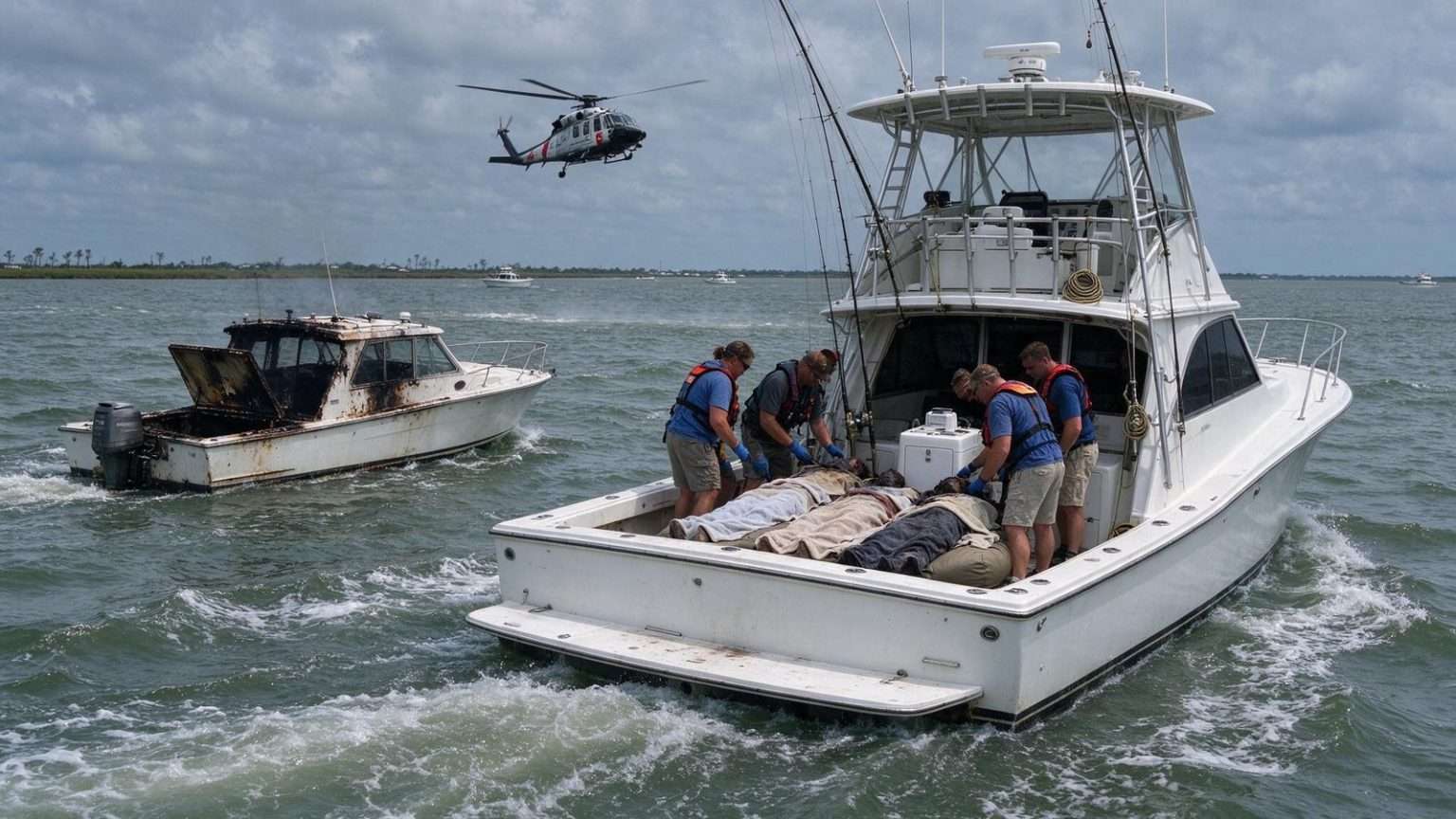
When he arrived, he found the disabled boat adrift with its engine hatch raised, surrounded by other vessels that had also stopped to help. Three passengers aboard the smaller, 24-foot boat, an older man, a woman, and a teenage girl, all appeared to have suffered severe burns, with the woman’s injuries looking the worst of the three. The scene that greeted rescuers was grim: a burned-out engine compartment, a wounded crew and a growing cluster of Good Samaritan vessels standing by with no medical equipment among them. The angler’s boat became the evacuation platform almost immediately.
Rescuers moved the injured passengers onto the angler’s boat, laying them on bean bags and wrapping towels around them to keep them as comfortable as possible for the roughly hour-long trip to a rendezvous point with the Coast Guard about 10 miles south of the Mobile Bay ship channel. The improvised arrangements, bean bags instead of stretchers, towels instead of burn dressings, reflect the reality of first aid on a recreational fishing boat, which carries none of the supplies a rescue vessel would. The three victims were laid out on the deck while the angler and helpers from other boats monitored their condition. Nobody aboard had burn treatment training, so the goal was simply to keep the victims still, covered and moving toward professional care.
During the trip, the angler said he could see the skin beginning to peel on the victims’ legs within about 30 minutes, an unsettling sign of how serious the burns were. The detail underscored what first responders know well: burns from an engine fire or fuel flash can penetrate deeper than they first appear, and the damage continues to develop in the minutes and hours after the fire itself is out. The angler later described the sight as one of the most difficult parts of the entire ordeal, a reminder that civilian rescuers take on an emotional burden alongside the practical work.
Fumes Sparked the Fire
According to the angler’s account, only fumes from the smaller boat’s engine had ignited, rather than a fuel tank explosion. That distinction matters both for what happened and for what could easily have happened. Vapor ignition in an engine compartment, often the result of fuel fumes accumulating in a bilge before startup or a fuel leak meeting a spark, produces a sudden fireball that can engulf anyone standing nearby without destroying the boat outright. A full tank explosion, by contrast, usually sinks a vessel and frequently kills everyone aboard. The passengers on the 24-footer were fortunate the fire burned itself out quickly, leaving the boat afloat and adrift rather than at the bottom of the Gulf.
The raised engine hatch the rescuers found points to how the fire likely ended. Boaters are taught to aim portable extinguishers at the base of the flames and to shut off fuel lines, and many engine fires are followed by someone opening the hatch to check the damage. The sequence on this boat, a brief fire, a raised hatch and a crew of three burned but alive, suggests the flames flashed through the compartment and were knocked down before they could reach the fuel supply. Fire investigators were not involved in the case since the incident fell under Coast Guard reporting rather than a criminal inquiry, so no formal public findings were issued.
That vessel was later towed back to Mississippi waters once the passengers had been safely transferred. Salvage and towing are a routine part of the Gulf boating economy, with commercial towing services based in Pascagoula, Biloxi and the Mississippi Sound communities standing by during the heavy summer season. A burned engine compartment typically renders a boat unpowered but not unsalvageable, and tow operators deal with such tows regularly during peak fishing weekends. The 24-footer’s owners were left to sort out repairs and insurance after the human emergency was resolved.
Treatment and Aftermath
At least two of the injured passengers were taken to a Mobile hospital for treatment of second-degree burns, though full details on all three victims’ conditions and identities were not immediately released. Second-degree burns, which damage both the outer layer of skin and the layer beneath, are intensely painful and carry a real risk of infection and fluid loss, but patients who reach hospital care promptly generally recover, often without grafting. Mobile’s hospitals serve as the primary trauma and burn-care destination for the northern Gulf Coast, a role that puts them in regular contact with injuries from boating, industrial and highway accidents across the region. The teenage girl and the two adults were evaluated after the Coast Guard rendezvous completed the evacuation chain the private rescue had begun.
The Coast Guard’s role in the case illustrates how the agency stages its assets across the northern Gulf. Sector Mobile, headquartered on the Mobile River, coordinates search and rescue for a zone that stretches from the Mississippi state line to the Florida border and well offshore. Helicopters and small boats from stations along the coast can reach a distress scene far faster than any surface vessel can transit, which is why the fixed-wing broadcast asking civilian boats to assist is such an effective tool: the aircraft finds the casualty and orchestrates from above while the nearest boat closes the distance.
By the time the angler’s boat met the Coast Guard about 10 miles south of the ship channel, the hardest part of the rescue was done. The transfer turned an improvised deck into a proper medical handoff, and the victims passed from towels and bean bags into trained care. From there, the case disappeared from public view in the way most rescue cases do, with the rescuer returning to his fishing trip and the victims to their recovery, connected only by an hour on the water that neither will likely forget.
A Reminder for Gulf Boaters
The rescue underscored how quickly recreational boaters along the Gulf Coast can find themselves called into service during an emergency, particularly during the busy summer boating season when the waters off Dauphin Island and Mobile Bay see heavy fishing and pleasure-craft traffic. The June 2014 opening of red snapper season draws an enormous fleet across the bar and into the open Gulf, with boats from Alabama, Mississippi and Florida ports converging on the same productive grounds. With that much traffic on the water, the nearest responder to any emergency is usually another private boat, minutes if not hours ahead of any official asset. Boating safety educators use stories like this one to encourage every captain to carry a working VHF radio, first aid supplies and a fire extinguisher sized for the engine compartment, since any of them could be the angler in this story.
The episode also carries lessons about fire prevention on small boats. Coast Guard Auxiliary and Power Squadron courses taught across the Gulf Coast stress the routine that most engine fires violate: run the blower for several minutes before starting a gasoline engine, sniff the bilge for fumes, and never open the engine hatch immediately after a fire until the compartment has been allowed to cool and the fuel has been shut off. Fume ignition is among the most common causes of boat fires on the water, and it is almost entirely preventable with a functioning bilge blower and a few seconds of patience at the ignition key.
Coast Guard crews and civilian boaters alike frequently work together on Gulf rescues, especially when a Coast Guard vessel isn’t the closest asset able to reach the scene quickly. The system formalizes what mariners have practiced for centuries under good Samaritan traditions, and federal law generally shields recreational responders who act in good faith. Emergency broadcasts to all stations, coordinated by aircraft overhead, have become the standard way to turn the mass of weekend fishing boats into a scattered search and rescue fleet.
The incident became one of several water-rescue stories to emerge from the Mobile Bay area that summer, as boat traffic around Dauphin Island and the surrounding Gulf waters remained heavy through the warm months. The barrier islands, the ship channel and the passes funneling traffic between the bay and the Gulf concentrate that traffic into predictable corridors, and rescues along them have become a seasonal staple of Coast Guard public affairs. For the Hattiesburg angler, the day ended with an empty fish box and a deck full of burn victims, a trade he made without hesitation when the request came crackling down from overhead.