University of South Alabama Mobile
Investigator Shuffle Follows Elections at Alabama AG and Mobile DA Offices
A wave of personnel changes reshaped the investigative ranks of the Alabama attorney general's office and the Mobile County district attorney's office as new officeholders prepared to take charge.
A round of personnel moves reshaped the investigative ranks of two key law enforcement offices as newly elected officials prepared to take charge, with veteran investigators shifting posts in Montgomery and Mobile. The changes paired a familiar name from federal law enforcement with the state attorney general’s office and a shake-up of the leadership tier inside the Mobile County district attorney’s operation, all as the incoming officials built out their command staffs before taking office.
An FBI Veteran Heads to the AG’s Office
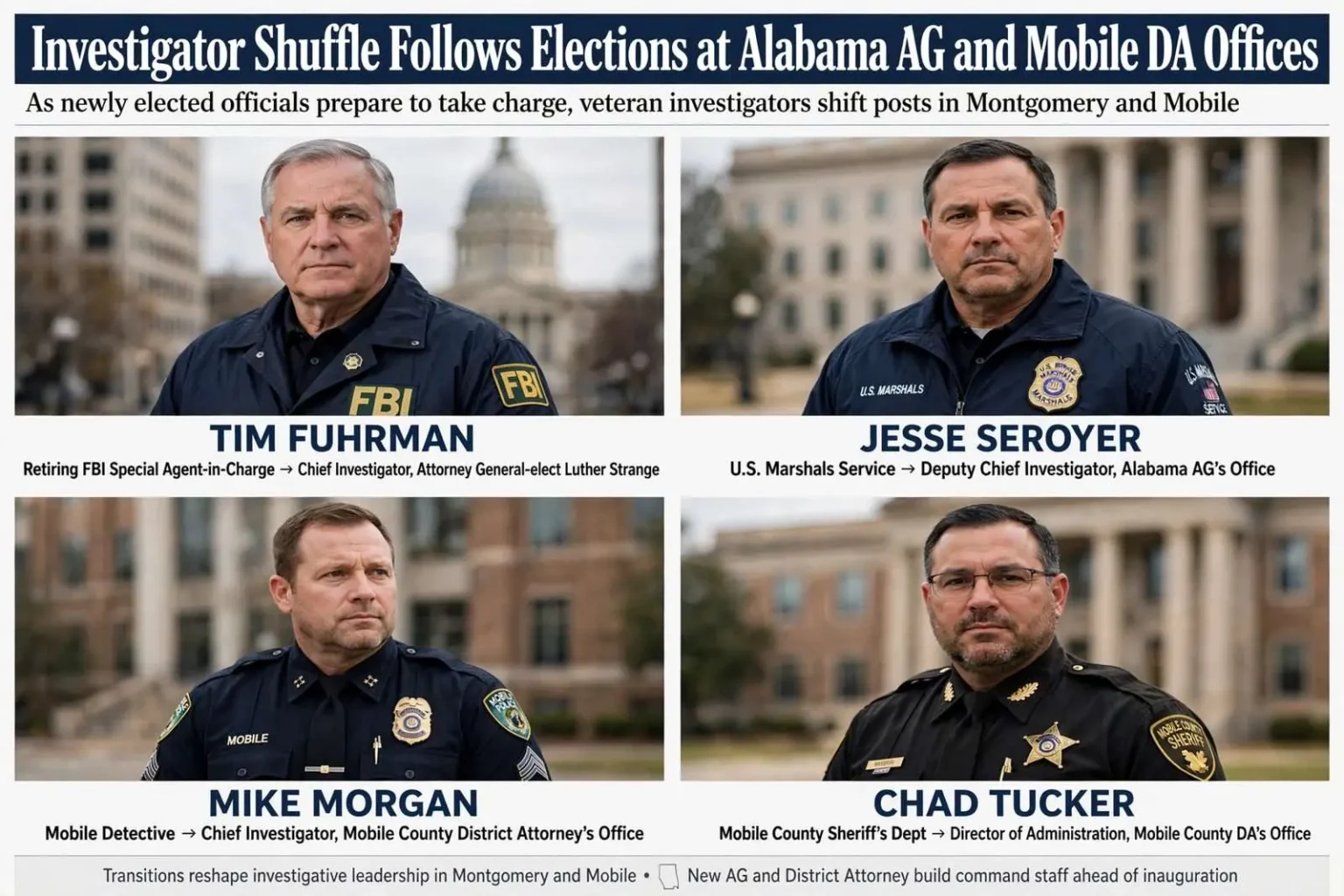
Tim Fuhrman, the special agent-in-charge of the FBI offices in Mobile and Montgomery, planned to retire that month to become chief investigator for Attorney General-elect Luther Strange. Fuhrman had supervised the investigation that led to the indictments of various legislators, lobbyists and gambling interests on charges of corruption stemming from proposed gambling legislation, a probe that had dominated Alabama political news.
That investigation — the product of a years-long federal probe into whether votes in the Legislature were bought and sold during the push to legalize electronic bingo — made Fuhrman one of the most recognizable federal agents in the state. His field offices spanned the territory where the alleged conduct occurred, and his agents sat through hundreds of hours of recordings and testimony before the indictments came down. Moving from supervising that case to serving the state’s top law enforcement office marked an unusual crossover, the kind that typically follows only when an official wants investigative leadership with unimpeachable federal credentials.
For Strange, who had won the attorney general’s race in November, hiring Fuhrman sent a message to sheriffs, district attorneys and state investigators alike: the office intended to be run with federal-level investigative discipline. The attorney general’s investigators handle everything from public corruption and Medicaid fraud to capital case support for prosecutors across Alabama’s 67 counties, and the chief investigator sets the tone for all of it.
Joining him at the attorney general’s office would be Jesse Seroyer, then with the U.S. Marshals Service, who was returning as deputy chief investigator. Seroyer had previously worked under Attorneys General Jeff Sessions and William Pryor, giving the office’s second-in-command his own deep institutional memory of how the agency operated under two of Alabama’s most prominent former attorneys general, both of whom went on to federal judgeships.
The law enforcement community planned to honor Fuhrman with a luncheon on the Eastern Shore, a farewell that doubled as a measure of the regard he commanded across the Gulf Coast’s federal, state and local agencies after a career spent in their service.
Changes at the Mobile DA’s Office
The transition at the Mobile County district attorney’s office brought its own reshuffling. Veteran Mobile detective Mike Morgan would replace Tony Goubil as chief investigator when District Attorney-elect Ashley Rich took over from departing District Attorney John Tyson Jr.
Morgan brought significant experience to the role. He had played a major part for the prosecution in the trial the previous year of Jamie Kellam Letson for the 30-year-old murder of Katherine Foster, her lifelong friend and fellow University of South Alabama coed, who was killed in 1980. Letson was convicted, closing a case that had lingered for three decades.
The Letson case had been one of Mobile County’s most haunting cold cases. Foster, a young coed, was killed in 1980, and for thirty years the file sat unsolved while her family waited for an answer. Advances in investigative technique and the persistence of prosecutors and investigators finally brought the case to trial in the county’s modern courthouse, where decades-old evidence and recollections had to be organized into a case a jury could follow. Morgan’s work in preparing that prosecution demonstrated exactly the skills a chief investigator needs: patience, organization and the ability to build a file that can survive a defense cross-examination.
The chief investigator’s post is one of the most demanding jobs in the district attorney’s office. Its holder supervises the office’s team of sworn investigators, manages the flow of cases requiring independent investigation, and serves as the bridge between the prosecutors who try cases and the police departments that generate them. Goubil had held the position through the Tyson years, and Morgan’s appointment marked a generational handoff inside an office that handles some 20,000 cases a year.
Major Chad Tucker, meanwhile, would leave his position overseeing administrative services for the Mobile County Sheriff’s Department to head administration for the district attorney’s office. The move moved a senior sheriff’s administrator into the civilian side of the courthouse, where budgets, personnel, technology and case-file logistics fall under his command. Administrative leadership rarely makes headlines, but an office the size of Mobile’s depends on it; thousands of felony and misdemeanor cases move through the system each year, and failures in file management or staffing ripple directly into courtrooms.
A New District Attorney Builds Her Team
As the transition took shape, Rich had not yet identified who would serve as her chief assistant, the top prosecutorial post beneath the district attorney. The delay was not unusual for an incoming DA; the chief assistant assignment shapes how trials are assigned, how plea negotiations are supervised and how the office’s dozens of prosecutors are mentored, and incoming administrations typically take weeks to weigh the choice.
Rich herself rose through the office’s ranks as a career prosecutor in the Tyson administration, winning the November election to succeed her boss. Her personnel decisions reflected the priorities she had campaigned on: continuity in the office’s casework, but fresh leadership in its investigative and administrative tiers. Taking a decorated street detective like Morgan into the chief investigator’s chair and importing a sheriff’s major to run administration signaled a preference for command experience earned in Mobile itself.
The departing Tyson left after a long tenure that spanned some of Mobile County’s highest-profile prosecutions. Under his leadership the office had built a reputation for taking on difficult cases — including cold-case murders once thought unprosecutable — and the Letson conviction stood as an example of that persistence. Preserving that institutional culture while installing new leadership was the central task of the transition.
Why the Shuffle Matters
Transitions like these matter to residents in concrete ways. The chief investigator shapes how thoroughly allegations are vetted before charges are filed; the administrative director shapes how quickly files reach the courtroom; and the attorney general’s investigative corps determines how seriously state-level fraud and corruption complaints are pursued. The people appointed in those weeks would influence those outcomes for years.
The parallel transitions also illustrated how Alabama’s law enforcement network renews itself. A retiring FBI special agent-in-charge carried his corruption-case experience into Montgomery. A U.S. marshal with two former attorneys general on his resume returned to state service. A Mobile detective who helped close a thirty-year-old murder moved up to chief investigator. And a sheriff’s major crossed the courthouse to keep the district attorney’s machinery running. None of the moves made headlines for long, but together they re-staffed two of the region’s most important law enforcement offices at the same moment — with veterans, for the most part, every one.
For the incoming officials, the appointments represented the quiet first work of governing: filling the command posts before the inaugural ceremony, so that when the oaths were taken, the offices were already staffed and moving. In Montgomery and Mobile alike, the new administrations began with the investigators, the people whose files and legwork decide what justice in Alabama looks like case by case.
Behind the appointments lay a broader truth about how Alabama fills its top law enforcement jobs: almost always from within, almost always with career investigators, and almost always at the moment a new official takes office. District attorneys and attorneys general inherit prosecutors from their predecessors, but the investigative and administrative chiefs they choose themselves, and those choices define how each administration actually works day to day.
The timing also mattered. Both transitions followed a November election that swept new leadership into offices across the state, and both administrations took office amid the fallout from the gambling corruption investigation that had dominated headlines for two years. State and local prosecutors alike faced questions about how they would handle politically sensitive cases, and the investigators they appointed would do the sensitive work of answering them.
The Faces Behind the Cases
For the public, the reshuffle put names to the people behind the region’s most important prosecutions. Fuhrman’s move to Montgomery meant the state’s corruption cases would be supervised by an agent who had just run the most consequential corruption investigation in recent Alabama history. Seroyer’s return meant the office’s second-in-command had served under two attorneys general who later sat on the federal bench. Morgan’s promotion meant Mobile’s homicide prosecutions would be guided by the detective who helped close a murder that had been cold for thirty years. And Tucker’s arrival meant the administrative side of the district attorney’s office would be run by someone who had managed logistics for one of the largest sheriff’s offices in the state.
Each appointment also represented a loss for the agency the appointee left behind. The FBI lost a seasoned special agent-in-charge in Mobile and Montgomery; the Marshals Service lost a veteran with state-level experience; the Mobile Police Department lost a detective whose case files prosecutors trusted; and the sheriff’s department lost a major who ran its administrative services. In a region where agencies depend on one another for manpower, evidence and information, those departures reshaped not just the receiving offices but the entire local law enforcement network.
What remained constant was the pipeline itself: Mobile County and the state’s law enforcement community grow their leaders internally, promote them at transitions, and send them across agency lines without friction. The incoming district attorney and attorney general inherited problems no appointment could solve, but they also inherited something rarer — a bench of veterans from which to choose, and a system that had already trained them.