Robert Battles Finally Wins a Mobile Election After Decades of Political Defeats
Longtime Mobile political activist Robert Battles won a seat on the Mobile County School Board after decades of election losses.
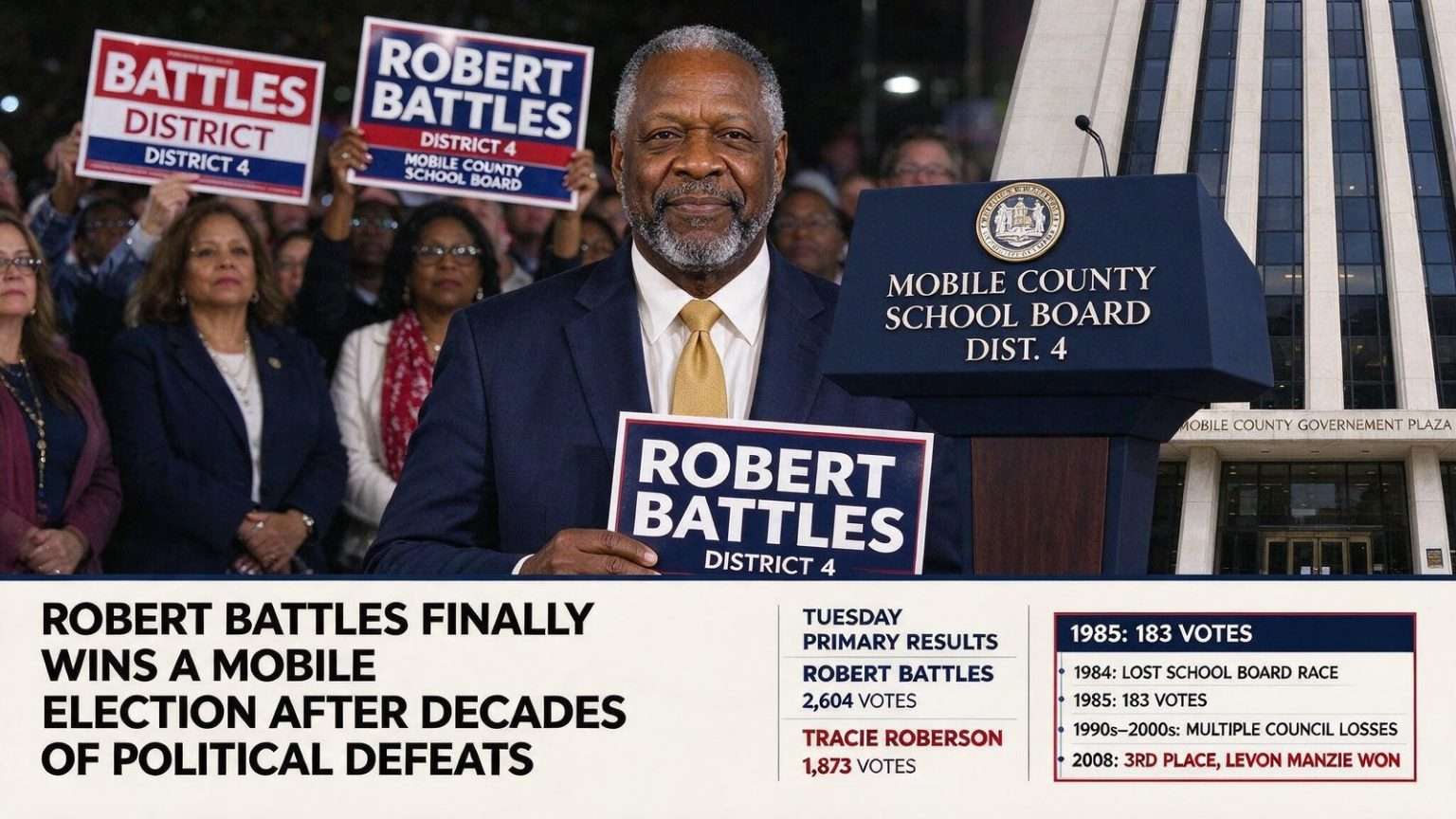
For nearly three decades, Robert Battles had built a reputation around Mobile as a perennial election loser, running for local office again and again without success. That streak finally ended in a Tuesday primary, when Battles pulled off one of the few incumbent upsets on the ballot, defeating Tracie Roberson for the District 4 Mobile County School Board seat.
A Long Road to Victory
Roberson had held the seat only by appointment, having been tapped to finish the term of Levon Manzie after he moved on to the Mobile City Council. That made her the incumbent on paper but gave her none of the entrenched advantages of a board member who had won the office outright, and Battles went after the seat as though it had been his all along.
Battles’ path to unseating her followed a long and, at times, painful electoral history. He drew just 183 votes running for a Mobile City Council seat in 1985 as publicity chairman of Citizens for Progressive Government, and lost a bid for the same District 4 school board seat back in 1984. He also lost three separate contests for a Mobile City Council district seat against the same opponent across the 1990s and early 2000s, and finished third in a 2008 council race won by Manzie.
This time was different. Battles topped Roberson decisively, 2,604 votes to 1,873, in the Democratic primary, and faces no opponent in the November general election, all but guaranteeing he will take the seat. School board members serve six-year terms and are paid $12,000 annually.
Asked why voters finally sided with him, Battles offered a simple explanation: it was time. After nearly thirty years of campaigns, the difference between the losing candidates and the winning one, in his telling, was persistence — the willingness to run again in a district he had never stopped working.
The margin told its own story. A 731-vote spread in a primary where most incumbents cruised suggested that Battles had assembled an organization rather than simply outlasted the field. District 4 takes in communities north and west of downtown Mobile, and winning there in a low-turnout primary requires support that shows up on a June Tuesday, not just at election-year forums.
Endorsements and Decades of Advocacy
Battles’ turnaround appears tied to institutional backing he had lacked in past campaigns, including an endorsement from the Mobile County affiliate of the Alabama Education Association and financial support from a local political action committee. The AEA affiliate’s endorsement carries weight in school board races, where teachers and school employees form a reliable bloc of primary voters and where the organization’s local arm knows the district’s politics in granular detail.
He has also stayed active in civic life for years as a political activist closely tied to the Africatown and Plateau community, regularly attending Mobile City Council meetings to speak on issues affecting that neighborhood. The Africatown community, north of downtown Mobile, carries a history unlike any other in the city — the settlement founded by the last shipload of enslaved Africans brought to the United States — and its neighborhoods north of the Cochrane-Africatown bridge have long relied on advocates willing to show up at public meetings.
That advocacy hasn’t been without friction. Earlier this year, fellow activists in the Plateau community publicly asked Battles to step down as head of a community organizing group he helped found, a request he rejected, citing his role as a founding member.
The disagreement underscored a tension that has followed Battles through his civic career: the same persistence that finally carried him to office has, at times, read to others as refusal to yield the microphone. His answer to critics has been consistent — he intends to keep working for the communities he has represented at council meetings for years, now from a seat on the school board.
Looking Ahead to the Superintendent’s Office
Looking ahead, Battles has signaled his next target will be Mobile County Superintendent Martha Peek, saying he supports a nationwide search for her replacement once her contract expires. The position puts him squarely inside the board’s most consequential responsibility — hiring and evaluating the superintendent who runs Alabama’s largest school system.
The Mobile County Public School System serves tens of thousands of students across the county, from downtown Mobile to the rural edges of the county line, and the superintendent’s office controls the system’s budget, personnel decisions and academic direction. Board members who want to influence that direction have one primary lever: the superintendent they hire and the contract they set.
A nationwide search, the approach Battles endorsed, has become the standard prescription for school systems seeking a reset. It opens the field beyond sitting administrators, brings outside candidates with fresh track records, and signals to the community that the board intends a deliberate process rather than a default reappointment. Whether a majority of the board ultimately agrees will shape Battles’ first year in office.
His arrival also changes the composition of a board that oversees a system facing the perennial challenges of urban districts in the South — shifting enrollment, aging facilities, and the financial pressures that come with both. Battles has framed his role as an advocate for the neighborhoods he has spoken for at council meetings, and District 4’s schools will now be his constituency’s direct claim on county government.
Other Mobile Government News
In other local government developments, former Mobile Mayor Sam Jones is set to formally join the Mobile Area Water and Sewer System board of directors later this month, with his term beginning June 16. The board meets regularly at MAWSS headquarters on Moffett Road.
Jones, who served as mayor from 2005 to 2013, brings to the water board a career’s worth of experience with the city’s utilities and infrastructure. MAWSS manages the water and sewer service for Mobile and surrounding areas, a portfolio that includes major capital projects and long-term obligations the board of directors oversees on the public’s behalf. His appointment gives the board a member who has seen city government from the executive side.
Meanwhile, with that appointment settled, the Mobile City Council is turning its attention to the fiscal year 2015 budget process, with city department heads expected to finalize their budget requests by the end of June ahead of a public presentation required no later than Aug. 20.
The budget calendar is the city’s yearly rhythm: departments draft their requests in early summer, the administration shapes them into a proposal, and the council reviews and amends the plan in public sessions before the fiscal year begins in October. The Aug. 20 deadline for public presentation is a state-law milestone, designed to give residents and council members alike time to examine the spending plan before votes are taken.
Together, the three developments — a new school board member after thirty years of trying, a former mayor taking a seat at the water board, and a city budget cycle moving into gear — sketch the summer’s shifting landscape at Government Plaza. For Battles, the change was the most personal: a campaign that began with 183 votes in 1985 had finally ended on the winning side of the ledger.
School Board Politics in Alabama’s Largest System
School board races rarely draw the attention that city hall contests receive, but in Mobile County the board’s decisions reach further into daily life than almost any other elected office. The district’s boundaries take in schools from the inner city to the suburbs, and the board votes on everything from bus routes and building repairs to curriculum adoptions and personnel policies that shape thousands of jobs.
The six-year terms mean that a single election can set the board’s direction for years, and the staggered seats mean that every primary season brings a different mix of incumbents and open positions. Battles’ seat — the one he first chased in 1984 — was one of the few where the incumbent had never actually been elected to the office she held.
Appointed incumbents occupy a peculiar position in school board politics. They carry the voting record and the institutional title, but they have never faced the district’s voters, and challengers can run against the record without running against a personal campaign organization. Roberson had inherited the seat from Manzie’s move to the city council; Battles had spent three decades making the case that he was its natural claimant.
The Alabama Education Association’s local endorsement fit the arithmetic of such races. Teachers, bus drivers, cafeteria workers and school office staff live in the districts they serve, vote at higher rates than the general public in off-year primaries, and pay close attention to which candidate will stand with school employees on pay, benefits and classroom conditions. A candidate with that backing starts the campaign with an organized network already in place.
For Battles, the endorsement also marked a change in how the political establishment viewed him. Perennial candidates rarely attract institutional support, because donors and organizations invest where they expect to win. Once the AEA affiliate and a local PAC concluded that 2014 was finally his year, the resources followed — and the margin over Roberson suggested the combination of message, machine and moment had done its work.
His victory speech, such as it was, amounted to a version of what he had told reporters: it was time. Thirty years of campaign seasons in District 4 had made his name familiar enough that, when the appointed incumbent stood between him and the seat, the voters chose the name they had been seeing on ballots since the 1980s.