
Mobile County Commission Backs a New I-10 Bridge Over the Mobile River
The Mobile County Commission issued a joint statement backing a proposed I-10 bridge over the Mobile River, calling the $700 million-to-$1 billion crossing vital to public safety and the region's economy.
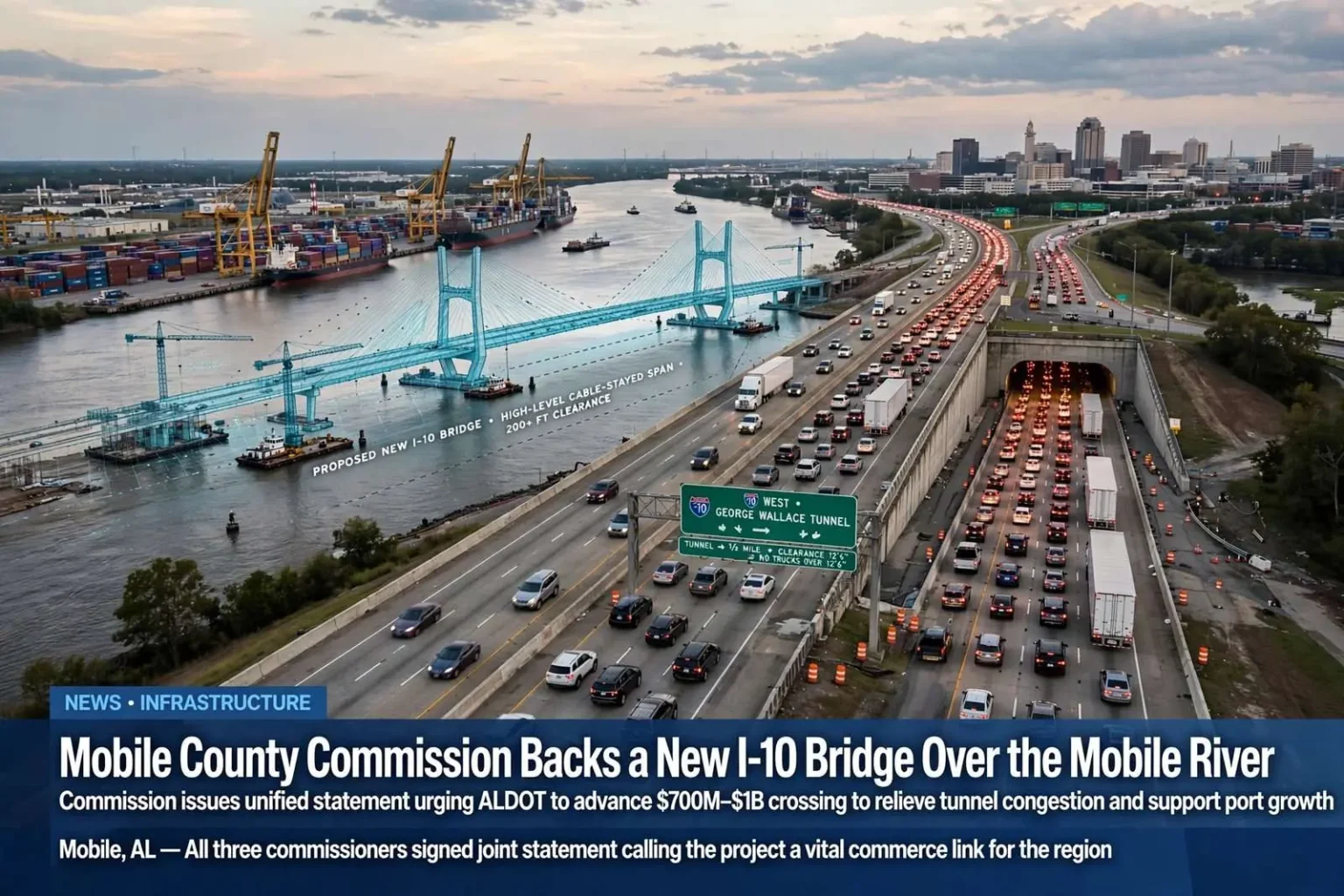
The Mobile County Commission put its collective weight behind one of the region’s most consequential infrastructure proposals, issuing a joint statement in support of a new Interstate 10 bridge over the Mobile River. In the statement, signed by all three commissioners, the county framed the long-discussed crossing as essential to public safety and to the continued growth of the Mobile-area economy, and it urged the state and competing interests to set aside their differences so the Alabama Department of Transportation could move forward.
The commission described the project as a “vital commerce link,” language that reflected how central the river crossing has become to daily life in Mobile. Interstate 10 is the main east-west artery of the Gulf Coast, carrying port traffic, beachbound tourists and commuter traffic alike through the heart of the city — and funneling all of it through the George Wallace Tunnel, where the interstate drops beneath the Mobile River in a pair of tubes with limited lanes and clearance that have constrained traffic flow for decades.
For commuters from West Mobile and taxpayers across the county, the case for relief is made every day at the tunnel approaches, where a single incident can back up traffic for miles in both directions. For the trucking companies and port businesses that move freight through the state’s only deepwater container port, the crossing is a choke point on a corridor that ties the Port of Mobile to markets across the southeastern United States. The commission’s statement was aimed squarely at both audiences.
A Crossing Years in the Making
The proposed span carried an estimated price tag of between $700 million and $1 billion, the commission noted, with a $500 million allocation already identified for the work. Commissioners argued that a modern bridge would ease congestion, reduce delays and, they hoped, cut the number of accidents along one of the busiest stretches of interstate on the Gulf Coast.
“Soon the Alabama Department of Transportation will be making a decision on the construction of a new bridge over the Mobile River,” the commission said. “This long-awaited project will provide a safe route of travel for our citizens.”
The idea of a high-level span across the Mobile River had been studied, discussed and deferred for years before the commission’s statement. A fixed crossing would replace the tunnel approach that forces interstate traffic to descend beneath the river and re-emerge blocks from downtown, a design that works for the 1960s traffic volumes it was built for but that engineers have long identified as the weak link in the Gulf Coast’s interstate network. The $500 million allocation represented the largest single commitment to the project to date, and county leaders were determined not to watch it slip away to other parts of the state.
The commission’s unified front mattered. All three commissioners signed the statement, giving the county a single voice on a question that had divided downtown business groups, neighborhood associations and preservation-minded residents for years. In a region where infrastructure decisions have historically moved at the pace of consensus, a three-signature endorsement was itself a form of momentum.
The Route Dispute
The commission acknowledged that the decision over the bridge’s route had grown contentious. On one side stood advocates focused on aesthetics and the look of the waterfront; on the other, ALDOT and those who favored the alignment engineers considered best suited to a growing city’s infrastructure needs. The debate centered on where a tall span would rise above the downtown skyline and how its approaches would cut through the city grid — questions that carry real consequences for property owners, riverfront views and the redevelopment of Mobile’s historic core.
Rather than take a hard line, the commissioners appealed for cooperation.
“We need to take advantage of this $500 million allocation and work together to resolve these concerns,” the statement read, “so that ALDOT may continue its work to make the roads of Alabama safe for travel and commerce.”
The commission’s positioning was deliberate: it endorsed the project without endorsing any particular alignment, leaving the engineering decisions to ALDOT while signaling that delay itself was the enemy. That stance allowed commissioners to keep the support of both waterfront-focused advocates and pragmatists who feared that continued dispute would cost the region the funding outright.
Lessons From Highway 98
To make its case, the commission pointed to its recent work with state highway officials on U.S. Highway 98, a project it said had resolved a problem three decades in the making and one that had cost too many lives. The winding two-lane stretches of Highway 98 through western Mobile County had been the site of repeated deadly crashes for a generation, and the effort to widen and realign the road became the region’s most prominent example of a highway project that local officials refused to let die.
The county credited the leadership of ALDOT staff, including Joe McGinnis, Don Vaughan and Ronnie Poiroux, for choosing to keep the money in the area and to work constructively with both supporters and opponents until the Highway 98 improvements were under construction. The commissioners said they hoped the same spirit could carry the I-10 bridge to completion.
“It would have been easy for ALDOT to pick up and take these valuable dollars and place them somewhere else in the state; but they did not,” the statement said.
The Highway 98 comparison served two purposes in the commission’s argument. First, it reminded residents that a long-stalled safety project could actually reach construction when state and local officials pulled in the same direction. Second, it put pressure on skeptics of the bridge process by pointing out that Alabama has a finite pool of major project dollars, and that communities which fail to coalesce around a plan watch that money go elsewhere. The message was subtle but unmistakable: the region got one second chance with Highway 98, and it should not count on another.
The statement also implicitly defended ALDOT against the criticism that had built up during the route dispute. By naming individual ALDOT engineers and crediting them by name, the commission framed the department not as an obstacle but as a partner that had already proven itself in Mobile County — a calculated piece of relationship-building aimed at keeping the department engaged on the bridge as the decision point approached.
Growth on the Horizon
The county tied the urgency of the project to the industrial expansion reshaping the region, citing a new container facility and the growth of Brookley Field among the developments driving traffic across the river. The container terminal on the Mobile River’s western bank has steadily expanded the port’s capacity to handle the box ships that carry much of the world’s trade, while Brookley Field — the former Air Force base turned industrial aerodrome at the southern edge of downtown — has become home to a growing aerospace cluster that puts thousands of workers on the roads into the city each day.
“As Mobile continues to grow with industry,” the commission said, “it is time to move forward with this project.”
The economic argument carried particular weight in a city whose identity has always been bound to the water. Every expansion at the port, every new tenant at Brookley and every cruise ship call adds traffic to a river crossing that was engineered for a different era. Commissioners framed the bridge not as an amenity but as the necessary circulatory system for an economy that has outgrown its infrastructure — a link that determines whether the region’s growth reaches the rest of South Alabama or stalls at the tunnel.
The statement closed on a note of partnership, with the commissioners pledging to continue working with ALDOT.
“The county commission has worked constructively with ALDOT over the past few years and they have been the most productive years yet,” the commissioners wrote. “We look forward to continuing to work with ALDOT to make this project a reality.”
For residents who live with the tunnel’s bottlenecks every day, the commission’s statement was the latest turn in a saga that has stretched across decades of studies, proposals and public meetings. Business leaders have long argued that a modern crossing is the price of keeping the port competitive; neighborhood advocates have asked hard questions about what elevated roadways do to the historic districts and waterfront views that make downtown Mobile distinctive; and everyone has agreed on the one point that matters most — the current crossing cannot handle the traffic the region expects to see in the decades ahead.
What comes next depends largely on ALDOT’s decision. A high-level bridge would rise high enough for ocean-going vessels to pass beneath it, eliminating the size restrictions that the tunnel imposes on ships calling at the port and opening options for the larger vessels that the container terminal is being built to serve. The engineering choice between alignments will determine whose neighborhoods feel the impact and what the span looks like rising over the skyline — questions the commission pointedly left open in its appeal for cooperation.
The funding arithmetic remains the project’s central challenge. Even with $500 million already identified, the gap between that allocation and the $700 million to $1 billion estimate means additional state or federal money will be needed, and major infrastructure dollars tend to follow regions that demonstrate unity behind a project. That is the lesson commissioners took from Highway 98, and it is the strategy behind the joint statement: present a united county government, praise the state agency publicly, and make it politically easy for ALDOT to say yes to Mobile.
In the meantime, commuters will keep filing into the tunnel twice a day, and the port’s growth will keep adding trucks to the interstate approaches. The commission’s message to the state was that Mobile has done its part — all three signatures were on the statement — and that the moment has arrived for the rest of the system to move with it. Whether the bridge rises over the Mobile River in the years ahead will depend on whether the cooperation the commissioners called for materializes in time to keep the $500 million — and the project it anchors — at home.


