As Mobile River Bridge Plan Takes Shape, Officials Weigh Tolls to Cover the Cost
ALDOT officials are eyeing tolls to help fund a new Mobile River bridge project, with cost estimates ranging from $800 million to $1.8 billion.
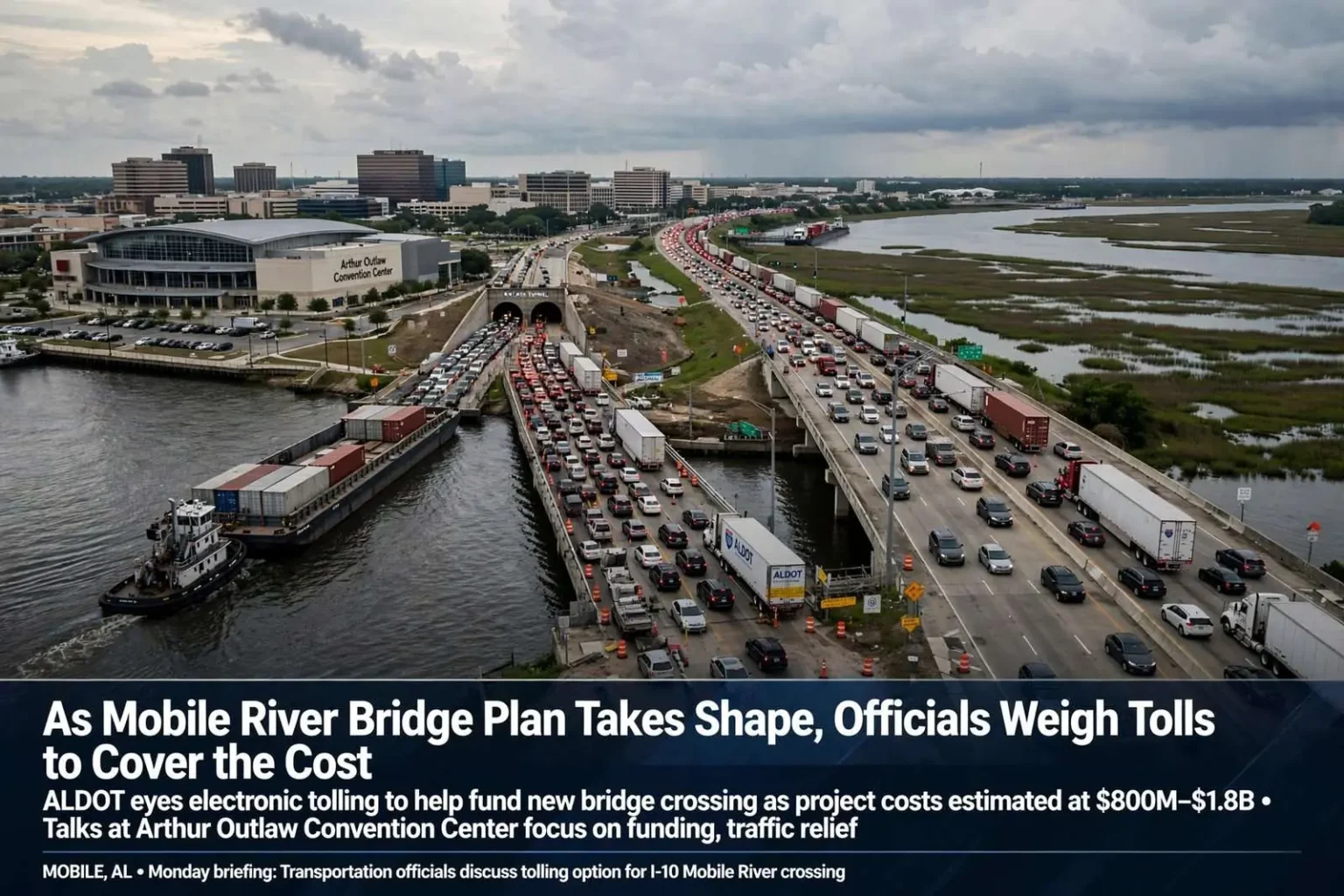
As plans for a new bridge across the Mobile River move closer to reality, transportation officials still do not have a final price tag for the project — but they are increasingly looking at tolls as one way to help pay for it.
At a briefing for reporters Monday at the Arthur Outlaw Convention Center in downtown Mobile, officials with the Alabama Department of Transportation discussed using tolls to fund a portion of the bridge and bayway project, an undertaking expected to cost more than ALDOT’s entire annual budget. With no realistic path to conventional funding at that scale, the question was no longer whether some form of user financing would be involved, but how large a share of the bill tolls would carry.
One reason tolling is on the table is where the traffic actually comes from: roughly 60 percent of the drivers who cross the Mobile River on Interstate 10 there are from out of state. In practice, that means a large share of any toll revenue would be paid by long-haul freight traffic and travelers passing between Texas and Florida rather than by Mobile and Baldwin County commuters alone — an appealing distinction for officials who must ask local residents to accept higher costs.
“We hope to get some form of [funding] from the federal government and ALDOT,” Transportation Director John Cooper said. “It would be nice to have those replaced with additional funding. We think tolls could be a portion of that …”
How Electronic Tolling Would Work
ALDOT is studying an electronic tolling system, meaning traffic would not have to stop at toll booths. Instead, cameras would capture license plates, and drivers would pay by mail or through an online system. The approach has become standard on newer toll facilities because it preserves free traffic flow — a critical consideration on a corridor that already operates beyond its capacity for much of the day.
The price of the tolls has not yet been set, and officials did not offer even a working range. The rate would ultimately be shaped by the final construction cost, the amount of federal and state money secured, and the financing structure negotiated with the private teams expected to compete for the work.
ALDOT Division Engineer Vince Calametti said the existing Wallace and Bankhead tunnels would stay open to local traffic, an attempt to answer early concern that tolling the new crossing could push everyday local trips onto the older routes. He did not say whether the tunnels would remain toll-free, leaving open one of the more consequential questions for residents who cross the river daily for work, school and medical appointments on both sides of the bay.
A Price Tag Still in Motion
The overall cost of the project remains uncertain. Cooper said estimates he has heard range from $800 million to $1.8 billion for the bridge and widening work — a spread wide enough that the final number will determine both the scope of construction and the size of any toll.
More precise figures are expected to emerge from an industry forum held the same day, where roughly 400 contractors, designers and financiers learned more about the scope of the project. ALDOT deliberately brought the people who would build the bridge and the people who would finance it into the same room early, hoping market feedback would sharpen the estimate before the agency committed to a design.
“I’m interested to see what these people believe it’ll take to get it done,” Cooper said.
How much funding ALDOT secures will directly shape how much of the project actually gets built, Cooper told reporters. At minimum, a new bridge has to be constructed and connected to the bayway that carries I-10 traffic across Mobile Bay. Beyond that floor, ambitions are larger.
“We’d like to raise [the bayway] … and we’d like to expand it to Spanish Fort,” Cooper said. “It’s not necessary, but if we have the option to do it we will.”
ALDOT’s stated goal is to add two additional lanes on each side of the bayway and to raise the roadway above the level of a 100-year storm surge — a change aimed squarely at the corridor’s chronic vulnerability. The existing low-lying stretch across the bay floods and closes during severe coastal storms, and closing it cuts the primary hurricane evacuation route for the entire region.
The Timeline
Officials laid out a rough timeline for the process. After the industry forum, ALDOT plans to issue a request for qualifications, then narrow the field to three teams made up of contractors, designers and financiers, according to ALDOT Mobile River Bridge Project Director Matt Ericksen. The agency hopes to have those three teams selected by the end of the year.
From there, ALDOT will work with each team on a request for proposals that includes specific design elements for the bridge. A winning team would then be chosen, with the goal of finalizing a contract by the end of 2018, Cooper said. Construction, expected to last roughly four to four and a half years, would begin in the spring of 2019 — a schedule that would put completion years away even after shovels hit the ground.
Why Mobile Says It Needs the Bridge
Mobile Mayor Sandy Stimpson said the long-awaited bridge is sorely needed, arguing that traffic gridlock at the Wallace Tunnel “stifles the economy,” hurts residents’ quality of life and discourages activity downtown.
Calametti underscored just how overburdened the current crossing has become. The Wallace Tunnel was designed to carry roughly 36,000 vehicles a day, he said, but now sees an average of 75,000 vehicles daily — a figure that climbs to 100,000 during peak travel times. A facility built for one population is serving better than double its design load, and the mismatch shows up as recurring, daily congestion rather than an occasional inconvenience.
Ericksen said a completed bridge should save commuters as much as 15 minutes compared with the current trip through the tunnel. For a corridor that functions as the main artery for freight moving along the Gulf Coast and for daily commuting between Mobile and Baldwin County, those minutes accumulate across tens of thousands of trips every day.
“Within a year from now we’ll see a lot of good progress,” Stimpson told reporters.
Regional Leaders Weigh In
State Sen. Bill Hightower, R-Mobile, a potential 2018 gubernatorial candidate, told reporters the bridge matters not just for Mobile but for the wider Gulf Coast region, from Texas to Florida, and said financing it may require some creative solutions. His framing reflected how planners along the corridor have long described the project: not a local road improvement but a piece of national freight infrastructure stuck with a regional price tag.
Baldwin County Commission Chairman Chris Elliott, who was running for a State Senate seat at the time, said all funding options remain on the table given the project’s outsized impact on local residents. Baldwin County, one of the fastest-growing counties in Alabama, sends thousands of commuters into Mobile each day across the bay, and residents there will live with both the tolls and the relief from congestion.
A Chokepoint Decades in the Making
The Interstate 10 bottleneck at the Wallace Tunnel has long been considered one of the most significant chokepoints on the Gulf Coast. The four-lane tunnel, bored beneath the Mobile River in downtown Mobile, funnels all through interstate traffic down to a narrow, slow crossing where the freeway effectively pauses before resuming on the far bank.
A new Mobile River crossing has been discussed by regional planners for years as a way to relieve that congestion, improve hurricane evacuation routes and support continued growth on both sides of Mobile Bay. Previous studies have examined alignment options and funding scenarios without producing construction, as the corridor’s traffic kept climbing and the gap between need and available money widened.
The geography leaves few alternatives. The Bankhead and Wallace tunnels carry traffic directly beneath downtown, and the Cochrane-Africatown USA Bridge carries U.S. 90 traffic farther north, but neither provides the interstate capacity the region requires. Every additional resident and every additional freight load along the Gulf Coast funnels through the same downtown pinch point.
What Residents Should Watch Next
For drivers on both sides of the bay, the practical questions ahead are concrete: how high the toll will be set, whether the tunnels remain free, what exemptions or discounts might apply to local commuters, and how much of the full bayway elevation and widening makes it into the first contract.
The selection of the three finalist teams by the end of the year will begin to answer some of those questions, since each consortium is expected to propose its own financing structure and design approach. The request for proposals that follows will lock in more of the specifics, and the contract targeted for the end of 2018 would set the final cost — and with it, the final toll.
Until then, the region’s daily experience of the corridor will keep illustrating the case officials made at the briefing. On an average weekday, twice the intended number of vehicles already squeezes through a tunnel designed for half the load, and on peak days the figure climbs further still. The bridge, the raised bayway and the expanded lanes are being sold as the region’s once-in-a-generation fix for a problem that has been building for decades.