ALDOT Narrows Field to Three Design Teams for I-10 Mobile River Bridge
ALDOT has narrowed a field of six design-build teams to three finalists for the proposed I-10 Mobile River Bridge, with a Mobile selection committee set to hear final presentations in late July.
Six Teams, Three Spots
State transportation officials have taken a major step forward on the long-discussed plan to build a new Interstate 10 bridge across the Mobile River, narrowing a field of six design-build teams down to three finalists who will compete for the contract later this summer. Representatives from the Alabama Department of Transportation and the Federal Highway Administration spent this week evaluating presentations from six design teams from around the country at ALDOT headquarters in Montgomery. The teams were selected in the spring after ALDOT issued a Request for Proposals seeking firms capable of designing the massive river crossing, one of the largest infrastructure undertakings ever proposed in south Alabama.
The caliber of the firms responding to the proposal reflects how the national engineering industry views the Mobile River crossing. Major cable-stayed and tied-arch bridges have become signature projects for design firms across the country, and the chance to design a new interstate crossing over a working port river draws interest from teams whose portfolios include some of the most recognizable spans in the United States. Alabama does not often host a competition of that scale.
ALDOT Southwest Region Engineer Vince Calametti attended the sessions and said the review panel came away impressed with the overall quality of the field.
“We were very impressed by all six candidates,” Calametti said. “The selection team expects to narrow the field to three designers in the next two weeks. It will be an extremely difficult decision.”
How the Selection Works
Once that shortlist is finalized, the three remaining design teams will travel to Mobile to present their proposals directly to a local selection committee at the end of July. That committee’s recommendation is expected to determine which firm ultimately wins the design contract for the bridge. Bringing the finalists to Mobile rather than deciding everything in Montgomery puts local eyes and local knowledge at the center of the choice, a point regional leaders had pressed for as the process took shape.
Local committee members bring stakes the state evaluators cannot fully weigh from a conference room in Montgomery. Members drawn from the region understand which downtown streets feed the current tunnels, where the approaches would land, how the port operates along the river and what the crossing would mean for neighborhoods on both banks. Their recommendation carries the weight of that lived knowledge.
After a consultant is chosen, ALDOT plans to begin detailed design work needed to complete the project’s Final Environmental Impact Statement, along with construction plans that will guide the eventual build-out of the span. The environmental statement is the document that will clear the project through federal review, resolving questions about alignments, impacts on historic properties and wetlands, and the mitigation measures required before any dirt moves. Pairing the environmental work with early design keeps the schedule moving on both tracks at once.
What the Bridge Would Look Like
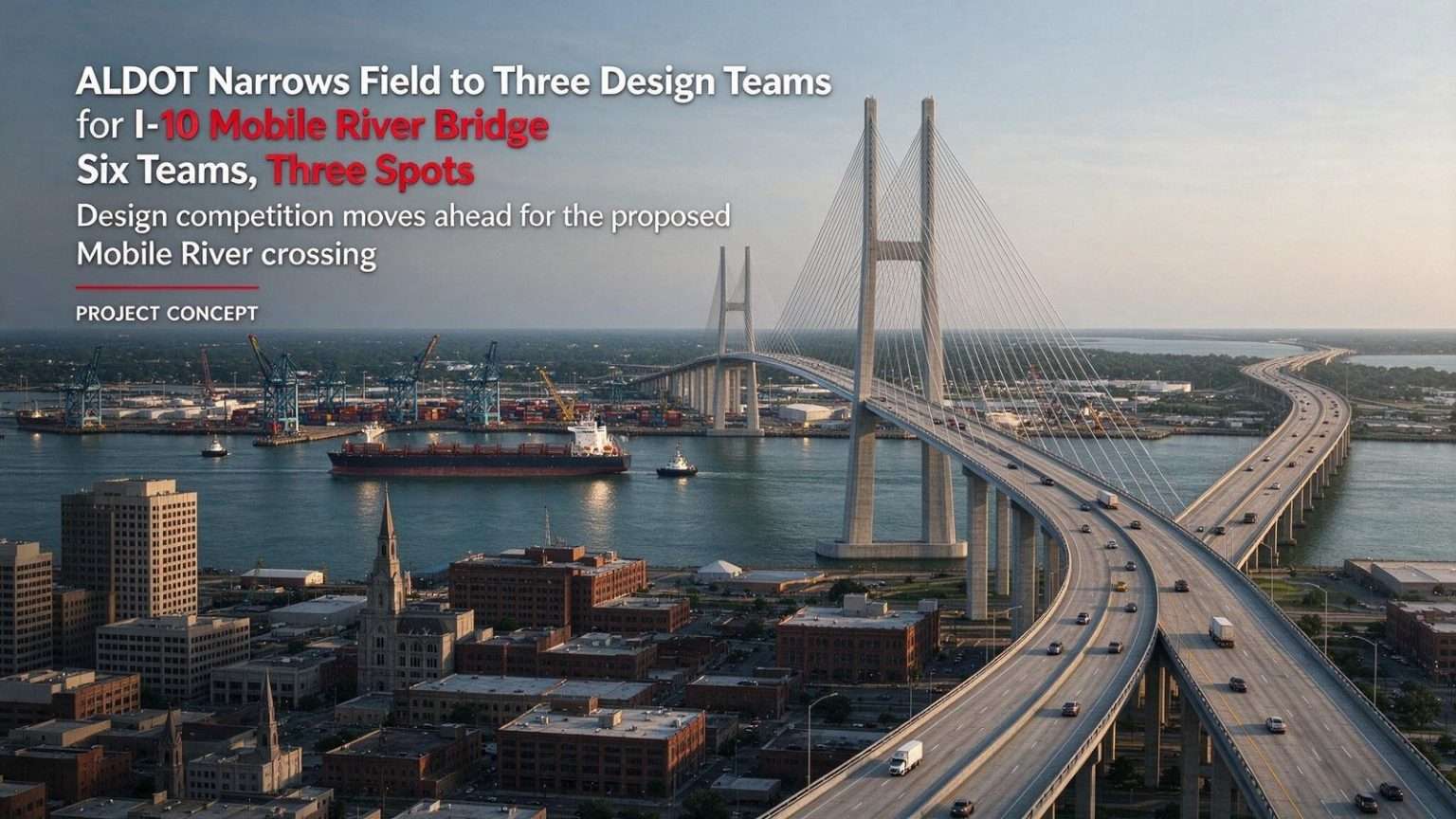
The proposed project centers on constructing a new bridge over the Mobile River that would connect directly into the existing I-10 Bayway, the 7.5-mile elevated span linking Mobile and Baldwin counties across Mobile Bay. Under the current plan, the Bayway itself would also be widened from four lanes to eight lanes to match the capacity of the new river crossing. The pairing matters because adding lanes on one side of the river without the other would simply move the bottleneck a few hundred yards east.
A new high-level crossing over the river would also clear the vessel traffic that shuttles beneath the current route. Mobile’s port and the growing industrial corridor along the river depend on oceangoing ships, barges and workboats that answer to tide and channel schedules, and a taller fixed crossing removes the conflicts between maritime commerce and interstate traffic that the existing tunnel alignments create.
Supporters of the project have long argued that a new bridge and wider Bayway are needed to relieve chronic traffic congestion at the George C. Wallace Tunnel, the current I-10 crossing beneath the Mobile River that regularly backs up during peak travel times and after wrecks. The tunnel carries the interstate in two bores that dive beneath the river just blocks from downtown, and any incident inside it closes the Gulf Coast’s main east-west artery until crews can respond.
Freight traffic, cruise ship visitors and the region’s growing population have all added pressure to the aging tunnel, which was not designed to carry today’s volume of interstate traffic. Cruise passengers streaming to and from the Alabama Cruise Terminal pass through the same chokepoint as daily commuters and port-bound trucks, and summer beach traffic from across the Southeast stacks onto the same corridor on weekends. Each year the mismatch between the tunnel’s design and the region’s traffic grows more pronounced.
A Milestone Years in the Making
The bridge project has been years in the making, with local leaders, business groups and elected officials pushing ALDOT and federal partners to move the plan from concept to reality. Study commissions, funding proposals and preliminary alignments have come and gone across the decades, and each generation of local officials has inherited the same congestion problem and passed along the same unfinished solution. The design competition now underway is the most concrete step the project has taken.
Selecting a design team is considered a pivotal milestone, setting the stage for the environmental review and engineering work that must be completed before construction can begin. The winning firm will inherit a set of interlocking problems: fitting new approaches into a dense downtown grid, crossing one of the nation’s busiest working rivers, tying into the elevated Bayway and satisfying federal reviewers that the design protects neighborhoods, wetlands and historic resources on both shores.
Design-build competitions of this kind reward teams that can show more than pretty renderings. Evaluators look at the engineering approach, the schedule the team can credibly commit to, the management plan for a project that will take years and the track record of the firms behind the proposal. The three finalists who emerge from Montgomery will have to make that full case again in front of the Mobile committee at the end of July.
For the region’s business community, the timing of the selection offers a measure of certainty after years of study. Construction planning has already reshaped thinking about land use near the proposed approaches, and employers on both sides of the bay have factored the crossing into long-term logistics decisions. A signed design contract converts those plans from speculation into a project with a name on it.
What Comes After the Contract
The engineering challenge is only part of the assignment. The selected team must also document every conclusion well enough to survive federal scrutiny, because the Final Environmental Impact Statement will be examined by resource agencies, historic preservation officials and the public before it can be approved. A bridge design that cannot clear that review cannot be built, no matter how elegant it looks in a rendering, so the firms competing in Montgomery were effectively auditioning their document writers alongside their bridge designers.
Community impact will be examined as closely as steel and concrete. New approaches would pass through one of the oldest parts of the city, where churches, businesses and residences sit close to the existing interstate corridors, and the final study will have to account for noise, property impacts and connections for local traffic. The design teams’ proposals to limit those effects, from elevated ramps to landscaped buffers, will be part of what the local committee weighs when the finalists present in Mobile.
ALDOT has not released a construction timeline or cost estimate tied to this stage of the process, but officials have indicated that additional public updates will follow as the design contract is awarded and environmental work gets underway. The Final Environmental Impact Statement process will itself include opportunities for public review and comment, giving residents another formal chance to weigh in once a specific design and alignment are on the table.
Funding remains the question the design process cannot answer by itself. Major bridge projects of this scale typically rely on a blend of federal highway funds, state dollars and sometimes tolling, and those decisions will come into focus as the environmental review nears completion. Regional leaders have lobbied for federal programs and Gulf Coast revenue sources that could help carry the cost.
What officials promise now is motion. Within weeks, the field of six becomes three; by the end of July, a local committee will have weighed the finalists; and by the time the summer ends, Alabama expects to have a design partner for the largest single infrastructure project in its southernmost region. For a crossing that has been debated for decades, the next two months will say more about its future than the last several years combined.