
Nashville Songwriter Tim Easton Plays Satori as USA’s Independent Music Collective Series Rolls On
Nashville songwriter Tim Easton plays Satori Coffee House Sept. 27, 2013 for USA's Independent Music Collective No.
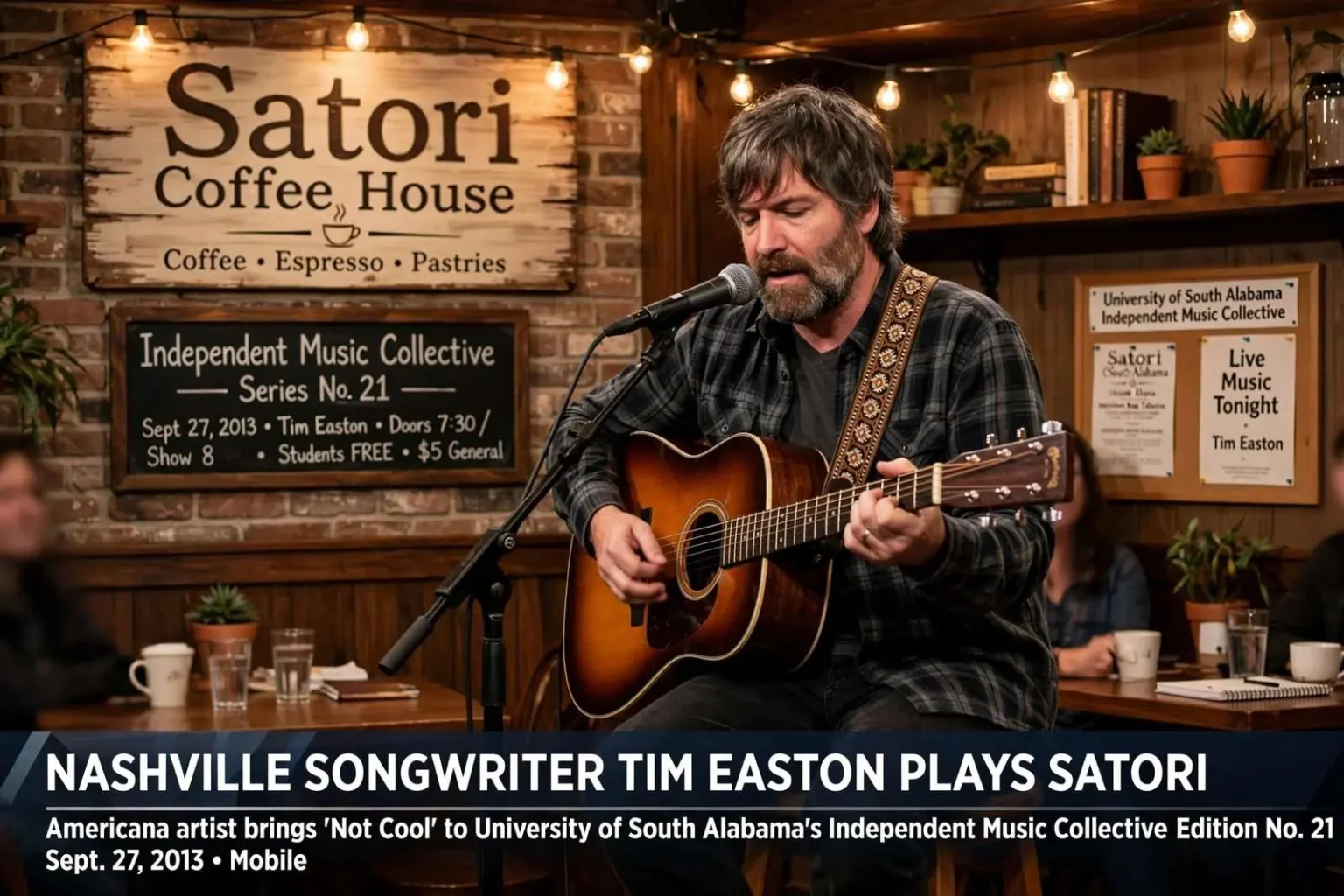
Nashville-based songwriter Tim Easton brought his road-worn Americana songbook to Satori Coffee House in Mobile on Friday, Sept. 27, 2013, for edition No. 21 of the University of South Alabama’s Independent Music Collective concert series. Doors opened at 7:30 p.m. with the show at 8, admission free for USA students and $5 for everyone else — a price point that has become part of the series’ identity as it brings nationally regarded artists to an intimate room near campus.
A Critic’s Favorite Arrives in Mobile
Easton arrived in Mobile with serious critical backing behind his most recent album, “Not Cool.” American Songwriter awarded the record four stars, writing that anyone who walked into a club not knowing Easton would “leave a raving fan.” AllMusic called him “pretty close to a modern Americana treasure,” praising songs “head and shoulders above what passes for alt-country or folk these days” and a keen pop sense that deserved a wider audience. NPR singled out his “unique songwriting approach” and described his work as both heartbreaking and uplifting — a combination critics rarely manage to attach to the same artist.
That kind of praise across publications with different sensibilities — the trade-focused American Songwriter, the encyclopedic AllMusic, and the public-radio audience at NPR — marks Easton as a songwriter’s songwriter, the sort of artist whose reputation is built album by album on the road rather than on a single radio single. Songwriters of his stripe survive on touring circuits that stretch from coffeehouses to clubs to festivals, trading on the durability of the material rather than the churn of commercial formats. Mobile audiences that night got him at close range, in a room built for listening rather than background noise.
For the collective’s organizers, landing Easton for the twenty-first edition meant scheduling a touring professional whose calendar is set months in advance, then turning a coffeehouse into a concert room for the evening. Those logistics — sound, seating, ticketing at the door — are handled largely by student volunteers, and the small margins the series operates on mean every $5 cover matters. It is a lean model, but it has kept the series alive through years when better-funded campus events have come and gone.
The Listening-Room Setting
The Satori show continued the Independent Music Collective’s run of bringing nationally regarded songwriters to an intimate coffee-house room near campus, where students got in free and the $5 cover kept the series accessible to the whole community. Coffeehouse listening rooms occupy a special place in American roots music: without drums and amplification washing out the details, an audience hears the wordplay, the fingerpicking, and the cracks in a voice that recordings can smooth over. For a writer like Easton, whose songs lean on language and melody in equal measure, the format is close to ideal.
The setting also changes the social contract between artist and audience. In a bar, conversation competes with the stage; in a listening room, the room itself agrees to quiet down, and the performer responds by playing songs that reward attention. Series organizers in college towns across the country have built entire seasons around that exchange, and Mobile’s Independent Music Collective has followed the same blueprint, pairing low admission prices with performers whose catalogs justify an attentive crowd.
The Independent Music Collective’s Role
The University of South Alabama’s Independent Music Collective has spent years building a bridge between the campus and the region’s independent music scene, and edition No. 21 of its concert series reflected a formula that has proven durable. By keeping admission free for students and $5 for the general public, the collective removes the price barrier that keeps many college audiences away from live original music, while still generating enough at the door to compensate touring artists fairly. The result is a series that functions as both a campus cultural institution and a genuine stop on the national singer-songwriter circuit.
Series like the IMC’s do quiet, cumulative work for a city’s music culture. Students who see a respected touring songwriter in a coffeehouse at 20 are more likely to fill local venues five years later, and artists who play a well-run college series carry word of it to bookers and fellow musicians on the road. Mobile’s scene has benefited from that cycle of visits and return visits, with the collective’s shows adding national names to a calendar long anchored by local and regional acts.
The choice of Satori as the venue reflects what touring acts need most from a college-town room: a location close to campus, a proprietor who understands listening-room etiquette, and a space where a solo performer is the loudest thing in the building. Coffeehouses that host original music fill a gap between the bar circuit and the concert hall, and in college communities they often introduce more first-time concertgoers to live songwriting than any other venue type.
Nashville and the Modern Songwriter’s Path
Easton’s Nashville base places him in the city that has become both the commercial center of American songwriting and, in recent decades, a haven for artists working outside the mainstream machine. Writers with Americana, folk, and indie leanings have made the city home precisely because the density of players, studios, and serious listeners there raises the bar for everyone. Touring songwriters based in Nashville fan out across the Southeast and beyond on circuits of listening rooms and house concerts, and the Gulf Coast — with venues from New Orleans to Pensacola — sits squarely within that web of routes.
The road-worn quality that defined Easton’s Mobile set is a product of that lifestyle: years of driving between one-night engagements, playing songs to rooms of strangers, and refining material until it holds up anywhere. Critics have noted that durability in his writing — songs that sound lived in rather than composed — and it is the quality that separates career songwriters from one-album acts. An audience at a show like the Satori date gets the benefit of all those accumulated miles condensed into a single evening’s performance.
What the Audience Heard
With “Not Cool” as the newest chapter in his catalog, Easton drew on a body of work that blends folk, country, and rock leanings with a pop instinct that reviewers keep flagging as underappreciated. His songs tend to move between the personal and the panoramic — heartbreak delivered in plain language, travel and restlessness rendered with the detail of someone who has actually lived out of a suitcase. Reviewers’ repeated descriptions of his work as both sad and uplifting capture the balancing act: songs about loss that still leave a room feeling lighter, a quality that plays as well to a coffeehouse crowd as to a festival field. The four-star reception for “Not Cool” gave the Mobile stop extra weight, since audiences arriving that night knew they were hearing material that critics had already ranked among the year’s strongest in the Americana field.
For students in the room, the show doubled as a master class. Songwriters at Easton’s level compress years of craft into three-minute structures — verse choices, chorus lifts, bridges that reframe everything that came before — and watching that material delivered a few feet away, unamplified or nearly so, teaches something no recording can. It is exactly the kind of exposure the Independent Music Collective was designed to provide when it began staging numbered editions of the series on campus.
A Series Worth Following
By the time Easton’s Satori show wrapped, the Independent Music Collective had logged its twenty-first edition, a run of consecutive bookings that few campus organizations sustain. The series’ low-key approach — coffeehouse, doors at 7:30, show at 8, students free — has kept overhead low and consistency high, and it continues to bring songwriters with national credentials to a room small enough that the audience can talk to them afterward. For $5, or nothing at all for USA students, Mobile audiences have had repeated access to artists whose records cost several times that amount.
The Easton date fits the pattern that has defined the collective’s bookings: writers with critical respect, catalog depth, and something to prove to every new room. The twenty-first edition also demonstrated the series’ reach beyond the student body — a Friday-night show that drew community members alongside students, mixing longtime fans of the artist with first-timers who paid their five dollars on a whim and left with a new favorite. As the series rolls on, each edition adds to the case that Mobile’s audiences will show up for original music when it is presented well and priced within reach — and that the stretch of campus-adjacent Mobile where Satori operates has become one of the city’s most reliable rooms for hearing a song the way it was written.


