Perfect Weather Sets the Stage for Mobile’s Fourth of July Fireworks Show
Mobile's Fourth of July fireworks show drew thousands along Battleship Parkway, aided by cool, clear weather and a redesigned display.
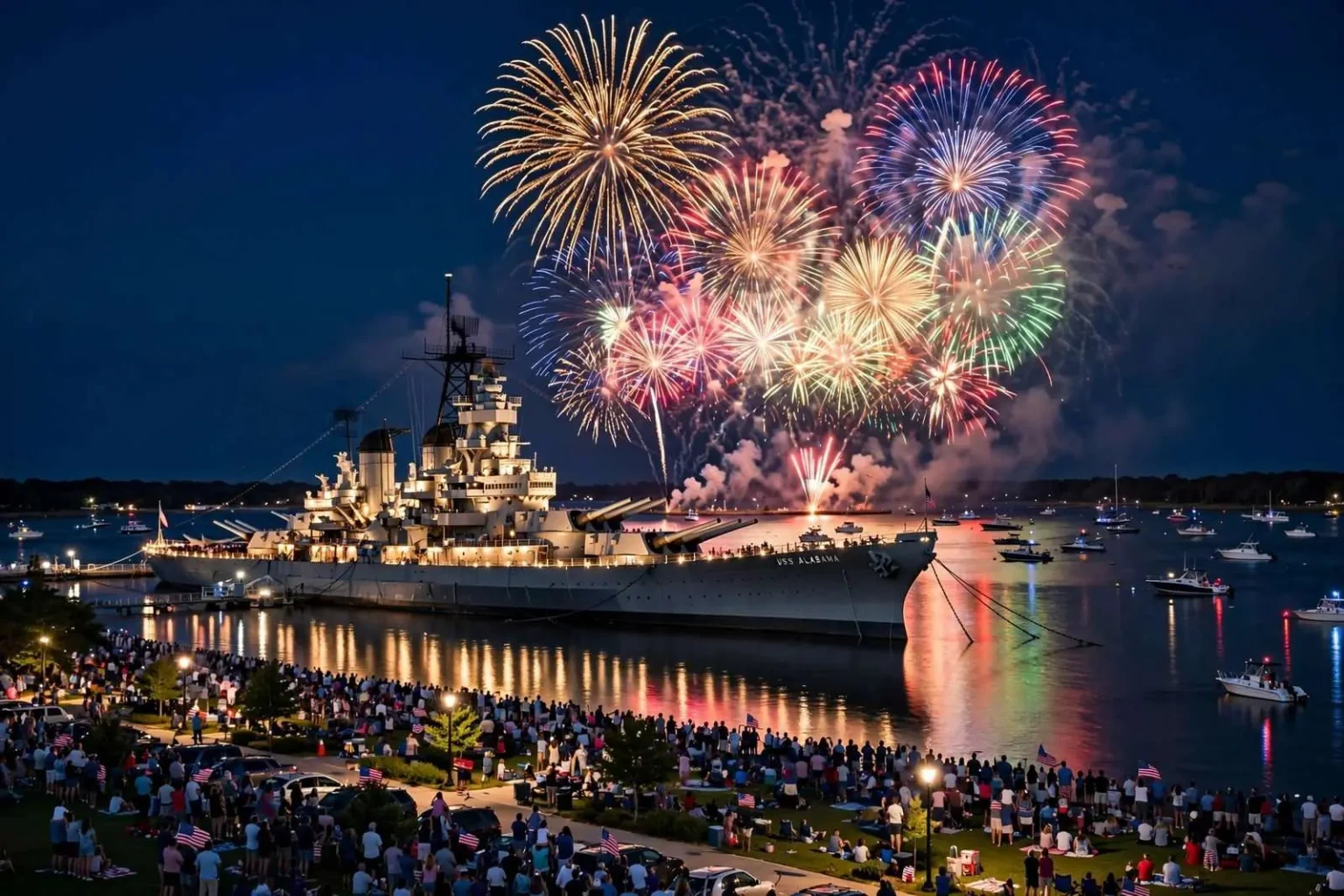
Mobile’s Fourth of July fireworks show delivered for organizers and spectators alike this year, helped along by weather conditions that were a welcome departure from the previous year’s washout. Where the 2013 show was postponed by wind and rain, this year’s display benefited from cool, dry conditions that kept the crowd comfortable along Battleship Parkway.
The contrast with the year before could hardly have been sharper. A July fireworks show on the Gulf Coast lives at the mercy of afternoon thunderstorms, and the storm that forced the 2013 postponement was a reminder that even a city with Mobile’s experience in staging large celebrations cannot schedule around the weather. This year, the cool, dry air that settled over Mobile Bay gave organizers the evening they had planned for, and spectators arrived in numbers that reflected both the holiday and the relief of a forecast that finally cooperated.
City special events coordinator Greg Cyprian said he made several changes to the show’s format this year aimed at maximizing its visual impact. The battleship itself was lit for the occasion, adding to the display’s backdrop.
The decision to light the USS Alabama transformed the staging of the show. The massive World War II battleship, moored permanently at Battleship Memorial Park on the causeway, is normally a dark silhouette once the sun goes down. Illuminated for the holiday, it became part of the canvas — a lit warship across the water as fireworks burst overhead, an image that gave the evening a patriotic centerpiece no ground-based display could manufacture.
A Shorter, Punchier Show
Although the overall show ran about five minutes shorter than in previous years, Cyprian said the compressed format actually made for a more dramatic experience. Cyprian said he drew inspiration from marquee fireworks displays elsewhere in the country, including shows associated with the Kentucky Derby and Boston’s Fourth of July celebration, aiming to replicate that same concentrated burst of spectacle by packing a similar volume of fireworks into a shorter window.
The approach reflects a shift that has reshaped fireworks design nationally. Long, evenly paced shows can lull a crowd, with lulls between volleys that let attention drift to phones and conversations. Compressed shows — the style popularized by events like Boston’s Pops production and the big Derby displays in Louisville — front-load the spectacle, layering simultaneous bursts and keeping the sky continuously busy so that the audience never has a reason to look away. Moving the same volume of pyrotechnics into a tighter window requires faster firing sequences and more careful choreography, but the payoff is an experience that feels bigger even when it lasts less time.
Format changes of that kind are not made casually with a city’s signature holiday show. A pyrotechnic production is built shell by shell — each burst type, color and height selected in advance, sequenced to music or a firing timeline, and rehearsed on paper long before the first barge is loaded. Adjusting the pacing means reworking that plan while still honoring the safety spacing that governs how shells can be stacked and fired. The fact that the changes came off cleanly on a night with a large holiday crowd is a credit to the preparation behind the scenes.
For Mobile, the shorter runtime had practical advantages as well. Less time on the water and on the parkway for a standing crowd, less exposure to the mosquitoes and heat that a long July evening guarantees, and a faster transition to the part of the night that everyone dreads: the drive home.
Thousands Line the Parkway
Police estimated the crowd at 7,000 or more, with spectators lining Battleship Parkway to watch, punctuated by audible reactions from the crowd throughout the show. The causeway, which stretches across the northern end of Mobile Bay connecting Mobile to the Eastern Shore, offers an unusually democratic viewing arrangement for a fireworks show — an uninterrupted sight line to the barge and the lit battleship from either side of the roadway, with the water itself doubling the display in reflections.
Some families used the occasion to introduce young children to the tradition for the first time, using the holiday as a chance to talk about the history and meaning behind Independence Day. Other attendees watched from boats on the water, describing the holiday as a time to reflect on both family and the sacrifices of those who have served in the military.
The boat traffic added another layer to the evening’s logistics. On a holiday night on Mobile Bay, vessels anchor along the shorelines and in the shallows near the park to watch the show from the water, and the slow parade of boats returning to ramps and marinas afterward has become part of the ritual. Watching from a boat also carries its own reminders: navigation lights, life jackets for children moving around a deck after dark, and the patience required when hundreds of boats converge on the same launch at the same hour.
Keeping the Night Safe
Not everyone found a viewing spot without some friction. Mobile Police asked several spectators to clear out from along the causeway shoulder where onlookers had gathered outside designated viewing areas. The request is a familiar one on holiday nights, when the pull of a good vantage point leads drivers to stop along roadway shoulders that were never designed for pedestrians standing beside active traffic lanes moving at highway speed.
Mobile Fire and Rescue officials reported no major incidents during the event, describing the evening as running smoothly overall. For a holiday that keeps emergency services on alert across the region — grill fires, heat illnesses, and fireworks injuries show up on the incident log every July 4th — a clean report from the city’s largest public celebration is the outcome first responders hope for and plan for all year.
City events of this scale take months of coordination among police, fire, public works and the special events office, from traffic control plans and road closures to medical standby crews positioned among the crowd. The smooth evening suggested the coordination held, even with the format changes and the larger-than-expected holiday turnout.
The Complaints Come After the Show
The biggest complaint from attendees came after the show ended, as traffic backed up along the parkway and the roads feeding it. It is the one problem no fireworks format change can fix: thousands of vehicles that arrived over the course of an afternoon all try to leave in the same twenty minutes, and the causeway’s geometry — a limited-access roadway with no alternate routes once you are committed — makes the exodus slow no matter how efficiently officers wave cars through.
The bottleneck is magnified by the Parkway’s dual role as both the viewing site and the only practical corridor between Mobile and the Eastern Shore communities of Spanish Fort and Daphne. Spectators leaving the show share the roadway with residents simply trying to get home, families who watched from restaurants and hotels on the bay, and the boat traffic surfacing at nearby ramps, all converging on the same lanes at the same hour.
Veterans of Mobile’s July 4th celebration know the rhythm. Some families linger by the water until the crowd thins, turning the wait into part of the evening rather than the end of it. Others leave a few minutes before the finale to beat the rush, sacrificing the last volleys for a clear road. City traffic plans typically include posted detours and officer-directed intersections on both sides of the bay, but the physics of the crowd remain the crowd’s to endure.
Why the Show Matters to Mobile
A successful Independence Day celebration carries more weight in Mobile than the one evening suggests. The city’s calendar of public events — from Mardi Gras, which Mobile claims as its birthplace, to festivals along the waterfront — is part of how the city defines itself against larger neighbors, and the Fourth of July show is one of the few celebrations that draws families from across the whole metro area to a single point on the map.
The partnership around Battleship Memorial Park also gives the show a setting with real historical weight. The park preserves the USS Alabama, whose crew earned nine battle stars in the Pacific during World War II, along with the submarine USS Drum and a collection of aircraft and armor. Lighting the ship for the holiday is more than decoration; it ties the evening’s celebration to the memorial purpose of the place where it happens, which is why so many attendees describe the night in terms of family and sacrifice rather than simply fireworks.
Cooler weather, a compressed and dramatic show, a lit battleship over the water and a clean safety report added up to the kind of Fourth of July that cities stage for years trying to achieve. The traffic afterward was the price of admission — a familiar one, paid willingly by the thousands who will plan to be back on the parkway again next July.