Endorsements and Fish Fries Crowd the Calendar as Primary Day Nears
With Alabama's June 1 party primaries days away, campaigns across Mobile and Baldwin counties raced to stack up endorsements, rallies and receptions, from a Battleship Park fish fry to a Montrose reception for a veteran lawmaker.
The final week before Alabama’s June 1 party primaries brought a rush of endorsements, rallies and receptions across Mobile and Baldwin counties, as candidates for governor, Congress and district attorney worked to convert months of campaigning into votes. Endorsement announcements crowded the same few days as fish fries and reception invitations, and the region’s political calendar read like a scramble to bank every name, every crowd and every news cycle before the polls opened.
Byrne rallies supporters at Battleship Park
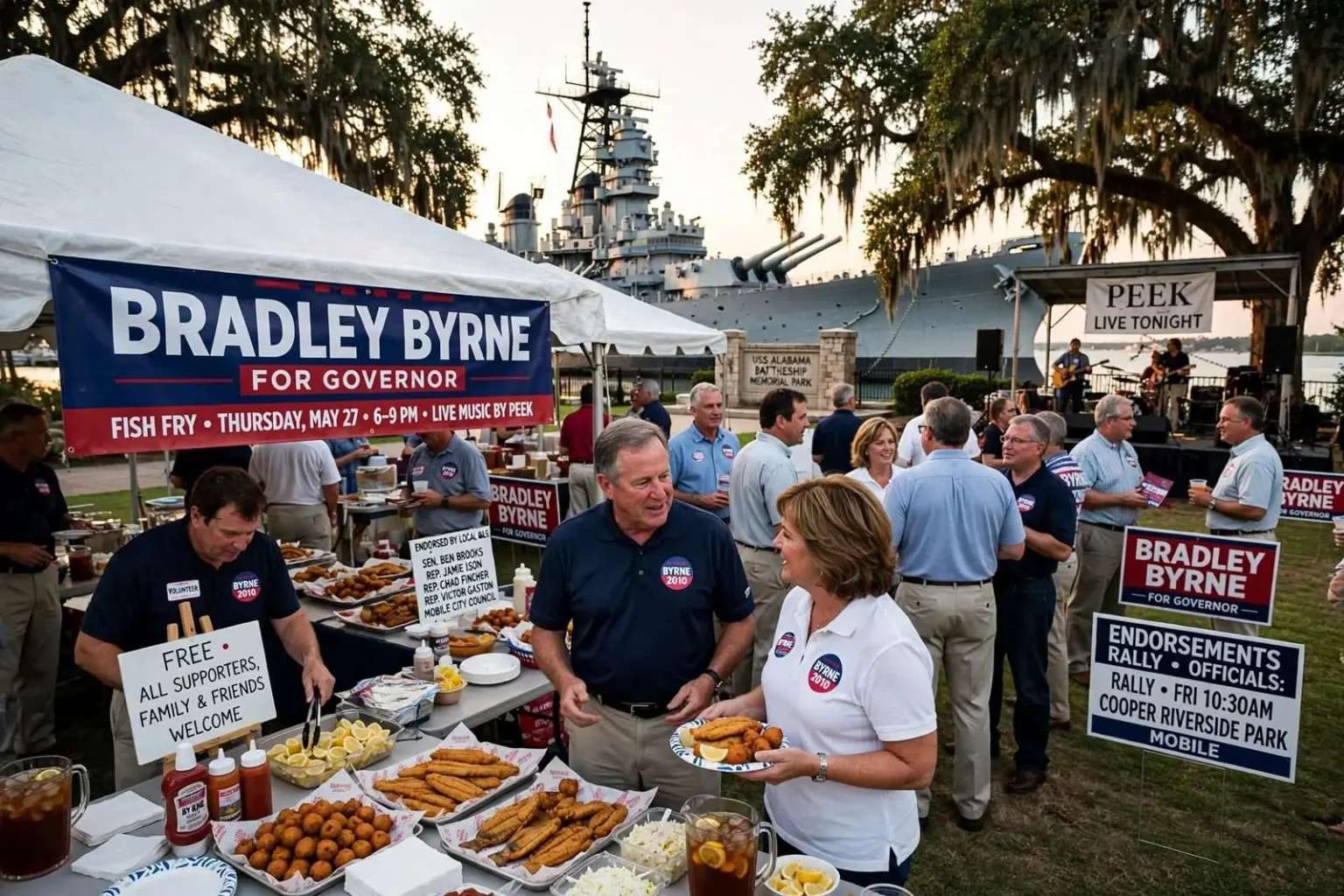
Republican gubernatorial candidate Bradley Byrne scheduled a free campaign fish fry for Thursday, May 27, from 6 to 9 p.m. at the hangar at USS Alabama Battleship Memorial Park, with live music by the band Peek. Byrne and his wife, Rebecca, invited supporters, family and friends to attend. The venue choice was pure Mobile — a campaign event staged in the shadow of the battleship that anchors the city’s waterfront identity, in a park that doubles as one of the region’s most recognizable gathering places.
The next morning, Friday, state and local elected officials planned to gather at 10:30 a.m. at Cooper Riverside Park in downtown Mobile to publicly declare their support for Byrne. Among those expected to lend their names were former U.S. Rep. Jack Edwards, state Sen. Ben Brooks, state Reps. Jamie Ison, Chad Fincher, Victor Gaston and Jim Barton, and Mobile City Council members John Williams and Connie Hudson. The list covered both sides of the bay and both chambers of the Legislature — a sweep of the region’s Republican officeholders that no rival campaign could match in a single morning.
For a campaign in its closing week, the value of that lineup was less about the individual names than the cumulative message: the elected establishment of Mobile and Baldwin counties was standing together on one riverfront stage. In a primary with several credible candidates and a guaranteed runoff, visible local organizations are the machinery that turns a strong first showing into a second-round victory.
James promises a national endorsement
The campaign of Republican gubernatorial candidate Tim James announced that a “major national endorsement” would be revealed at a press conference at 4:30 p.m. Friday at the Big Time Diner, 4936 Cottage Hill Road in Mobile. Speculation among political observers centered on Grover Norquist, the founder and president of Americans for Tax Reform and one of the better-known figures in the national conservative movement.
Norquist’s Americans for Tax Reform had made its no-tax-increase pledge a fixture of Republican primaries nationwide, and its founder’s personal appearances drew the kind of conservative activist attention that money could not directly buy. Choosing a diner on Cottage Hill Road rather than a hotel ballroom signaled the audience James wanted: the grassroots primary voter, not the downtown establishment.
Bonner collects business backing
U.S. Rep. Jo Bonner, the Mobile Republican who represented Alabama’s First Congressional District, picked up the endorsement of the Alabama Association of Realtors. “Jo Bonner … is always ready, willing and able to tackle our most difficult issues ‘head on’ without being distracted by political consequence,” said Lee Metzger, a trustee of the group’s political action committee, who described Bonner as a defender of private property rights and an advocate for home ownership.
The board of directors of the U.S. Chamber of Commerce also endorsed Bonner, citing his support for legislation the organization said promotes job creation and economic growth. “We believe that (Jo’s) election to the U.S. House will help produce sustained economic growth and help create more jobs,” said Thomas Donohue, the chamber’s president and chief executive. National business endorsements of a sitting incumbent are routine, but in a year when the economy dominated every race, the chamber’s blessing was framed as a jobs argument rather than a seniority argument.
Bonner’s challenger for the Republican nomination, Peter Gounares, announced endorsements of his own, from the Alabama Tea Party Express and from Conservative Christians of Alabama. The tea party movement was then at a high-water mark of national attention, and its involvement in Alabama primaries was one of the season’s open questions — whether the energy that had filled rallies across the country in the preceding year could translate into organizational muscle at a rural-state ballot box.
The matchup of endorsements told the story of the Republican Party’s internal tension in 2010: an incumbent congressman backed by the chamber of commerce and the state’s realtors against a challenger carrying the banner of the movement then challenging incumbents nationwide. Both campaigns wanted the same voters; the endorsements were the labels each side pinned on its case.
District attorney race enters its final stretch
In the Republican primary for Mobile County district attorney, candidate Ashley Rich rolled out a new television advertisement for the closing days of the campaign against county attorney Mark Erwin. The contest had grown pointed in its final weeks, in part because of the shadow cast by the criminal charges pending against county commissioner Stephen Nodine.
The Nodine case had dominated Mobile County’s headlines for weeks, and it hung over the district attorney’s race in a way no campaign could fully control. Both candidates were running to lead the office that would handle the prosecution, and every development in the commissioner’s case sharpened the debate over experience, judgment and how the next district attorney would handle cases that put the county’s own government under scrutiny.
Television advertising in the closing week is the most expensive weapon in a local race, and Rich’s decision to spend it then reflected the standard math of primary campaigns: late-deciding voters are the largest bloc in a low-turnout election, and the last message they see before the ballot is the one most likely to move them.
Montrose reception for Rep. Joe Faust
Across the bay, Don and Jeanne McGriff and Bob and Cathy Bousson hosted a reception for state Rep. Joe Faust on Thursday, May 27, from 5:30 to 7 p.m. at the McGriffs’ home at 7143 Adams Street, at the corner of Adams and Second streets in Montrose. Faust had represented House District 94, covering a swath of Baldwin County’s Eastern Shore, for eight years.
A home reception in one of the Eastern Shore’s older neighborhoods is Baldwin County politics at its most traditional: no venue rental, no crowd count, just a legislator and a roomful of neighbors who know him by name. After eight years representing Daphne, Fairhope-area communities and the surrounding district, Faust’s case to voters rested on the same seniority-and-access argument that Bonner’s Washington endorsers were making at the same hour across the bay.
The stakes
The 2010 cycle was the first Alabama governor’s race in many years without an incumbent on the ballot, and the crowded fields on both party tickets guaranteed runoffs. With Governor Bob Riley term-limited out of the picture, the open seat drew a field large enough that no candidate could realistically win a majority in June — making the July runoff, not the primary itself, the true finish line, and making every endorsement banked this week a down payment on the second round.
Local endorsements mattered more than usual, because turnout in a primary is thin and organized blocs of voters carry outsized weight. In a June election decided by a fraction of the electorate, a state senator’s list, a realtor association’s mail file or a tea party group’s phone tree can be worth more than a week of television.
For Mobile and Baldwin voters, the ballot also carried consequential local choices: district attorney in both counties, legislative seats, and county commission races that would help set the region’s direction for the next four years. The final week’s scramble of fish fries, press conferences and backyard receptions was, in the end, the last chance for every campaign on that ballot to make its case in person — and the region took full advantage of it.
Reading the closing week
Political veterans read a final-week calendar the way scouts read a map. A fish fry at the battleship, a riverfront endorsement rally, a diner press conference and a backyard reception in Montrose each served a different constituency within the same electorate, and the fact that all of them crowded into the same forty-eight hours was not an accident. Campaigns save their biggest shows for the end, when attention finally turns to a race that has been running for a year.
The geography of the week also mapped the region’s political terrain. Byrne’s two Mobile events and James’ Cottage Hill Road stop fought for the city’s Republican voters, while Faust’s Montrose reception and the Baldwin County offices on every countywide ballot reminded the campaigns that the fast-growing Eastern Shore was now the region’s decisive voting bloc. Any Republican running statewide or countywide in 2010 had to run up numbers in Baldwin County to survive, and the endorsement lists reflected that arithmetic.
Endorsements as organization, not just news
For all the headlines an endorsement generates on the day it is announced, its real value arrives later, in the mechanics of turnout. A legislator’s endorsement comes with a donor list, a network of neighbors and an implicit vouching that matters in communities where personal reputation decides local races. Business group endorsements come with member communications and independent expenditure capability. Movement endorsements bring volunteers who will actually staff the polls on Election Day.
That is why closing-week endorsement news clustered so heavily in this primary: with a guaranteed runoff ahead, each campaign was not just trying to win June 1 but positioning for the coalition it would need in July. A candidate who finished second with the right organizational allies could still win the runoff; one who finished second without them could not.
What voters saw on the ballot
Beneath the top-of-ticket contests, the region’s down-ballot races carried their own weight. The Mobile County district attorney’s race would determine who led an office central to the county’s most consequential prosecutions. Legislative seats in both counties would shape the delegation that represented the coast in Montgomery. County commission contests would decide budget and infrastructure decisions from road paving to park spending in fast-growing suburbs and struggling rural districts alike.
The final week before a primary is when all of those races converge on the same voters at the same time — through the same mailboxes, the same yard signs and the same supper-table conversations. In Mobile and Baldwin counties in late May 2010, the convergence was unusually crowded, unusually pointed, and, for the campaigns involved, the last full week of persuasion before the counting began.