Downtown Mobile Brewery Plan Clears Zoning Hurdle at Old Roussos Building
A proposed brewery and cafe at the former Roussos building in downtown Mobile cleared a zoning review after officials determined a variance wasn't needed.
A Zoning Fight That Never Happened
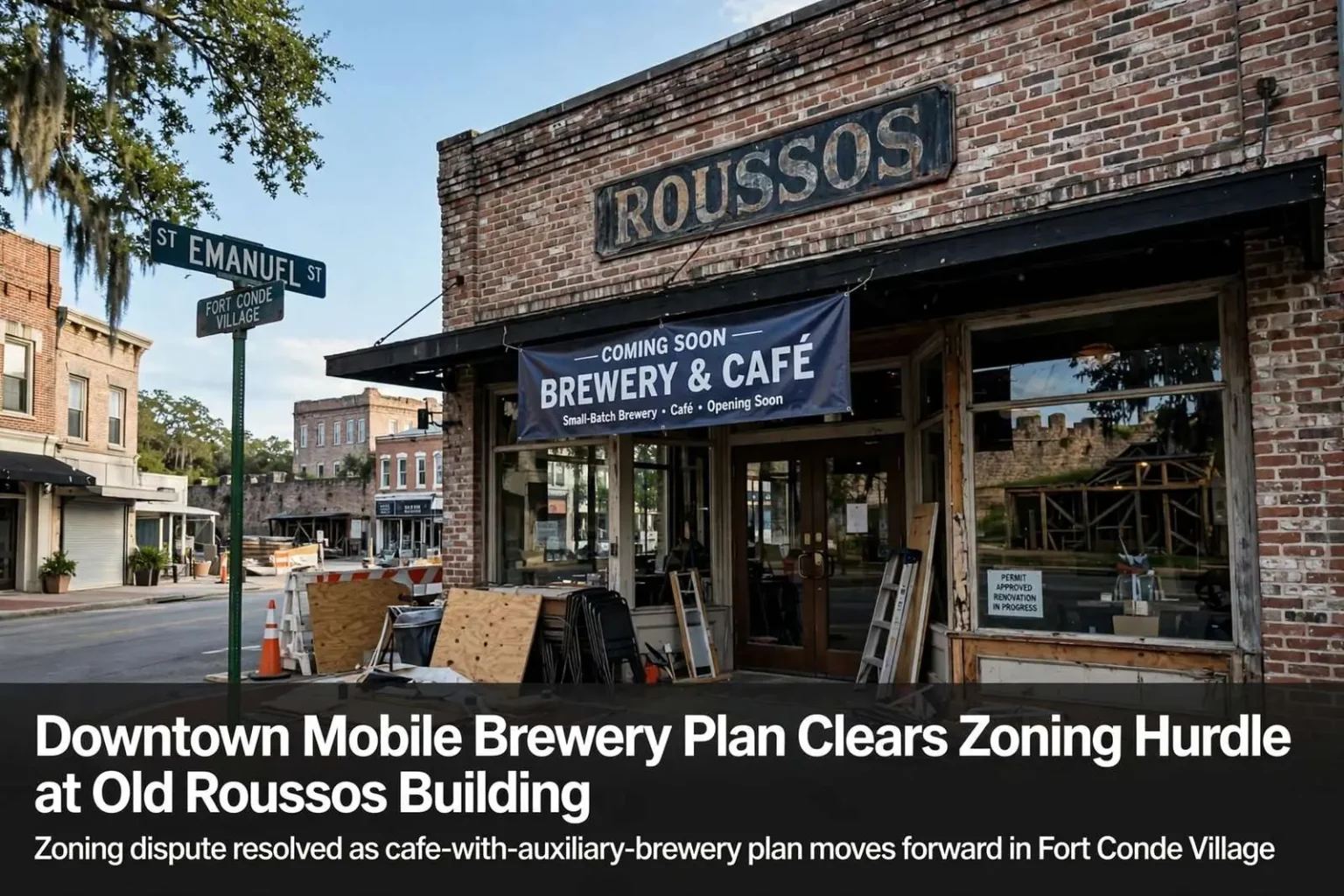
A long-planned brewery aiming to open in the heart of downtown Mobile cleared what looked like a significant regulatory obstacle this week, when a zoning dispute unexpectedly resolved itself before it ever reached a vote. Mobile’s Board of Zoning Adjustment had been scheduled to consider a variance request for the former Roussos restaurant building, a one-story brick structure in the Fort Conde Village area slated to become home to a new microbrewery and cafe.
The project, backed by downtown business owner John Serda and brewmaster Todd Hicks, had run into early pushback from the city’s Land Use Administration staff, who initially raised concerns about the zoning and recommended against approving a variance. But by the time the board’s meeting rolled around, the matter had quietly disappeared from the agenda entirely.
According to the board chairman, city staff had reconsidered the proposal after the venture’s backers clarified exactly what they intended to build. Rather than a standalone brewing facility, the plan centers on a cafe with an auxiliary brewing operation on-site, a distinction that turned out to already be permissible under the property’s existing zoning. Once staff determined no variance was necessary, the request was withdrawn and the board had nothing left to act on, effectively clearing the path for the project to move forward.
The episode offered a small case study in how development questions get sorted out in a city rewriting its development rules. What looked like a head-on collision between an entrepreneur’s plans and the city’s zoning map dissolved the moment both sides were talking about the same building in the same terms.
A Long Time Coming
Serda and Hicks said they’ve been working toward this venture since 2008 and were relieved to see the zoning question resolved without a prolonged fight. They noted that some of the uncertainty stemmed from the city’s Downtown Development District code, which had only been adopted a couple of months earlier, leaving both business owners and staff still getting familiar with how it applies to new projects.
The Downtown Development District overlay represented Mobile’s most recent attempt to consolidate and modernize the rules governing its urban core, and nearly everyone involved acknowledged a learning curve. For applicants, a new code means re-checking assumptions that might have been safe under the old rules; for staff, it means interpreting provisions that have never been applied to a live project. The Roussos building proposal became one of the early tests of how the new framework handles production uses mixed into commercial districts.
While the brewery has drawn much of the public attention, Serda emphasized that the attached restaurant will actually be the venture’s primary revenue driver. The pair are targeting a microbrewery focused on small-batch production rather than distribution at scale, with the beer flowing to taps in the attached cafe and, over time, to a handful of accounts around the city rather than to grocery shelves across the region.
The Building and Its Neighborhood
The former Roussos restaurant building sits in the Fort Conde Village area, a pocket of downtown Mobile just off the major tourist corridors where older commercial structures have been steadily finding new uses. The one-story brick building has the kind of bones that renovation-minded operators look for — solid construction, street presence and a layout that adapts well to restaurant use — and it had stood largely idle since the restaurant that gave it its name closed.
The location matters to the business plan as much as the building does. Downtown Mobile has spent years trying to add destinations that give visitors and residents a reason to linger after dark, and the brewery-cafe model has proven in other cities to be a reliable anchor for that kind of foot traffic. A working brewery in view of the bar, with tanks visible to customers, has become a signature of the genre and a draw in its own right.
Fort Conde Village itself sits in the shadow of the reconstructed Fort Conde replica near the Mobile waterfront, within walking distance of the convention center, the theaters and the growing cluster of restaurants and bars that make up downtown’s entertainment district. For Serda, who has been part of the downtown business community for years, the neighborhood was the only serious candidate for a venture of this kind.
What the Distinction Meant
The difference between a standalone brewing facility and a cafe with auxiliary brewing sounds technical, but under zoning it is everything. A production facility is an industrial use, typically pushed toward heavy commercial or industrial districts; a restaurant that brews its own beer on the premises is simply a restaurant, with the brewing treated as accessory to the primary business. The Land Use Administration’s initial concerns evaporated once the plans made clear which of the two was being proposed.
That reading also aligns with how the craft beer industry has actually evolved. Most new small breweries nationally are built around a taproom, with the majority of sales made on-site in pints and growlers rather than in cases shipped to stores. Zoning codes written before that shift often lag behind, forcing brewers into variance requests that consume months. Mobile’s experience with the Roussos building suggests the city’s newest code, whatever its learning curve, can accommodate the taproom model without special treatment once the use is understood.
Serda’s Stake in Downtown
For John Serda, the project extends a long involvement in Mobile’s downtown revival. As the owner of an established downtown business, he has been a consistent voice for the idea that the city’s core competes not just with the suburbs but with other cities’ urban districts for restaurants, residents and nightlife. A brewery-cafe within sight of the fort adds exactly the kind of destination that advocates have argued downtown needs more of.
Hicks brings the production side. As a brewmaster, he is responsible for turning the auxiliary brewing space into a working operation — recipes, equipment, and the small-batch schedule that will keep the cafe’s taps supplied with beer made steps from where it is poured. The pairing of a business operator with a working brewer is the standard template for ventures of this kind, and both partners said the years spent planning since 2008 were largely spent waiting for the right building, the right rules and the right moment to converge.
What Comes Next
With the zoning question resolved, the project moves to the less visible stages that follow: permits, renovations and equipment installation inside the Roussos building. No variance hearing means no appeal window and no board vote to wait for, which in practical terms removes the single largest schedule risk the partners faced when the dispute first surfaced.
The partners’ caution about publicity reflected that experience. After years of stop-and-start planning, both said the priority is getting doors open rather than celebrating a regulatory hurdle that, in the end, turned out not to exist. The building’s transformation from a closed restaurant to a working brewery-cafe will be the next visible sign of progress.
For downtown observers, the outcome carries lessons beyond one building. The city’s newest development rules were tested by an actual applicant and proved flexible enough to allow a use that barely existed when older codes were written. The brewery and its cafe will be judged, soon enough, by the harder standard of the market — but the regulatory path, the one thing that could have stopped the project outright, is now clear.
Beer and the Downtown Economy
The partners’ timing, whatever the frustrations of the past several years, lands in a period of momentum for craft brewing across Alabama. State law has gradually made it easier for breweries to sell beer on-site and to operate tasting rooms alongside production, and cities around the state have watched small breweries function as anchors in revitalizing districts. A brewer like Hicks, working at small batch scale, can rotate recipes and seasonal releases in ways that keep regulars coming back, and the cafe gives those beers a kitchen behind them — a combination neither a bar nor a standalone production facility can match.
The revenue emphasis Serda described is also a hedge against the volatility of the brewing business. Restaurants generate steadier daily traffic than taprooms alone, and a menu built for lunch and dinner crowds keeps the building active well beyond brewery hours. That structure — restaurant first, brewery as signature attraction — has become the dominant playbook for ventures of this size, and it explains why the zoning question resolved the way it did: under the city’s rules, the project really is a restaurant.
Neighbors in Fort Conde Village, for their part, get a use that activates a long-closed building without the noise or traffic profile of an industrial operation. The distinction that saved the variance request is also the distinction that makes the project a fit for its block — beer made on-site, but poured and served in a cafe, in a neighborhood built around storefronts rather than factories.