Fairhope Police Warn of Phone Scammers Impersonating Officers Across Mobile Bay
Fairhope police are warning residents about callers posing as law enforcement demanding fine payments, following similar scam reports in Mobile.
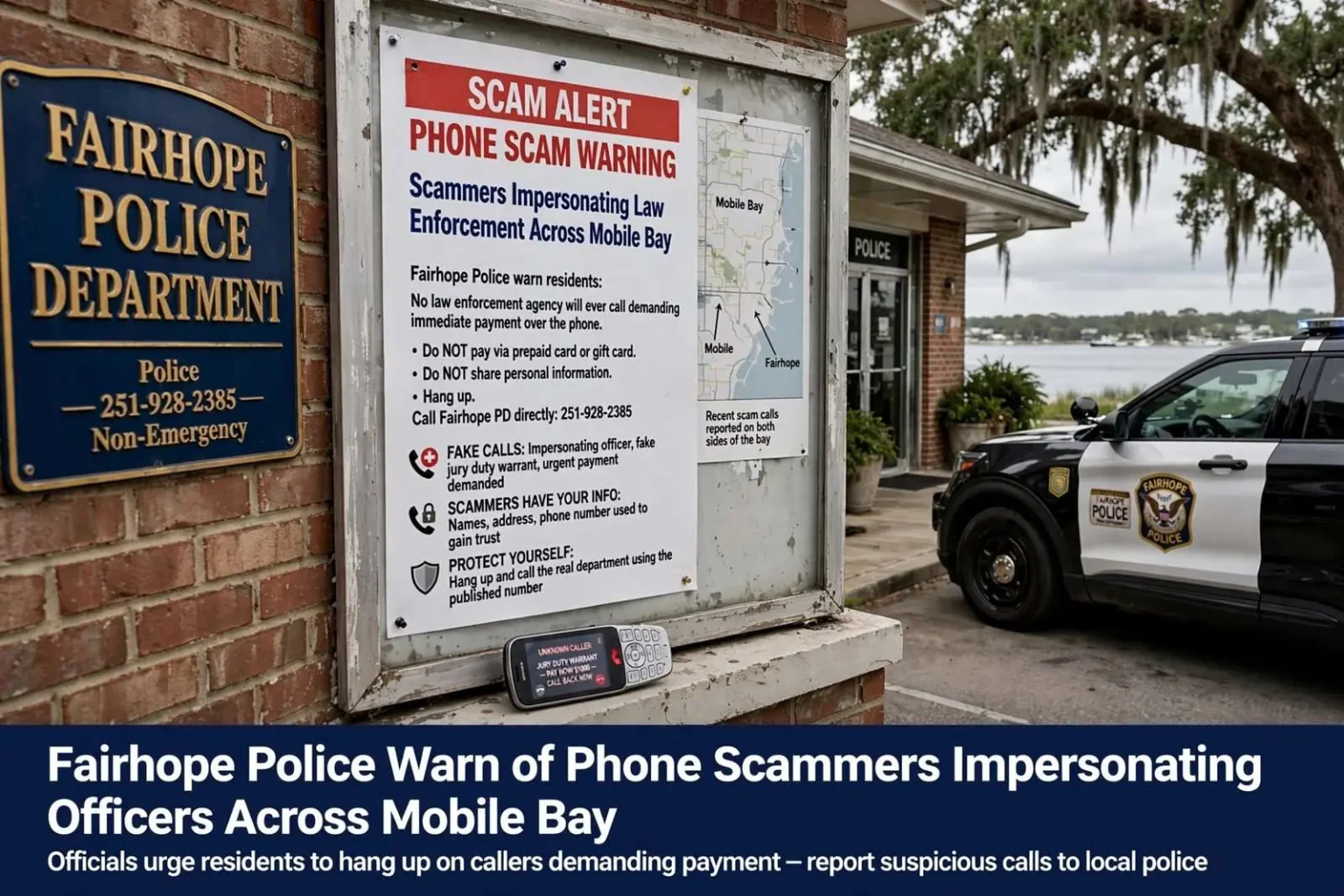
Fairhope police are cautioning residents to hang up on callers claiming to be law enforcement officers after a wave of scam calls hit both sides of Mobile Bay over the holiday weekend. The warning comes just a week after the Mobile County Sheriff’s Office issued a similar alert about callers impersonating deputies, and the back-to-back advisories signal that the scheme is not isolated to one jurisdiction or one shoreline of the bay.
The pattern followed by the callers is a familiar one in consumer-fraud circles: authority claimed over the phone, a fabricated emergency, and a deadline measured in hours. What made this round stand out to investigators was how much the callers already knew about the people they targeted — and how far they were willing to go to make the threat look real.
How the calls unfolded
According to Fairhope police, one resident reported receiving a call from a man identifying himself as a longtime lieutenant with a fictitious “Baldwin County Police Department.” The agency does not exist — Baldwin County is served by the Baldwin County Sheriff’s Office and municipal police departments — but the title and the confident delivery were designed to sound official to someone unfamiliar with local law enforcement’s structure.
A neighboring resident received a separate call from someone claiming to represent the Mobile County Sheriff’s Office. In both cases, the callers pressured elderly victims to pay roughly $1,000 in supposed fines by early the next afternoon, threatening arrest over claims the victims had failed to appear for jury duty. The jury-duty angle is a staple of phone scams for a reason: it sounds plausibly bureaucratic, most people have only a vague sense of how jury summonses work, and the threat of arrest carries real weight, particularly for older residents who grew up treating law enforcement with deference.
Police say what made the calls especially unsettling was how much personal information the scammers already had, including the victims’ ages, names, addresses and phone numbers. During the calls, the scammers extracted even more details from their targets. Each question a victim answers — confirming a spouse’s name, repeating a date of birth, verifying an address — becomes another piece of ammunition, both for the current call and for future schemes aimed at the same household.
In at least one instance, the caller followed up by emailing a fabricated warrant to the victim to add legitimacy to the threat. A document in an official-looking format, complete with case numbers and signatures, is often the step that tips a hesitant target into paying. Investigators note that a genuine arrest warrant is never emailed by a deputy or officer demanding payment over the phone; warrants are served in person or executed through the courts.
A known playbook
Officials say scammers targeting the Mobile area have used a similar playbook, telling residents that a family member had been arrested or had an outstanding warrant, then instructing them to purchase a prepaid debit card to settle the supposed debt over the phone. The prepaid card request is the tell: cards bought at retail stores can be drained anywhere in the world within minutes, the money is effectively unrecoverable once the card numbers are read aloud, and no legitimate government agency collects fines that way.
Variations of the scheme circulate constantly across the Gulf Coast, shifting the pretext with the seasons — jury duty one month, a grandchild in jail the next, an unpaid traffic ticket after that. The constants are urgency, secrecy, an immediate payment demand and a payment method that is hard to trace. Law enforcement agencies across Baldwin and Mobile counties have repeated the same advice for years precisely because the scams keep working on someone: urgency exists to keep victims from pausing, checking, and calling someone who knows better.
Law enforcement agencies stress that no legitimate police department or sheriff’s office will ever call demanding immediate payment over the phone, especially through prepaid cards. Real fines and court costs are assessed through a court clerk’s office, documented in writing, and payable through official channels — not settled with a card number dictated to a stranger who called at dinnertime.
Where the scammers get their information
A Fairhope police spokesman urged residents never to share personal information with unsolicited callers, noting that much of what scammers use to sound convincing is already available through public records and online searches. Property records, court filings, voter rolls, obituaries and social media all feed the data brokers whose lists end up in call centers running these operations. A caller who recites a victim’s address and phone number is not proving he is a lieutenant; he is proving he has an internet connection and a list.
That reality changes the advice investigators give. The test is not whether the caller knows things about you — it is whether the request itself makes sense. No court summons a juror by demanding $1,000 over the phone by tomorrow afternoon. No police agency resolves an arrest warrant with a prepaid card from a grocery store checkout. The moment money and urgency combine, the call is over, no matter how accurate the details sound.
What residents should do
Residents are encouraged to hang up immediately on any caller claiming to be a law enforcement officer requesting money and to instead call their local police department directly to verify any claims. Calling the agency’s published, publicly listed number — not a number the caller provides — is the step that defeats the scheme every time, because the real department has no record of the call and can confirm in minutes that nothing is pending.
The Federal Trade Commission also maintains guidance for identifying and reporting phone scams on its consumer website. The FTC’s materials walk through the common pretexts, the payment red flags and the reporting process, and they are written for exactly the audience these scams target: people who want to check whether a call was real after the fact. Family members of older residents are encouraged to walk through the basics with parents and grandparents before the calls arrive, since the first defense is knowing the pattern exists.
Anyone who receives a suspicious call of this nature is asked to contact the Fairhope Police Department, the Mobile County Sheriff’s Office, or the Baldwin County Sheriff’s Office to file a report. Officials say documenting these calls helps investigators track patterns and warn other residents before more people fall victim to the scheme.
Why the scam persists
The arithmetic explains why the calls keep coming. A thousand dollars at a time is small enough to escape the kind of attention that follows large fraud, but a call center working through a purchased list of numbers can attempt hundreds of calls a day across multiple area codes. Most recipients hang up; the operation only needs a handful of frightened or isolated targets a week to stay profitable. Elderly residents living alone remain the preferred target for the same reason, and the holiday weekend timing was likely no accident, when families are traveling and a victim has fewer people nearby to consult before paying.
Recovery is rare. Prepaid card funds are moved and laundered within hours, callers spoof their numbers so they cannot be traced to a phone, and many operations run from outside the United States. That is why every agency issuing these warnings emphasizes prevention over investigation: the report a victim files helps map the pattern, but the $1,000 is usually gone. Hanging up before any information is shared is the only reliable protection.
A regional problem with a shared response
The near-simultaneous warnings from the Mobile County Sheriff’s Office and the Fairhope Police Department reflect how these operations work — they dial across jurisdictional lines even though local agencies can only investigate their own victims’ cases. Coordination between departments, along with reports to state and federal consumer-protection agencies, is how a scattering of individual complaints becomes a pattern worth publicizing. Residents who report a call, even one where nothing was lost, contribute to that picture.
The events described in this report connect to broader patterns across the Gulf Coast region, where fast population growth has brought new residents who may not know which agencies serve their community — making the fictitious “Baldwin County Police Department” sound plausible to someone who moved to the area recently. Local institutions, government agencies, and community organizations all play roles in addressing these issues, from the sheriff’s offices issuing warnings to the senior centers and churches that pass them along. The outcomes of these efforts will shape the region’s future development and resilience, and for now the simplest step remains the one police keep repeating: if a caller claims to be an officer and asks for money, hang up, look up the real number, and call the department directly.