Baldwin EMC Warns Its 54,000 Members About a Phone Scam Demanding Money for Meter Repairs
Baldwin EMC issued an urgent warning after a member was scammed by a caller posing as the cooperative and demanding money to repair a meter, part of a wave of scams in the Mobile Bay area.
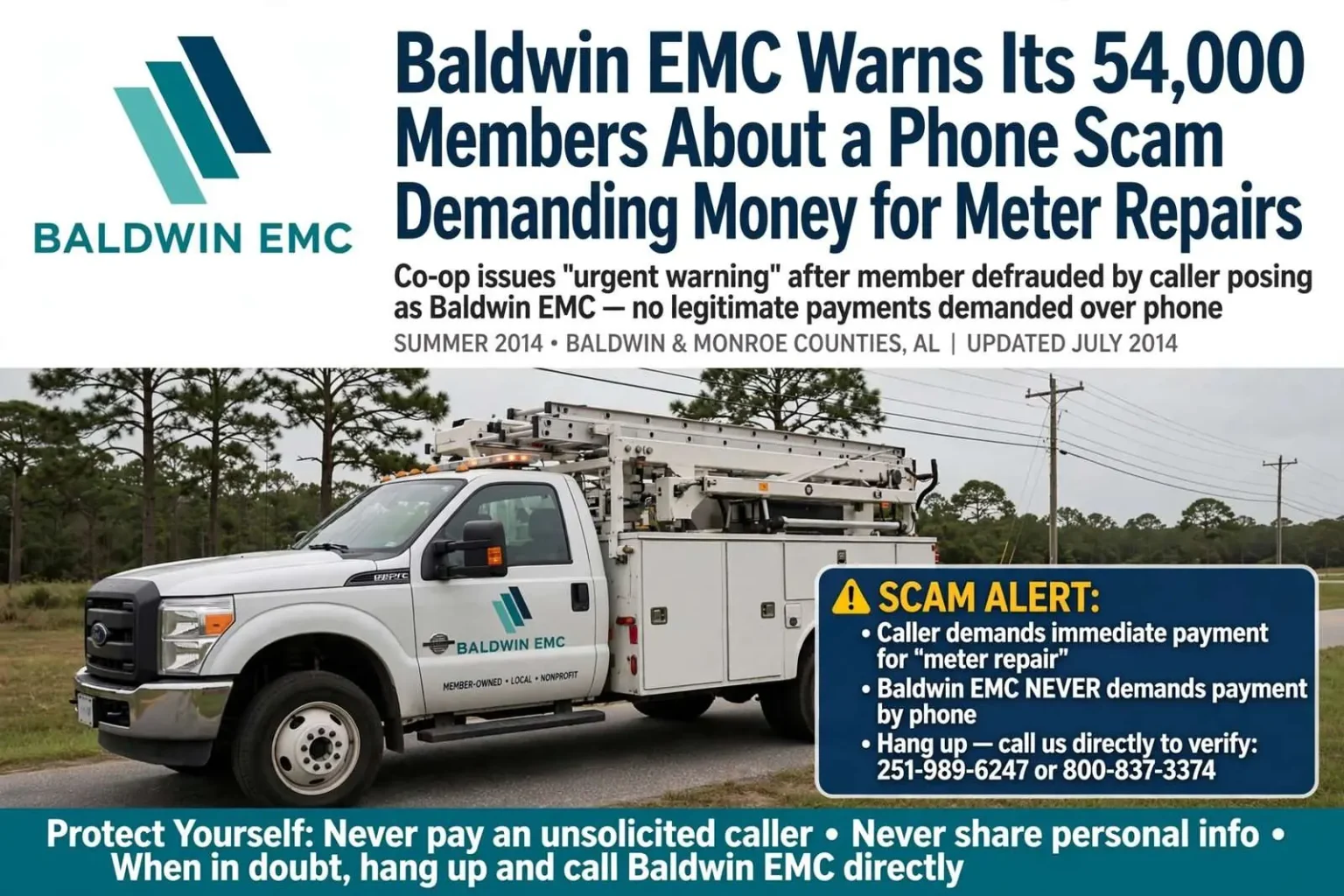
Scam artists were busy across the Mobile Bay area in the summer of 2014, and Baldwin EMC customers found themselves the latest target. The member-owned electric cooperative issued an “urgent warning” one Tuesday morning after learning that one of its members had been defrauded. According to the cooperative, a member had been “scammed by a caller claiming to represent Baldwin EMC, demanding a large amount of money to repair their meter.” The call, the co-op stressed, was not legitimate and did not follow its protocol.
The episode put a local face on a problem that utility customers across the country had been confronting for years: con artists who borrow the name of a trusted local institution and weaponize it against the very people it serves. For a cooperative whose name is on the bucket trucks residents see on rural roads every day, the misuse of that name was more than an annoyance — it was a direct attack on the trust the organization had spent decades building.
How the scam worked
The fraudulent caller posed as a representative of Baldwin EMC and pressured the member to pay immediately over the phone to address a supposed problem with a meter. That demand, the cooperative said, was a clear red flag: members are never forced to pay over the phone. The fabricated “meter repair” angle was a twist on the more common threat of immediate disconnection, but the mechanics were the same — an urgent problem, a deadline measured in minutes, and a demand for money before the victim could think or verify.
Baldwin EMC urged any customers who received calls from someone claiming to represent the co-op and asking for money to guard their sensitive personal information, warning that the callers were most likely scammers. Beyond the immediate financial loss, a call like that can harvest exactly what fraudsters need for follow-up crimes: account numbers, addresses, and confirmation that the household answers the phone and responds to pressure. The cooperative asked members never to confirm personal details to an unsolicited caller, no matter how convincing the story.
Part of a broader wave
The warning came amid a rash of similar schemes in the region. In the same period, residents reported calls from people impersonating law enforcement officers, another variation on the same basic con: an authoritative-sounding caller, a fabricated emergency and a demand for quick payment. Such scams often relied on urgency and intimidation, pressuring victims to act before they had time to think or verify. By impersonating a trusted local utility, the callers targeting Baldwin EMC members sought to exploit exactly that trust.
The pattern is well documented among consumer protection agencies, which have long noted that utility impostors tend to become more active in extreme weather, when customers are most afraid of losing power, and around the end of billing cycles, when the threat of disconnection sounds plausible. The disguises rotate — utility, sheriff’s office, IRS — but the playbook rarely changes. A demand for immediate payment by phone, wire transfer, or a prepaid card is the tell that separates a legitimate collection call from a theft in progress.
Consumer advocates had long warned that utilities, banks and government agencies are common disguises for such schemes precisely because people trust them and fear ignoring them. A caller who threatens to cut off power, or insists a meter must be fixed at once for a fee, is banking on that fear. The cooperative’s advice cut through the pressure with a simple rule: legitimate business is never conducted through a demand for immediate payment to an unknown caller.
A cooperative rooted in the community
Baldwin EMC served roughly 54,000 members — and about 68,000 accounts — across Baldwin and Monroe counties, making it one of the larger electric cooperatives in Alabama. Its service territory stretched from the fast-growing communities along the Eastern Shore and the coast to the rural stretches of Monroe County, a footprint that put the co-op’s linemen and bill collectors inside the daily lives of tens of thousands of households.
As a member-owned cooperative, it occupied a familiar and trusted place in the daily lives of the households it powered, which made the impersonation especially concerning. Unlike an investor-owned utility, a co-op answers to its own customers: members vote for the board, share in margins, and expect the organization to look out for them in return. A scam that costs a member money under the co-op’s name therefore wounds the institution twice — once in the victim’s wallet and once in the credibility that makes the cooperative model work.
The structure also shaped the response. Because a cooperative’s members are its owners, Baldwin EMC treated the warning not as a customer-service matter but as a protection-of-members duty, pushing the alert out through every channel it had and asking members to warn each other. In small communities across Baldwin and Monroe counties, word of mouth from a neighbor is often more persuasive than any press release, and the co-op leaned on that.
The defense: hang up and call back
The cooperative reminded members of the simplest defense: it does not demand immediate payment by phone, and any caller who does should be treated with suspicion. Customers were encouraged to hang up and contact the co-op directly using its published numbers. That call-back habit, officials stressed, defeats the scam no matter how elaborate the script, because the fraudster’s entire advantage evaporates the moment the victim is talking to the real utility.
Baldwin EMC asked members to report suspicious calls to the cooperative at 251-989-6247 or 800-837-3374. Reports mattered for more than the individual case: each call logged gave the cooperative a picture of where the scheme was operating and what script the callers were using, information that could be passed to law enforcement and shared with other utilities across the region fighting the same wave.
The cooperative encouraged members to share the warning with elderly relatives and neighbors, who are often the most heavily targeted by phone fraud, so that a scheme reported by one household might spare many others. Seniors living alone, in particular, are disproportionately victimized by impostor calls, and a heads-up from family — “the co-op will never demand money over the phone like that” — is one of the most effective deterrents available.
What members should take from it
By spreading the word quickly, officials hoped to keep a single reported loss from becoming many, and to arm their members with the information needed to recognize and resist the next attempt. For residents across Baldwin and Monroe counties, the episode was a reminder that even a trusted local name could be turned into a tool for fraud — and that a moment’s skepticism, and a direct call to the cooperative, could make all the difference.
The summer of 2014’s string of impersonation scams — utility callers, fake lawmen, urgent demands — never required victims to be gullible, only to be hurried. Baldwin EMC’s message distilled the entire counter-argument into a habit that costs nothing: hang up, look up the co-op’s number yourself, and call. The meter, the co-op assured its members, could wait; the money, once wired, usually could not be recovered.
Why cooperatives make tempting targets
The irony of the Baldwin EMC case was that the very qualities that make a cooperative trustworthy — local identity, a familiar name, a reputation for fairness — are exactly what make it useful to a con artist. A member of a national bank expects a call center; a member of a local co-op expects a neighbor. Scammers understand that expectation and dress their scripts in it, counting on the fact that a caller claiming to be “the co-op” starts with a level of credibility a stranger could never earn.
Electric cooperatives across the Southeast had reported similar schemes in the same era, and industry groups had begun circulating warnings among member systems as the impostor calls multiplied. The common threads were consistent from system to system: a caller who claims the power will be cut within the hour, refuses to let the customer hang up, and steers payment toward channels that are hard to trace — prepaid cards, wire transfers, or, increasingly in later years, payment apps. None of those channels is ever used by a legitimate cooperative collection department.
Baldwin EMC’s own billing practices, like those of its fellow Alabama cooperatives, gave members additional reference points. Members receive regular statements, have access to payment offices and established phone lines, and can verify the status of any account directly. A genuine delinquency notice gives a customer time — days, not minutes — and never arrives as a demand for a meter repair fee from a stranger on the telephone.
The checklist officials wanted members to remember
In the wake of the warning, the guidance boiled down to a handful of rules that applied equally to the utility scam and to the fake law-enforcement calls circulating in the same period. Never pay an unsolicited caller immediately, no matter the emergency described. Never give out account numbers, Social Security numbers, or banking details to someone who called you. Hang up rather than argue, because engaging only invites more pressure. And when in doubt, look up the organization’s number independently and call back — the few minutes it takes is the cheapest insurance against a loss that may never be recovered.
Members who had already received suspicious calls were asked to write down the number that appeared on caller ID, the time of the call and anything they could recall about the script, then report it through the co-op’s published lines. Even a failed scam attempt was worth reporting, officials noted, because the callers typically worked through lists of numbers, and each report helped map how widely the scheme had spread across Baldwin and Monroe counties.
For the cooperative, the episode closed with a promise repeated in every message it sent: the organization would keep its members informed, and it would never — under any circumstances — demand immediate payment by telephone. For members, the lasting lesson was smaller and sturdier: the co-op already knows who you are, already has your account, and will never need a stranger on the phone to prove it. Anyone who says otherwise is selling something, and the best response is the sound of a dial tone followed by a call to a number the member chose personally.