Stolen Cars in the Front Yard Lead Mobile Police to a Texas Fugitive and a Counterfeit-Check Operation
Mobile police arrested a Texas fugitive after two stolen vehicles in his front yard led to a search warrant that turned up counterfeit checks and the equipment to make them.
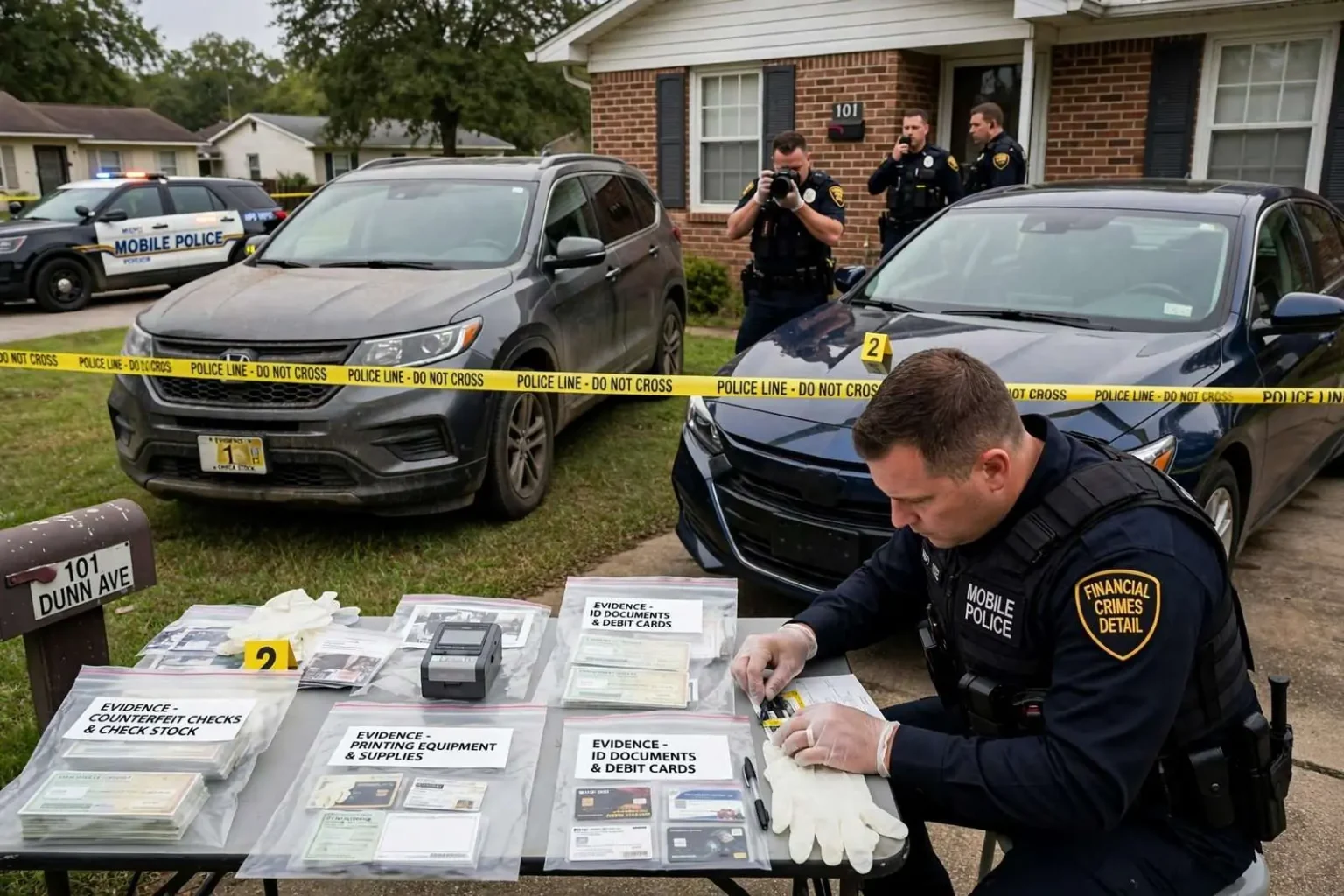
Mobile police arrested a fugitive from Texas after two stolen vehicles parked in his front yard led officers to a cache of counterfeit checks and the materials used to produce them.
The Mobile Police Department said officers received a tip that the Texas fugitive was in the area and began building a case. “We began to set up surveillance and monitor his residence,” said MPD Public Information Officer Terence Perkins. “What gave us the insight to get the search warrant was he had two stolen vehicles parked in his front yard.”
The case began, as many do, with an anonymous tip — but what detectives did with it illustrates the step-by-step process by which street-level information becomes a courtroom case.
The search warrant
The warrant was executed in the 100 block of Dunn Avenue by the department’s Financial Crimes Detail, with assistance from the Intelligence Unit. Inside, according to a police news release, officers discovered numerous counterfeit checks, check stock, check-printing software and all the components needed to manufacture fraudulent checks.
Investigators also recovered identifying documents and debit cards belonging to several other people, suggesting the operation extended beyond a single victim. A haul of that kind transforms an arrest from a single complaint into an ongoing investigation: every debit card and identification document represents another potential victim whose information was in play, and another count that prosecutors can consider.
Check counterfeiting operations of this scale depend on three components that the search turned up together: blank check stock, software capable of reproducing bank routing and account details, and a printer capable of producing documents good enough to pass casual inspection at a retail counter. Modern consumer-grade equipment has put that capability within reach of nearly anyone, which is why financial crimes units across the country have seen check fraud persist and even flourish in the digital era.
The pairing of the Financial Crimes Detail with the Intelligence Unit was a deliberate match. Financial crimes detectives bring the document expertise needed to recognize the scope of a counterfeiting operation, while intelligence officers bring the databases and background files needed to connect a suspect to warrants, prior victims and associates. Executing a search warrant with both units on hand means evidence is documented with an eye toward the charges that will follow.
The charges
Based on the evidence, police arrested 53-year-old Morris Mosley. He was charged with two counts of first-degree receiving stolen property, two counts of identity theft and 25 counts of second-degree criminal possession of a forged instrument.
Alabama law treats each counterfeit check as a separate offense, which is how a single search can produce 25 counts of forged instrument possession. First-degree receiving stolen property applies to stolen property worth substantial amounts — including vehicles — while identity theft counts cover the unauthorized possession of another person’s identifying information with intent to use it fraudulently. Stacked together, the charges exposed Mosley to potential prison time measured in decades if convicted across the board.
Mosley was also wanted in Texas on a series of felony charges, including burglary, two counts of forgery of financial instruments, an additional forgery count, a parole violation and theft. The out-of-state warrants added another layer to a case that began, in effect, with two cars that did not belong to him sitting in plain view.
Fugitive warrants from another state change the calculus of a local case. Once Texas authorities are notified of an arrest, they can lodge a detainer and begin extradition proceedings, meaning Mosley would face Alabama’s charges first but would not leave the criminal justice system when they concluded. Parole violations carry their own consequences — a parolee picked up on new charges can be returned to custody in the sentencing state without a new trial.
How a small detail cracked the case
The arrest illustrated how a seemingly minor observation, stolen vehicles left in a front yard, can give investigators the probable cause needed to obtain a search warrant and uncover a far larger scheme.
Probable cause is the legal hinge on which every search warrant turns. Officers must present a judge with specific facts — not hunches — establishing that evidence of a crime is likely inside a particular place. Two stolen vehicles parked in plain view at a suspect’s residence is exactly the kind of articulable fact that persuades a judge: it connects the suspect to stolen property, places that property at a specific address, and suggests what a search of the residence may uncover.
Surveillance preceded the warrant, as it does in most cases built from tips. Detectives monitoring a residence document comings and goings, confirm that a wanted person is present, and look for the corroborating details — in this case, the stolen vehicles — that turn suspicion into legal justification. The discipline matters: evidence gathered without proper justification can be suppressed, collapsing charges that might otherwise stand.
Financial crimes of this kind often operate quietly, relying on printed checks and stolen identities that leave little visible trace. In this instance, the visible presence of stolen property provided the opening. Counterfeit check operations tend to surface only when a victim notices a fraudulent withdrawal, a retailer catches a bad check, or — as here — investigators stumble onto the physical apparatus through some other offense entirely.
The volume of charges, particularly the 25 counts tied to forged instruments, pointed to an operation with the capacity to produce fraudulent checks in quantity. The recovery of check stock, printing software and the personal information of multiple individuals suggested that others could have been victimized had the operation continued undisturbed.
For the Mobile Police Department’s Financial Crimes Detail, the case represented the kind of methodical work that turns a single tip into a substantial arrest. By combining surveillance with the physical evidence in plain sight, officers were able to secure a warrant, seize the equipment and take a wanted man into custody.
What happens to the victims
The identification documents and debit cards recovered on Dunn Avenue point to the case’s quieter aftermath: notifying victims, restoring their financial standing and tracing how their information was obtained. Identity theft victims often learn of the crime only when collection notices arrive or accounts are frozen, and unwinding fraudulent transactions can take months of correspondence with banks and credit agencies.
Each document in the cache becomes an investigative thread. Detectives work backward from a recovered debit card to its rightful owner, then to the transaction history that shows where and how the card was used. Those patterns — whether the fraud was concentrated in a neighborhood, a retail corridor or a specific bank — tell investigators whether they are looking at a single operator or a distribution network that supplied fraudulent documents to others.
Under Alabama’s identity theft statute, each victimized individual can support a separate count, and prosecutors frequently use the breadth of victimization to argue for significant sentences. That is part of why a single search warrant can produce the stacked charging structure seen in this arrest.
Check fraud in the digital age
The persistence of check counterfeiting surprises many consumers who rarely write checks themselves. But checks remain a fixture of commerce — rent payments, contractor payments, government benefits and older account holders keep billions of paper checks circulating annually — and every check in circulation carries the routing and account numbers a counterfeiter needs.
Arrests like the one on Dunn Avenue document the supply side of that fraud. The check stock, software and printing equipment seized in such cases represent production capacity: a single operation can generate thousands of fraudulent instruments before detection. Financial crimes detectives estimate that the paper trail of a check operation — passing bad checks at multiple retailers, cashing them through mules or accounts — spreads losses across dozens of businesses before any single victim connects the dots.
Retailers along the Gulf Coast absorb a share of those losses, and the cost eventually surfaces in prices and in the verification systems stores use at the register. Check verification services, identity confirmation requirements and hold policies on large checks are all countermeasures shaped by cases like this one.
Two states, one defendant
Mosley faced prosecution in Mobile County on the local charges while remaining subject to the outstanding warrants in Texas, ensuring that the case would follow him well beyond the Dunn Avenue residence where it began.
The sequencing of multi-state prosecutions follows a familiar order: the state holding the defendant in custody prosecutes first, while the other state’s detainer waits. If Texas proceeds to extradition after Alabama’s case concludes, Mosley would answer for the burglary, forgery, theft and parole charges pending there — a process that can add years to a defendant’s total custody regardless of how the Alabama charges resolve.
For the detectives who started with a tip about a Texas fugitive, the outcome validated the slow build. Surveillance confirmed the tip, the stolen vehicles supplied the probable cause, and the search warrant converted a fugitive arrest into a financial crimes case with 29 local counts, multiple victims and an international-picture of an operation that had been running quietly in a residential front yard.