Orange Beach Man Sentenced to 14 Years in Friend’s Death, Freed on Appeal Bond Under House Arrest
Jon Washington of Orange Beach was sentenced to more than 14 years for manslaughter in a 2012 shooting, then released on a $25,000 appeal bond under house arrest while he appeals.
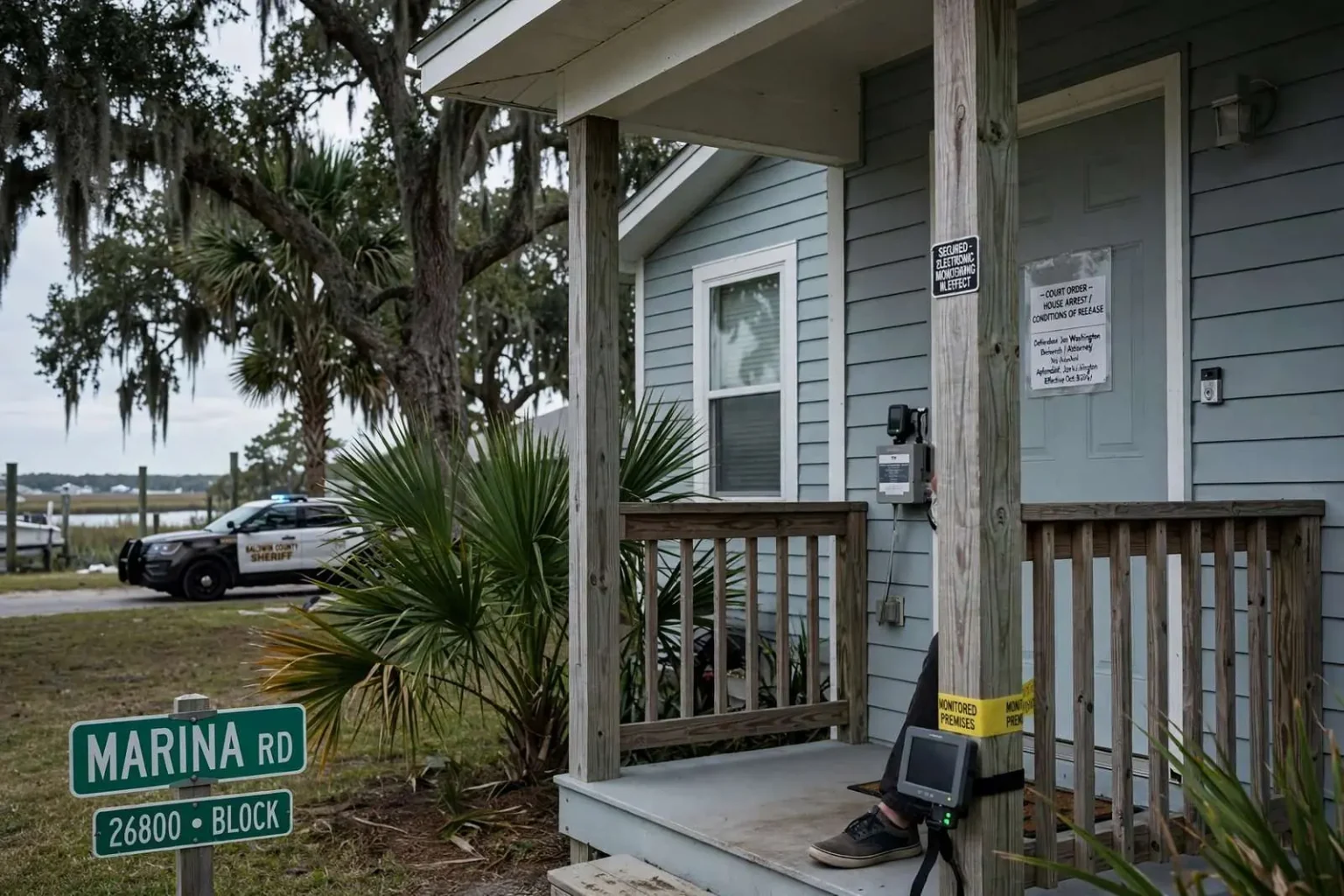
An Orange Beach man found guilty of manslaughter in a 2012 shooting was sentenced to more than 14 years in prison, then released the same day on an appeal bond while he challenges his conviction. Jon Washington, 43, was convicted in May in the death of his friend, Kenneth Myers, 49. A Baldwin County judge sentenced him to 14 years and four months in prison.
That Thursday afternoon, Washington was released from the Baldwin County Corrections Center after posting a $25,000 appeal bond. The turnaround — from sentencing to release within a single day — is the kind of sequence that can look unusual from the outside, but it follows a defined legal track. A conviction ends a trial, not a case. Until the appellate process runs its course, the sentence exists on paper while the courts decide whether it will stand.
For Baldwin County, the case drew attention both for the setting — a death at a home in one of Alabama’s most heavily visited beach communities — and for the questions it raised about how the justice system treats a defendant between conviction and appeal. The next phase of Washington’s case will unfold not in a Baldwin County courtroom but before an appellate court reviewing the record of the trial below.
Conditions of release
While out on bond, Washington was placed under house arrest and barred from consuming alcohol. The terms permitted him to attend church, go to work and meet with his attorneys, but otherwise confined him as his appeal proceeded. Those conditions amount to a narrow corridor of permitted movement: three routine activities, each of them verifiable, with everything else off limits.
House arrest in cases like this typically means electronic monitoring, scheduled absences and swift consequences for violations. The alcohol ban is significant given the circumstances of the offense — both men had been drinking on the night of the shooting — and it signals the court’s effort to remove the very element that played a role in the crime. Conditions on appeal bonds are not symbolic; a defendant who violates them can forfeit the bond and return to custody.
His attorney, John Beck, expressed confidence in the challenge ahead. “We certainly feel very good about our prospects on appeal,” Beck said. He added that his client understood his improved position. “Mr. Washington also understands he’s in a whole lot better shape than he was prior to trying the case.”
From murder charge to manslaughter conviction
The shooting occurred at a home in the 26800 block of Marina Road in Orange Beach. According to Beck, Myers and Washington had been drinking at the time. When Washington was arrested, he was charged with murder, a count that alleged an intentional killing. The jury, however, rejected the state’s theory.
“He was alleged to have committed an intentional act,” Beck said. “The jury did not agree with the state’s theory, and they came back and found that he was reckless.” The manslaughter verdict reflected that finding, treating the death as the result of reckless conduct rather than a deliberate act.
The distinction matters enormously in Alabama law. Murder requires intent — the state must prove the defendant meant to kill or acted with extreme indifference to human life under circumstances showing it. Manslaughter, by contrast, covers deaths caused recklessly: conduct the defendant was aware of and consciously disregarded a substantial and unjustifiable risk from. A jury choosing between those verdicts is essentially deciding what was in the defendant’s mind, and juries weighing evidence that includes alcohol and a fatal confrontation often land on recklessness rather than purpose.
The practical effect shows up in the sentence. A murder conviction in Alabama carries a much longer potential punishment; the 14-years-and-four-months sentence reflects the jury’s manslaughter finding. That same finding is the backbone of the appeal to come, since the defense’s argument will be built on the record of how the evidence supported — or failed to support — even the lesser verdict.
What an appeal bond means
The case highlighted the workings of an appeal bond, which allows a convicted defendant to remain free while a higher court reviews the case, typically under strict conditions. In Washington’s situation, the combination of house arrest, an alcohol ban and limited permitted activities represented the constraints a court may impose to balance a defendant’s release against public safety and the seriousness of the offense.
Appeal bonds are not automatic, and the decision to grant one can turn on factors including the strength of the appeal and the defendant’s ties to the community. Courts weigh whether the defendant is a flight risk, whether the public faces any danger from release, and whether the appeal raises substantial questions worth reviewing. The bond amount itself — $25,000 here — functions as a financial guarantee that the defendant will appear as the case proceeds.
The appeals process itself is slow by design. A defendant’s team files written briefs identifying errors at trial — instructions to the jury, evidentiary rulings, the sufficiency of the proof — and the prosecution responds. In many cases the appellate court decides on the written record without new testimony, which means months or years can pass between sentencing and a decision. Throughout that period, conditions like Washington’s remain in force, and any change requires the court’s permission.
Beck’s stated confidence in the appeal suggested the defense saw grounds to contest the conviction, though the outcome would rest with the appellate court. Defense assessments at this stage are common, but they are not empty: an attorney who believes the verdict rests on a genuine error will say so in the briefs, and judges will answer those arguments point by point.
An unresolved case on the coast
For the family and friends of Kenneth Myers, the sentencing brought a measure of resolution even as the appeal left the case unsettled. A jury had held Washington responsible for a reckless killing, and a judge had imposed a sentence of more than 14 years. Yet with the appeal bond posted and house arrest in place, the question of whether that conviction would stand remained open as the matter moved to the next stage in the courts.
Cases like this one sit uncomfortably in a community’s memory. Orange Beach, a resort city of a few thousand permanent residents that swells with visitors along the Gulf, rarely sees deaths of this kind, and the fact that the two men were friends added a layer to the story that residents followed closely. A conviction usually closes the public chapter of such a case; an appeal keeps it open on the courthouse docket even as attention fades.
The legal stakes run in both directions. If the appellate court affirms the conviction and the sentence, Washington would begin serving the prison term imposed in Baldwin County. If the court finds error, it could order a new trial, modify the judgment, or grant relief on the specific grounds raised. Either way, the conditions of his release remain the operative fact of his daily life — house arrest, no alcohol, and only church, work and his attorneys’ offices until the courts speak.
Until then, the case stands as a local illustration of how Alabama’s criminal justice system handles the space between verdict and final judgment: a sentence announced in open court, a bond posted the same day, and a defendant back home under monitoring while the record of his trial is read once more, this time by judges deciding whether it was enough.
How Alabama courts handle the gap after a verdict
Washington’s same-day release fits a familiar pattern in Alabama felony cases. Once a jury returns its verdict, the defense can ask the trial court to set an appeal bond, and the court holds a hearing on whether release is appropriate pending the appeal. Judges look at the defendant’s record, his appearance history during the trial itself, his connections to the community and the nature of the offense. In this case the court concluded that monitored release was workable, and the bond was set at $25,000.
House arrest as a condition carries its own enforcement machinery. Electronic monitoring tracks a defendant’s movements against a schedule of approved absences, and every trip outside the permitted zone — church, work, the attorney’s office — must fit the categories the judge approved. Violations surface quickly, and in Baldwin County, as elsewhere, a defendant who breaks the conditions of an appeal bond risks both revocation of release and additional charges.
The alcohol prohibition deserves particular note. Courts routinely attach such conditions when intoxication was part of the original offense, and compliance is usually checked through testing. In a case where both the defendant and the victim had been drinking on the night of the shooting, the condition directly addresses the circumstance that the jury heard the most evidence about.
What comes next for the case
The practical next steps are procedural and slow. The appellate record is compiled from the trial transcripts, the defense files its brief, the state answers, and the court may schedule oral arguments. Only after that does a ruling arrive, and even a ruling is rarely the end: a losing party can seek further review. For Washington, the appeal bond converts that timeline from imprisonment into confinement at home; for Myers’s family, it means the legal questions remain alive long after the verdict.
For residents of Baldwin County and the Gulf Coast, the case is a reminder of how much of the justice system happens away from the courtroom. The trial produced the verdict and the sentence everyone saw; the appeal bond, the monitoring and the briefs that follow happen quietly, governed by rules designed to protect both the public and a defendant’s right to challenge the judgment against him. Until the appellate court rules, both protections are in effect at once — and Washington’s 14-year sentence remains a possibility that is real, but not yet final.