The Speaker’s Wallet: How More Than $1 Million Kept Alabama’s House in Democratic Hands
Campaign records showed House Speaker Seth Hammett moved more than $1.4 million to Democratic candidates across Alabama in the 2006 cycle, including several from Mobile and the southwest counties.
Republicans in Alabama spent the years after 2006 puzzling over a question that seemed, on its face, to answer itself: how does a state that votes Republican for president, sends Republicans to the U.S. Senate and elects Republicans to most statewide offices keep sending Democratic majorities to Montgomery? An examination of campaign finance records on file with the Alabama Secretary of State suggested one answer, and it had a name and an address: House Speaker Seth Hammett of Andalusia.
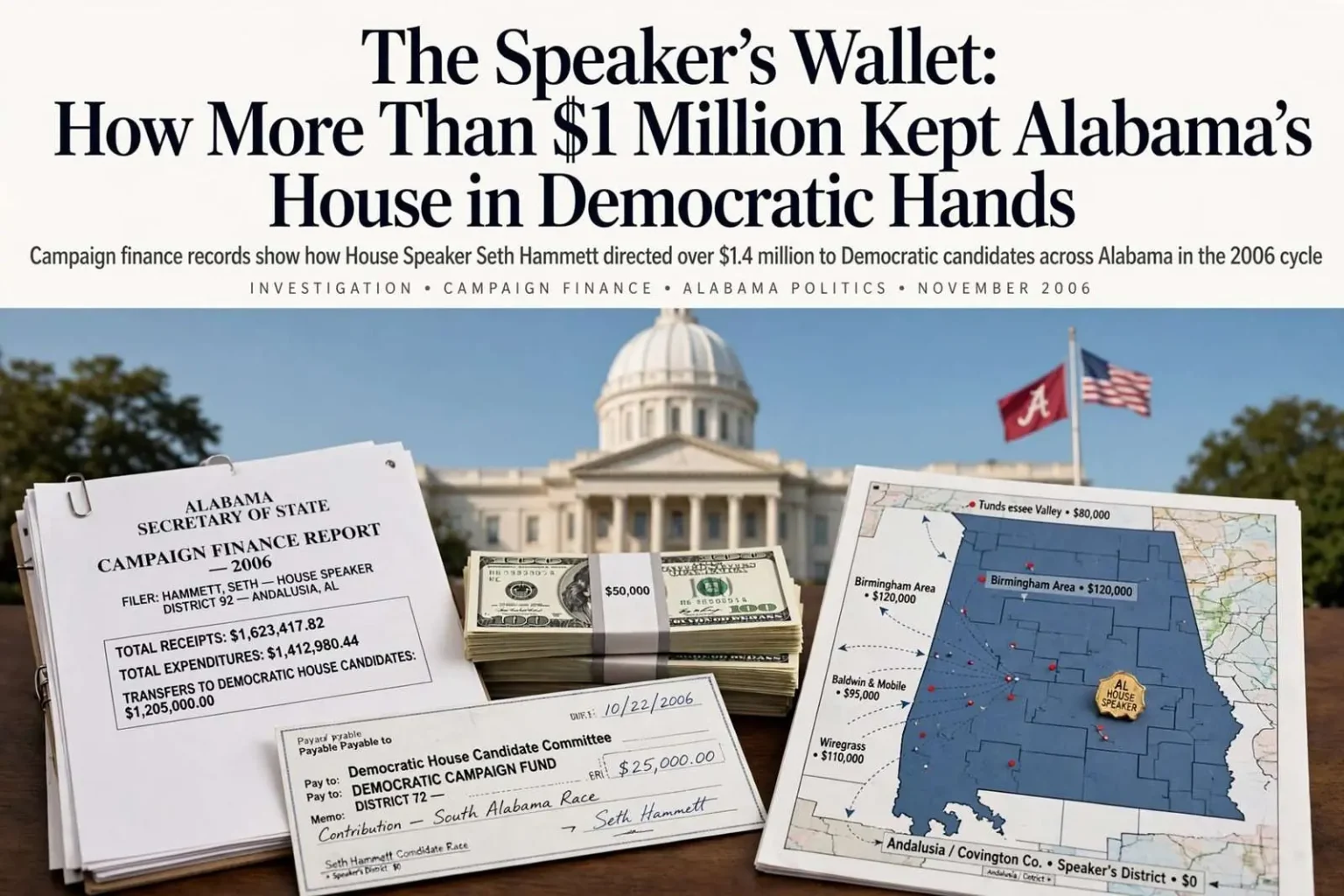
Hammett moved more than a million dollars through his campaign account in the 2006 election cycle, and very little of it went toward defending his own District 92 seat in Covington County. Instead, the money went out in checks to Democratic House candidates across the state — a flow of cash that helped explain how one party could dominate every statewide ballot while losing fight after fight for control of the legislative chamber where budgets, committees and district lines are decided.
The scale of it
The numbers were remarkable for a legislative account. The Hammett campaign’s cumulative assets during 2006 exceeded $1.6 million, allowing him to spend more than $1.4 million in a single cycle. For comparison, a typical House member’s campaign account in a safe district might raise and spend a small fraction of that amount — enough for yard signs, a few radio spots and a fish fry. Hammett was operating, in effect, a statewide political bank.
The money went out in checks to Democratic House candidates across the state, in amounts ranging from $1,000 to figures that dwarfed the budgets of most legislative campaigns. A single transfer from the Speaker’s account could exceed what a rural incumbent would raise on his own in an entire cycle. The recipients were not limited to marginal districts; the money reached incumbents across Alabama, from the Tennessee Valley to the Wiregrass, binding the House Democratic caucus to its leader financially as well as institutionally.
Few of those dollars needed to be spent at home. Hammett’s Andalusia-area seat was never seriously contested, which is precisely what made the arrangement possible. A politician who has to fight for survival cannot act as a banker for his colleagues; one who runs unopposed can turn his war chest into the caucus’s lifeline.
How the money worked
The mechanism was not complicated, and it was entirely legal under Alabama law at the time. Interests that were philosophically closer to the Republican Party — insurance companies, retailers, real estate, forestry, medical professionals and manufacturers — generously funded Republican challenges to Democratic incumbents. They wanted a functioning two-party system in Montgomery, and their checkbooks said so in open races across the state.
Then many of the same interests hedged, contributing to Hammett. The speaker served as a middle man, giving where others dared not openly give after reaping substantial support from an array of political action committees. A business group could back a Republican challenger publicly and still, through Hammett, help protect the Democratic incumbent who chaired the committee its bills had to pass through.
That dual-track giving was the essence of the system. PAC money pooled into Hammett’s account from dozens of sources, laundered of any single donor’s fingerprints. By the time it reached a House candidate, the contribution carried the Speaker’s name rather than the industry’s — and the incumbent who received it owed his gratitude to the man who controlled his committee assignments, not to the boardroom that had hedged its bets.
South Alabama on the receiving end
Among the many beneficiaries were Democrats in south Alabama’s legislative delegations, where Hammett’s reach was longest. The region’s House members — representing river counties, timber country and the Baldwin and Mobile suburban fringe — operated in districts that were trending Republican at the top of the ticket even as they re-elected Democratic legislators by comfortable margins. Campaign cash from the Speaker’s account was often the margin between a competitive race and a lost one.
The geography was no accident. Hammett’s own power base sat in Covington County, and the Democratic majority of that era was held together substantially by rural and small-town south Alabama legislators who could survive a Republican wave only with overwhelming financial superiority. A candidate who could swamp a challenger three-to-one on television and direct mail did not need the top of the ticket to cooperate.
The money also bought loyalty in a chamber where every vote counted. With the House narrowly divided for much of the decade, a member whose campaign survival depended on the Speaker’s account had a reason to stand with leadership on the votes that mattered: the budget, the rules, the committee chairs and, above all, redistricting.
The self-reinforcing machine
The result was self-reinforcing. The party in power commanded both the legislative process and the cash flow, and the cash flow tended to keep it in power, including through the drawing of legislative district lines. The maps adopted after the 2000 census were drawn by the same Democratic majority that the money helped sustain, and the lines were crafted to protect incumbents — packing some districts, cracking others — so that the money spent defending seats purchased maximum returns.
Alabama’s campaign finance rules made all of this difficult to see in real time. Contributions were reported, but the trail from a corporate treasury to a PAC to the Speaker’s account to a candidate was visible only to anyone patient enough to piece together the filings at the Secretary of State’s office. Voters saw a check from Seth Hammett; the underlying hedge by an industry group never appeared on a single yard sign.
The system also discouraged challenges from within. A House member who considered breaking with leadership knew that the money that had protected him in past cycles could just as easily fund an opponent in the next one. The Speaker’s account was simultaneously a shield for allies and a sword against rebels, and everyone in the caucus understood both uses.
For Republicans, the arrangement was a standing grievance and a lesson. Party leaders pointed to the Speaker’s million-dollar operation as evidence that Democrats were defending their majority not with ideas but with structural advantages — PAC networks, incumbency and maps. The GOP’s answer was organizational: recruit candidates everywhere, raise money nationally and locally at once, and nationalize every legislative race by tying each Democrat to the unpopular heads of the ticket.
The Speaker’s own trajectory
Hammett, a former educator and banker first elected to the House in 1978, was the ideal custodian for such a fund. His persona was affable and businesslike rather than ideological, and his base in Andalusia gave him distance from the urban Democratic politics that Republican candidates most loved to attack. He could take a check from a forestry company in the morning and defend a Democratic colleague’s seat with it in the afternoon without ever appearing on anyone’s target list himself.
Under his leadership the House functioned as a stable, disciplined operation, and business groups that might have preferred a Republican majority learned to live with — and fund — the Democratic one. The arrangement favored stability over partisanship, and plenty of interests concluded that stability was worth the price of both checks.
How the era ended
The machine’s vulnerabilities were visible by the middle of the decade, even as it ran at full strength. The statewide Republican trend kept compounding — every presidential election, every constitutional amendment fight, every statewide race peeled more straight-ticket Republican voters away from down-ballot Democrats. A majority built on incumbent money and favorable lines could hold as long as the money flowed; it could not reverse the underlying drift of the electorate.
The 2006 cycle examined in the records was, in hindsight, near the system’s high-water mark. Democrats held the House and Senate and won the governorship that year, while Republicans carried the state in federal races on the same ballots. The contradiction grew sharper with each election until it broke in November 2010, when Republicans won both legislative chambers for the first time in modern Alabama history, sweeping away the majorities that the Speaker’s account had spent millions defending.
The aftermath changed the rules of the game. Alabama law moved to ban transfers between political action committees, closing the laundering mechanism that had made the Speaker’s account so useful. Disclosure requirements tightened, and the era in which a single legislative leader could quietly redistribute more than a million dollars a cycle drew to a close — a shift that both parties, now alternately in the majority, had reason to accept.
What the records show about power
The 2006 filings remain a case study in how Alabama politics actually worked in the era between parties. The question Republicans kept asking — how a red state stayed blue in the Legislature — had a mundane answer: money, positioned precisely, flowing through a leader whose own seat never needed it.
The lesson was not lost on the party that inherited the process. Modern legislative leaders in Montgomery operate central accounts and caucus funds with the same strategic logic — defending vulnerable members, disciplining dissent and converting financial advantage into chamber control. The mechanics of disclosure have improved; the underlying arithmetic of incumbency has not.
For voters in south Alabama, the episode is a reminder that the ballot is only the visible half of the machine. In the 2006 files at the Secretary of State’s office, the other half sits in plain view: a Speaker in Andalusia, a million dollars in motion, and a majority that stayed in power in no small part because the money never stopped.