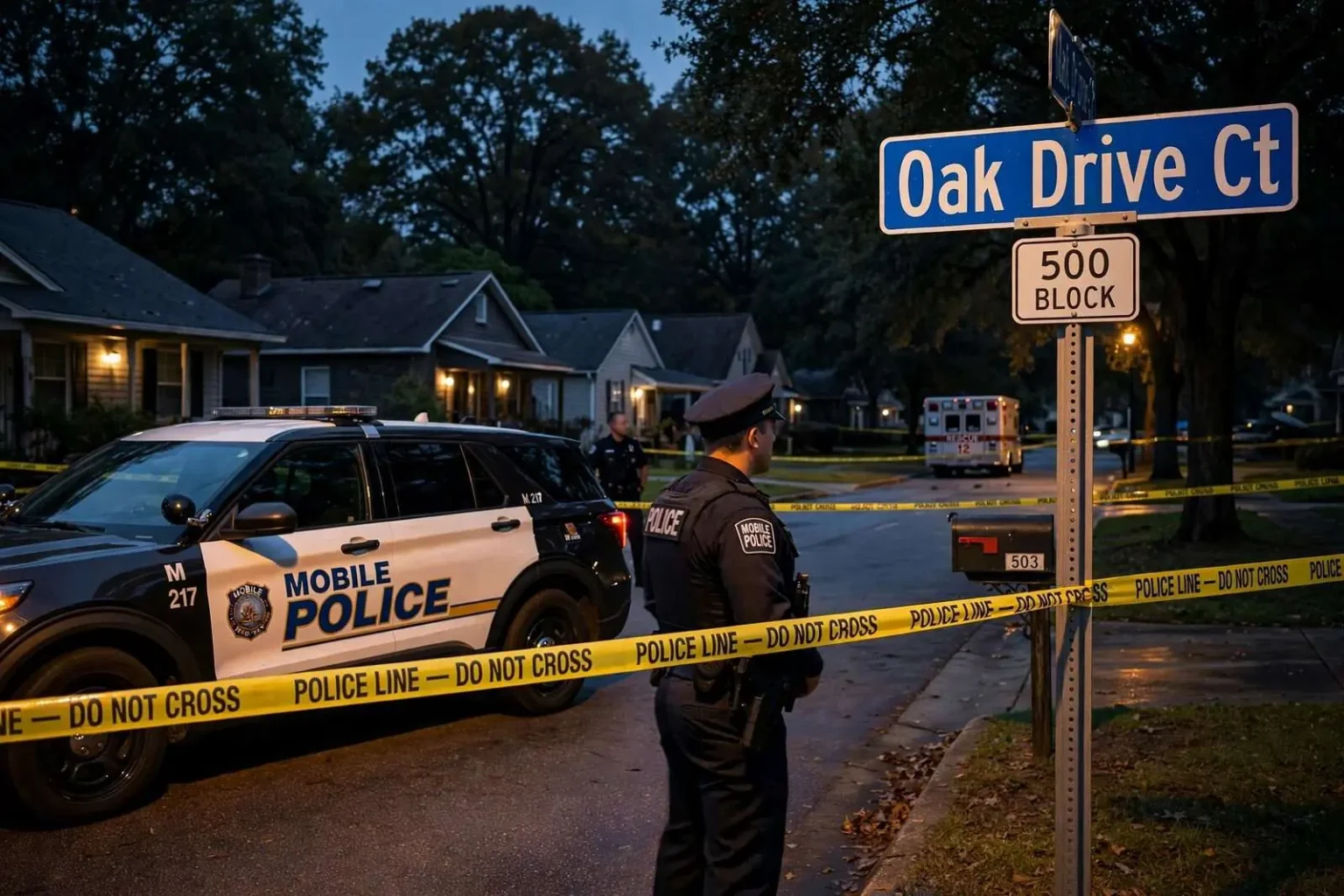
A woman was hospitalized after a stabbing in the 500 block of Oak Drive Court on Friday evening, and Mobile police have handed the case to the Mobile County District Attorney’s Office rather than making an immediate arrest.
Officers responded just before 7 p.m. Friday, July 10, after a report of a stabbing. They found a woman with visible injuries, and she was transported to a local hospital for treatment.
What Police Learned
During the investigation, officers determined the woman had been in a physical fight with a man she knew, and that he stabbed her during the altercation, according to a Mobile Police Department news release.
The department has not released the identity of either the victim or the man, and has not announced charges.
Why the Case Went to the District Attorney
The decision to refer a case to the District Attorney’s Office instead of arresting a suspect on the spot is a routine and often misunderstood step. It typically happens in one of a few circumstances: when the facts are contested and both parties give conflicting accounts; when the question of who was the primary aggressor is genuinely unclear; or when self-defense is raised and prosecutors must evaluate it before charges are filed.
In Alabama, prosecutors have discretion to review an investigative file, request follow-up work from detectives, and then decide whether to seek a warrant or present the matter to a grand jury. That process protects both the potential defendant, who is not arrested on a case that may not hold, and the state’s ability to charge correctly the first time.
It does not mean nothing will happen. It means the charging decision has moved from the patrol officer’s judgment to a prosecutor’s desk.
The Mobile County District Attorney’s Office: Gatekeeper of Felony Charges
The Mobile County District Attorney’s Office, led by the elected District Attorney for the 13th Judicial Circuit, is responsible for prosecuting all felony cases in Mobile County. The office employs a team of assistant district attorneys, investigators, and victim-witness coordinators who review cases referred by law enforcement agencies across the county, including the Mobile Police Department, the Mobile County Sheriff’s Office, and municipal police departments in Prichard, Saraland, Satsuma, and other jurisdictions.
When a case is referred for a charging decision, an assistant district attorney reviews the police report, witness statements, photographs, medical records, and any available video or forensic evidence. The prosecutor may request additional investigation — such as follow-up interviews, crime scene processing, or laboratory analysis — before making a determination. This review process is especially critical in cases involving potential self-defense claims, where the line between justified force and criminal assault can depend on nuanced factual findings.
Under Alabama law, a person is justified in using physical force in self-defense if they reasonably believe it is necessary to defend themselves or another person from imminent unlawful force. Deadly force is justified only when the person reasonably believes the other person is using or about to use unlawful deadly force. The determination of “reasonable belief” is a fact-intensive inquiry that prosecutors must evaluate carefully before filing charges.
Fights Between People Who Know Each Other
Police noted that the woman and the man knew one another, which places this incident in the largest single category of violent crime in Mobile and virtually every other American city. Assaults between acquaintances, family members and partners consistently outnumber violence between strangers, and they are also the cases most likely to involve conflicting narratives about who started what.
Data from the FBI’s Uniform Crime Reporting program and the Alabama Statistical Analysis Center consistently show that the majority of aggravated assaults and homicides involve victims and offenders who have a pre-existing relationship. In Mobile County, this pattern holds across urban and suburban areas alike, and it shapes how law enforcement and prosecutors approach these cases — with an understanding that the dynamics of the relationship are often central to both the commission of the offense and the resolution of the case.
When the parties know each other, investigators must carefully document the history of the relationship, prior incidents, protective orders, and any pattern of escalation. The Mobile Police Department’s Domestic Violence Unit and the Mobile County Sheriff’s Office’s Special Victims Unit are trained to gather this contextual evidence, which can be critical for prosecutors in establishing the primary aggressor and rebutting self-defense claims.
Hospital Treatment and Medical Evidence
The victim’s transport to a local hospital for treatment creates a medical record that will become a key piece of evidence in any prosecution. Emergency department documentation of the wound — its location, depth, trajectory, and the treatment required — helps establish the severity of the injury and can corroborate or contradict the accounts given by the parties. Under Alabama law, “serious physical injury” is defined as physical injury that creates a substantial risk of death, causes serious and protracted disfigurement, or causes protracted loss or impairment of the function of a bodily organ. The medical records will inform whether the injury meets this threshold, which affects the potential charges.
Hospitals in Mobile County, including USA Health University Hospital, Infirmary Health’s Mobile Infirmary, and Springhill Medical Center, have protocols for documenting injuries in suspected assault cases and for notifying law enforcement when required by mandatory reporting laws. The chain of custody for medical evidence is maintained to ensure admissibility in court.
Community Resources for Victims of Violence
Anyone in Mobile County who needs confidential support related to domestic or interpersonal violence can contact the Penelope House 24-hour crisis line, or the National Domestic Violence Hotline at 1-800-799-7233 (SAFE). The Penelope House, Mobile County’s primary domestic violence shelter, provides emergency shelter, safety planning, counseling, legal advocacy, and referrals to other services. The Mobile County District Attorney’s Office also operates a Victim Services Unit that assists victims with navigating the criminal justice process, understanding their rights, and accessing compensation through the Alabama Crime Victims Compensation Commission.
For victims of violent crime more broadly, the Alabama Crime Victims Compensation Commission may provide financial assistance for medical expenses, counseling, lost wages, and funeral costs. Applications are processed through the Mobile County District Attorney’s Victim Services Unit.
What Happens Next
This story will be updated if charges are announced. The District Attorney’s Office may seek an arrest warrant based on its review, present the case to a Mobile County grand jury for indictment, or decline to prosecute if the evidence is insufficient. If charges are filed, the case will proceed through Mobile County District Court for a preliminary hearing and then, if bound over, to Mobile County Circuit Court for arraignment and trial or plea resolution.
Court records will be accessible through the Mobile County Circuit Clerk’s Office once formal charges are filed.