One State Senate Race Could Topple a Row of Political Dominoes in Mobile
If Ben Brooks unseated Sen. Gary Tanner in 2006, the result would open a Mobile City Council seat, revive a county commission rivalry and set off a scramble that would reach well past Election Day.
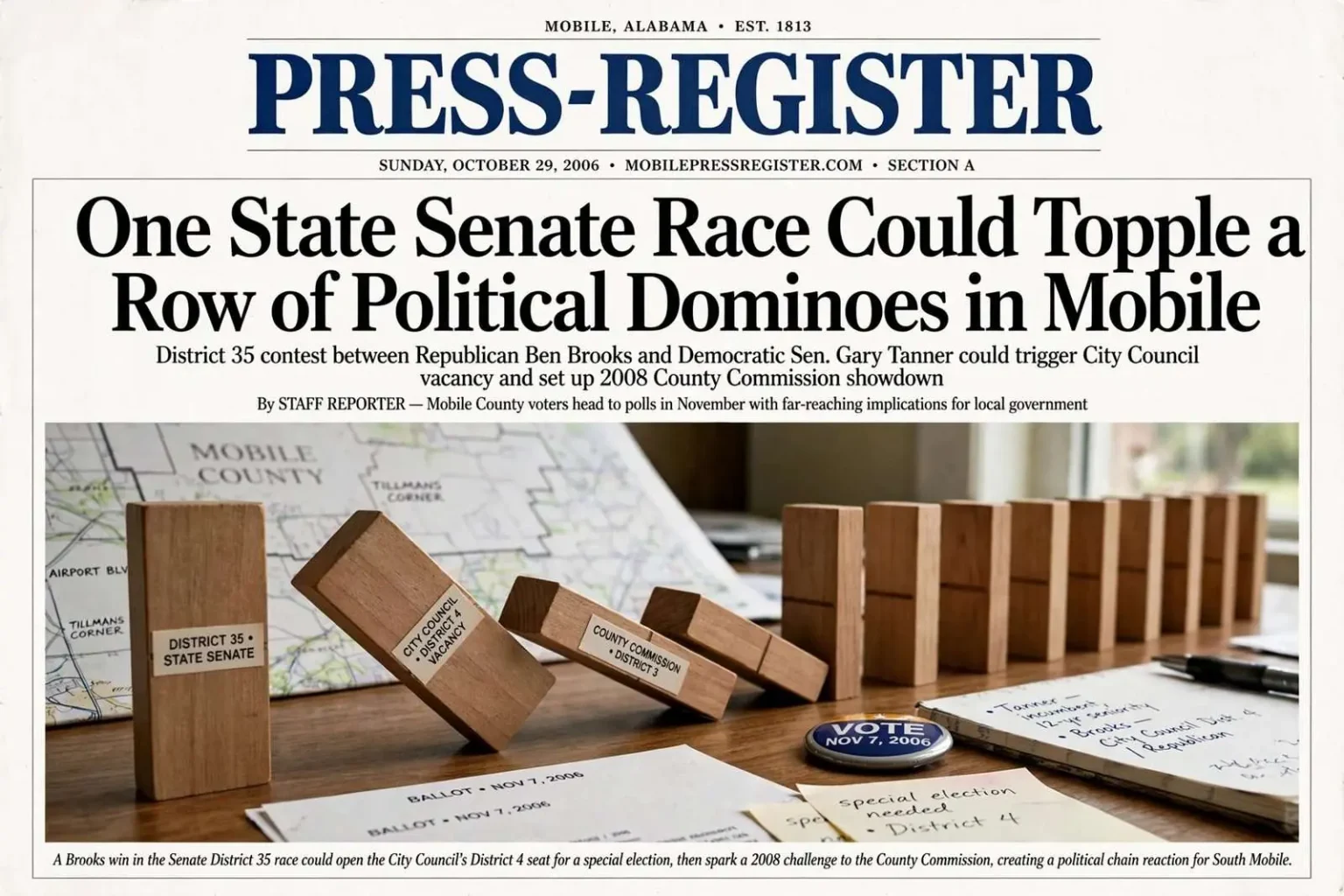
As Mobile County voters prepared to go to the polls in November 2006, one legislative contest carried consequences far beyond the seat actually on the ballot. The outcome of the state Senate District 35 race threatened to set off a chain reaction through the county’s political ranks, reshuffling offices from the council chamber to the county commission and setting up contests years in the future. For the political class of Mobile County, the race was less a single contest than a line of dominoes standing on end.
Republican Ben Brooks, then a member of the Mobile City Council representing District 4, was challenging incumbent Democratic state Sen. Gary Tanner. The matchup pitted a rising councilman with a law practice and a reputation for preparation against a Democratic incumbent whose career in Montgomery had given him seniority and a network of county relationships. The district stretched across a swath of south Mobile County that both parties considered genuinely competitive — the kind of territory where party labels matter less than names, friendships and turnout operations.
The 2006 contest also unfolded against the backdrop of Mobile County’s gradual political realignment. Republican registration had been climbing for a generation, but south Mobile County retained enough Democratic-leaning precincts — along the river, in older subdivisions and among the county’s Black Belt of urban neighborhoods — that a well-funded incumbent could still win there. Tanner’s allies pointed to his seniority and his record of delivering for the district; Brooks’s supporters answered that the county was trending Republican everywhere and that the Senate seat would fall eventually, so it might as well fall to a candidate with a long future.
The immediate stakes were simple enough. If Tanner held the seat, Brooks would return to the City Council and resume representing his district, and Mobile’s political landscape would remain broadly as it was. If Brooks won, matters became considerably more interesting — and considerably more complicated for nearly everyone in the county’s power structure.
The first domino: a council vacancy
Brooks’s departure for Montgomery would leave an opening on the Mobile City Council representing south Mobile, a seat that would have to be filled by special election for the remainder of his term. The timing would have been awkward by design of the calendar rather than anyone’s maneuvering: a councilman elected days earlier to the Senate would be gone from the council before the next municipal cycle, and the district would need representation in the interim.
Two names surfaced immediately in speculation about who might seek it: Mabin Hicks, a former member of the Mobile City Council, and Marilyn Culpepper, director of the Historic Mobile Preservation Society. Hicks brought the familiarity of prior service and the contacts that come with it; Culpepper brought a civic profile built on preservation and neighborhood issues rather than electoral politics. Neither had announced anything — the seat was not yet open — but the early list told observers what a special election would look like: a quick campaign among known quantities, decided by whoever organized fastest.
A council seat in a city the size of Mobile is a genuine prize, and a special election, typically low-turnout and dominated by organized constituencies, is a very different animal from a regular municipal campaign. With a fraction of the electorate participating, neighborhood associations, business interests and church networks punch far above their weight, and the candidate with the deepest roots in a few key precincts often beats the better-known name. That arithmetic shaped the early speculation as much as any candidate’s résumé.
The second domino: the county commission
The chain did not stop at Government Plaza. If Tanner lost his Senate seat, he was widely expected to consider a return in 2008 to the Mobile County Commission District 3 seat then held by Commissioner Mike Dean. Tanner had a history with the commission and the standing to mount a serious bid, and a politician displaced from the Senate at the peak of his career does not usually stay on the sidelines for long.
Tanner had served in the Legislature for years and, before that, had held county office — the kind of resume that travels well in a commission race, where road projects, drainage and the county budget dominate the conversation. Dean, a Republican, had held the seat through the county’s political realignment, and a challenge from a well-known Democratic former officeholder would have been among the most expensive and hard-fought local contests of 2008.
That prospect meant that a Brooks victory in 2006 would not only reshuffle the City Council but would also plant the seed of a contested county commission race two years later, one pitting a displaced state senator against a sitting Republican commissioner. One Senate seat, in other words, connected to at least three offices — and the domino imagery took hold among county politicos precisely because the connections were so direct.
Why these cascades happen
Alabama’s overlapping local offices, staggered terms and reliance on special elections create exactly this kind of political physics. An officeholder who wins a higher seat vacates a lower one; the vacancy draws candidates who may themselves hold other offices; and each move opens a further opportunity for someone waiting on the bench. The system was built piece by piece over a century of constitutional conventions, legislative acts and local custom, and no one designed it for tidiness.
The result is that local politics in Alabama operates like a game of musical chairs in which every seat matters and the music stops at unpredictable moments. State senators hold influence over local road and bridge projects; county commissioners control zoning and infrastructure outside city limits; council members decide annexation, drainage and development inside them. Ambitious officeholders move among the offices as opportunity allows, and each move ripples outward through the networks of supporters, donors and would-be successors that surround every politician.
Political observers in Mobile spent as much energy tracing these possible sequences as they did handicapping the races on the actual ballot, and with reason. A voter in south Mobile casting a ballot in a state Senate contest was, without necessarily knowing it, helping determine who would represent that same neighborhood on the City Council within a matter of months. The connections were not hypothetical; they were the ordinary mechanics of Alabama local government, visible to anyone who had watched the county’s politics for more than an election cycle or two.
The stakes for south Mobile
District 4 covered a substantial slice of south Mobile, and its representation on the council mattered for questions of drainage, zoning, annexation and city services that residents felt directly. The neighborhoods along Airport Boulevard, Cottage Hill Road and the corridors running toward Tillmans Corner had absorbed decades of suburban growth, and the district’s councilman was the first phone call for residents dealing with flooded streets, rezoning fights and the constant friction between development and quality of life.
The prospect that the district’s councilman might depart for Montgomery days after being elected there raised the practical question of who would carry those concerns in the interim. A special election takes weeks to organize and months to resolve; in the gap, a district of tens of thousands of residents would have a caretaker rather than a representative. Business owners and neighborhood leaders tracked that possibility as closely as the race itself.
The Historic Mobile Preservation Society connection in one of the mooted candidacies was itself telling. Preservation politics in Mobile were never merely aesthetic. They ran into development, tax incentives and downtown revitalization at a moment when the city was investing heavily in its historic core, and a candidate emerging from that world would have arrived on the council with a distinctive agenda — one that treated the city’s architectural inheritance as an economic asset rather than an obstacle.
For the candidates themselves, the domino logic cut both ways. Brooks had to weigh the risk of leaving a safe council seat for a Senate race he might lose; Tanner had to consider that winning might only delay a commission challenge he could not avoid. In Alabama local politics, ambition and exposure travel together, and every calculation in the fall of 2006 carried a two-year horizon attached.
A cautionary note
All of this depended on an election that had not yet been held, in a year when the county’s probate judge was warning that turnout would be low. Political speculation of this kind is a durable local pastime, and it is right roughly as often as it is wrong. Candidates who surface in October’s speculation may decline to run in December; incumbents written off in the fall sometimes win going away; and the dominoes that were supposed to fall have a way of standing up.
Still, the exercise illustrated something true about local governance: the ballot in front of a voter is almost never the whole of what that vote decides. A Senate race in District 35 was simultaneously a question about a council seat, a commission race two years downstream and the shape of south Mobile’s representation for a decade. The voters who understood that — and in Mobile County, enough of them always have — were reading the ballot not as a list of names but as a chain of consequences.