Congressional Hopefuls Court Escambia GOP as Young Republicans Head to Mobile
Candidates for the open First District seat courted Escambia County Republicans, a national Young Republicans convention prepared to descend on Mobile, and coastal insurance drew a crowd in Fairhope.
Mid-June 2013 found South Alabama’s Republicans in constant motion, as candidates for an open congressional seat worked the region’s party gatherings, a national youth convention prepared to bring hundreds of visitors to Mobile, and coastal homeowners rallied over the price of insurance.
The activity reflected a moment when the First District’s politics were unusually fluid. U.S. Rep. Jo Bonner’s departure from the seat set off a scramble among ambitious Republicans across south Alabama, and every county committee meeting, fish fry and convention between now and the special election became a stage where candidates could introduce themselves to the activists who turn out in primaries.
The First District field on the trail
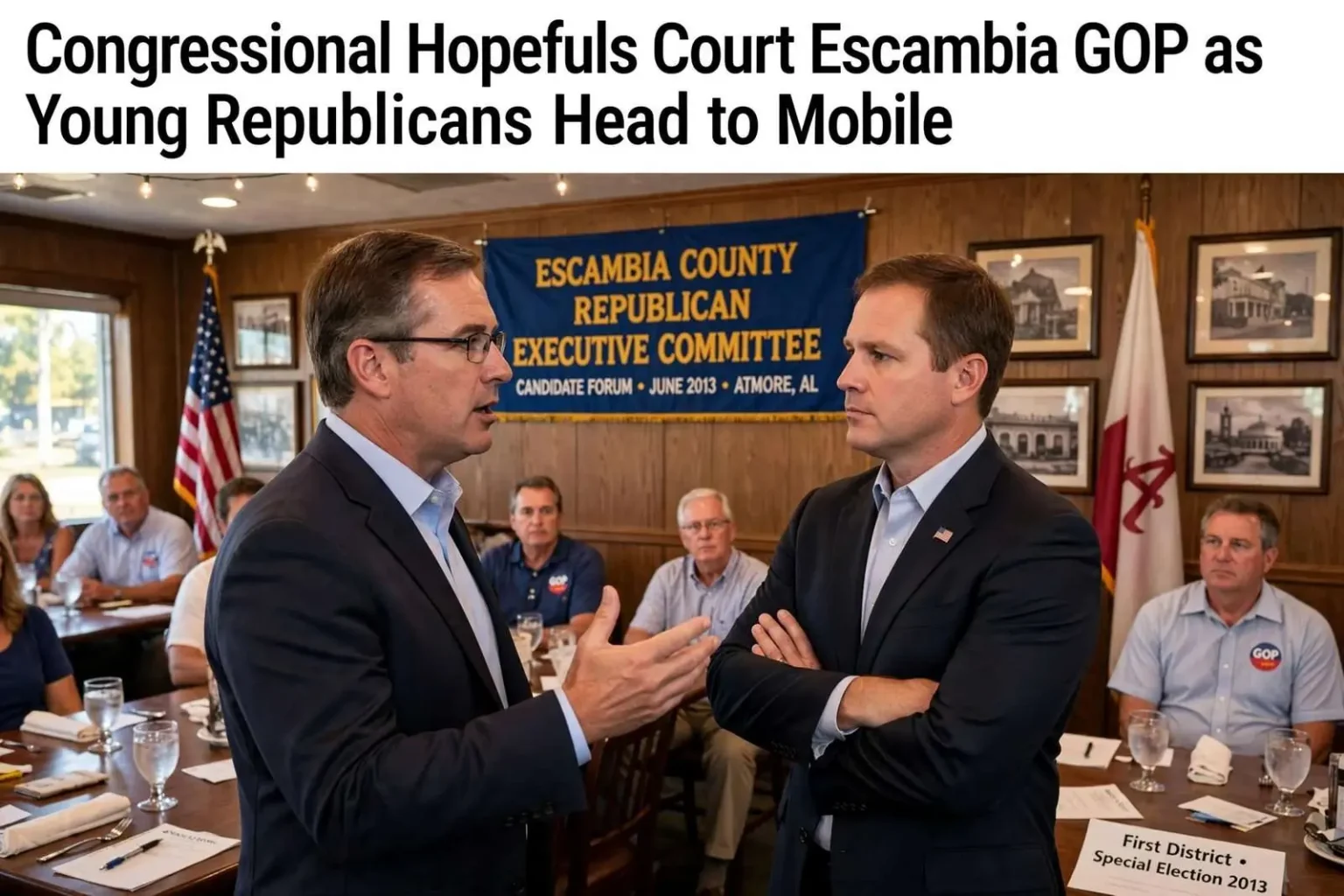
Bradley Byrne and state Rep. Randy Davis, two of the several candidates hoping to succeed U.S. Rep. Jo Bonner as Alabama’s First District congressman, were slated to speak to the Escambia County Republican Executive Committee at a restaurant in Atmore. The appearance was one of many stops as the contenders introduced themselves to Republican audiences across the district ahead of a busy election calendar.
The First District sprawls across southwest Alabama, taking in Mobile and Baldwin counties and a string of rural counties that include Escambia, and its politics carry two distinct flavors. Mobile and Baldwin bring the district’s population and its suburban, business-oriented Republicanism; the rural counties bring smaller gatherings where a candidate’s willingness to show up, eat supper and answer questions face to face matters as much as any television buy.
Byrne, a lawyer and former state senator and community college chancellor, and Davis, a Republican state representative from the Eastern Shore, were among the names most frequently mentioned for the seat, and their joint appearance in Atmore gave Escambia County’s committee members a rare side-by-side look. In county committee settings like that one, the questions tend to be practical — party loyalty, local roads, economic development — and the answers follow candidates home with the activists who will staff their campaigns.
The special election calendar compressed everything. With the seat vacant, the primary and runoff were set to unfold quickly, giving candidates a narrow window to build name recognition across a district that stretches more than a hundred miles from the Florida line to the Mississippi border. Every Escambia, Washington, Clarke and Monroe County appearance counted double in that timeline.
A national convention comes to Mobile
The National Federation of Young Republicans announced it would hold its annual convention in downtown Mobile from July 10 to 14. Daniel Dyas, a vice chairman of the Young Republicans in Alabama, said the gathering was expected to draw about 500 members, whose ages ranged from 18 to 40. The announced speakers included Kentucky Sen. Rand Paul, Louisiana Gov. Bobby Jindal and Alabama Gov. Robert Bentley, giving the convention a decidedly national profile and a welcome economic boost for the host city.
Landing the national convention was a win for Alabama’s Young Republicans and for Mobile’s convention business alike. Several hundred young political operatives filling downtown hotels, restaurants and bars for four nights in July is a modest event by convention-industry standards but a visible one for the city, and it put Mobile in front of a national audience of activists early in their careers.
The speaker lineup reflected the convention’s ambition. Paul and Jindal were both mentioned regularly as potential presidential contenders, and either would have drawn attention on his own; together with Bentley, they gave the Young Republicans a program that looked more like a national cattle call than a state gathering. For local Republicans, the chance to watch three national figures under one roof downtown was an event in itself.
The convention also served the federation’s organizational purpose: charters from across the country send delegates, the group elects its national leadership, and the host state’s federation gets a showcase. Alabama’s chapter, smaller than those in some states, used the week to demonstrate that it could run a national-scale event, with Mobile as the backdrop.
Coastal insurance takes center stage
The persistent grievance of coastal insurance costs drew a large turnout to Fairhope, where Mobile and Baldwin countians packed the barn at Oak Hollow for an event organized by the Homeowners Hurricane Insurance Initiative. The gathering featured a free fish fry and Cajun music alongside a serious message about what the group described as unfair industry practices along the Gulf Coast.
The initiative called for greater transparency and equity in insurance rates statewide and proposed the creation of a 70-mile-deep “coastal re-insurance band” running from Maine to the Texas border. According to the group’s research, homeowners in that band paid an estimated $8 billion in premiums each year, an amount the organization argued far exceeded what the actual storm risk along those miles justified, with the excess effectively subsidizing policyholders elsewhere.
The idea behind the band was to pool the windstorm risk of the entire Atlantic and Gulf coastline into a shared reinsurance mechanism, spreading costs across states rather than concentrating them on Gulf Coast homeowners. Whether such a structure could be enacted was an open question — it would require cooperation across dozens of state insurance regimes and the insurance industry itself — but the proposal gave the movement a concrete demand and a talking point that survived from rally to rally.
The frustration behind the Fairhope turnout had years of history behind it. Hurricanes Ivan and Katrina had hammered the Gulf Coast in the mid-2000s, and in their wake insurers had raised wind premiums sharply, tightened underwriting, and in some cases withdrawn from the coastal market altogether. Homeowners who had never filed a claim watched their premiums double, then double again, while policy cancellations forced them into the state’s insurance pools or onto the shrinking private market.
For Baldwin and Mobile County residents, the issue cut across party lines in a way few others did. The same legislators and county commissioners who heard about roads and schools in campaign season heard about insurance deductibles and non-renewal notices at their town halls, and groups like the Homeowners Hurricane Insurance Initiative turned that frustration into organized pressure on the state’s insurance department and Legislature.
The Oak Hollow barn event showed the organizing formula that coastal groups had settled on: pair the policy message with food, music and community, and draw a crowd big enough that politicians could not help but notice. Speakers connected the premium math to daily life — escrow payments that swallow a retirement budget, homes that cannot be sold because buyers cannot afford the wind policy — and urged attendees to carry the message to elected officials.
What it meant for the summer ahead
For south Alabama Republicans, the mid-June burst of activity was a preview of a summer that would be dominated by the congressional race and its candidates passing through every county gathering the district could offer. The special election would decide who followed Bonner in Washington, but the summer’s events — the Atmore dinner, the Young Republicans convention, the Fairhope rally — did something quieter: they mapped out which issues the district’s activists cared about, and which candidates had shown up to listen.
The insurance question in particular was not going away with the summer. Premiums would keep arriving in the mail, and candidates for the First District seat would keep being asked, from Atmore to Fairhope, what they intended to do about a market that coastal homeowners believed had turned against them.
The Young Republicans and the next generation
The convention’s expected 500 attendees represented more than a hotel booking for Mobile. The Young Republicans have historically functioned as the farm system of party politics — the organization where future legislators, chairmen and campaign managers get their first experience running events, raising money and managing internal elections. A national convention in Mobile put Alabama’s young Republicans at the center of that system for a week, working the floor, hosting delegations and showing visitors the city.
The age range, 18 to 40, spans everyone from college students to established professionals, and the federation’s structure mirrors the party’s: local chapters, state federations and the national body that gathers each summer. For the Alabama federation, hosting meant months of preparation — hotel contracts, security coordination for the visiting officeholders, and a volunteer corps drawn from chapters across the state.
Local Republicans also saw the convention through a political lens. With the First District special election unfolding at the same moment, hundreds of young activists from around the country were arriving in the district’s largest city just as its congressional candidates were courting every available audience. Some convention attendees would return to their home states with impressions of south Alabama’s candidates; more importantly, Alabama’s own young activists got a front-row seat to both the national party’s rising figures and their own district’s contest.
Escambia County’s place in the district
Atmore, the site of the Escambia County committee’s candidate night, sits at the northern edge of the county on the railroad line that helped build it, a town with a manufacturing base and a long history of civic pride. For candidates traveling from Mobile or the Eastern Shore, a stop in Atmore is a commitment — an hour and a half of driving each way to speak to a room of a few dozen activists — and that commitment is precisely the point. County committees notice which candidates make the trip.
Escambia County’s Republicans, like those in neighboring rural counties, weigh candidates on a mix of social conservatism, economic development and simple accessibility. A congressman from the First District represents towns like Atmore, Flomaton and Brewton alongside the suburbs of Mobile, and the county committee’s endorsement conversations begin with the question of who actually understands that. Byrne and Davis’s appearance put them both on record before exactly that audience.
The rhythm of the summer — candidate nights, conventions, rallies — would carry through to the election itself, and the activists filling those rooms would form the backbone of whichever campaign emerged from the field. In south Alabama politics, the road to the nomination runs through supper meetings in county-seat restaurants and fish fries under a barn roof, one county at a time.