On the Eve of a Bruising 2006 Election, Mobile Insiders Place Their Bets
As a hard-fought general election approached, attorneys, lobbyists and officials around Mobile and Baldwin counties handicapped races from governor to the local juvenile bench, and braced for a low turnout.
With one of the most contentious general elections in years bearing down on Alabama, an array of contacts in and around the political arena were asked for their read on how the balloting might break. Their predictions, offered in the final days before voters went to the polls, ranged from confident to weary, and nearly all agreed on one thing: everyone would be glad when the negative advertising finally stopped. The 2006 campaign had been expensive and hard-edged from the primary season onward, and by the final week the airwaves and mailboxes across Mobile County were saturated with attack spots on races large and small.
The survey of insiders was informal, but it captured the mood of a state heading into an election with genuine uncertainty at the top and the bottom of the ticket. What follows is a rundown of what the politicos, attorneys and operatives watching the campaign expected when the polls opened.
The statewide picture
At the top of the ticket, most observers expected Republican Gov. Bob Riley to defeat Democratic challenger Lucy Baxley, with guesses ranging from a comfortable margin to a rout. Riley, seeking a second term after a first highlighted by tax reform fights and, later, a strengthening state budget and hurricane recovery on the Gulf Coast, entered the final stretch with a consistent polling lead. Baxley, the state treasurer and a former state senator, campaigned on competence and personal popularity but struggled to gain traction against an incumbent with a deep war chest.
The lieutenant governor’s contest between Luther Strange and Jim Folsom was widely seen as a coin flip, with several predicting Folsom would edge it and others giving Strange the narrowest of leads. Folsom, a former governor and former state agriculture commissioner from one of Alabama’s most famous Democratic political families, was running to reclaim a statewide office; Strange, a first-time candidate and longtime GOP activist, had poured personal money into the race. Insiders disagreed on who held the edge, which was itself telling about how fluid the race remained.
The attorney general’s race between Republican incumbent Troy King and Mobile County District Attorney John Tyson Jr. split the room. Some insiders gave King a slight edge; a Mobile Democratic attorney felt “pretty certain” Tyson would prevail, especially after a debate earlier in the week. Tyson brought a prosecutor’s résumé and a Mobile County base into a statewide contest, while King, the incumbent, carried the advantages of office and party backing — making the race one of the few statewide contests where Democrats genuinely believed they could score an upset.
The chief justice contest between Drayton Nabers and Sue Bell Cobb was called too close to call by nearly everyone, with polling described as “wildly divergent.” Cobb, a Court of Criminal Appeals judge, was running the most aggressive campaign of any Democrat on the statewide ticket, while Nabers, the appointed incumbent and former finance director, ran on his record leading the court system. Most predicted the remaining Republican Supreme Court candidates would win, and several expected Beth Chapman to defeat Nancy Worley for secretary of state — races that tracked the state’s underlying partisan lean even as the two marquee judicial contests stayed in doubt.
The local battlegrounds
Closer to home, attention centered on two expensive state Senate races and a hotly contested juvenile judgeship. In Senate District 35, city councilman Ben Brooks was challenging Democratic incumbent Gary Tanner, and observers were divided; several noted that consultant Steve Raby had run a strong campaign for Tanner. Raby, one of north Alabama’s most respected Democratic strategists, had been brought in to defend a seat Republicans had targeted, and his presence signaled that Democrats intended to fight for every vote in a district that spanned west Mobile and the Tillman’s Corner area.
In the north Mobile and Baldwin district, John McMillan was pressing incumbent Pat Lindsey in a race most expected to be decided by a point or two. Senate District 22 stretched across rural Washington and Monroe counties as well as parts of Mobile and Baldwin, an awkward, sprawling geography that made both candidates’ travel schedules and name recognition matter as much as any television buy. The district had flipped between the parties before, and few observers were willing to call it confidently on the eve of the vote.
The juvenile court contest between Republican Edmond Naman and Democrat Chip Herrington was repeatedly described as one of the closest on the ballot. One attorney predicted Naman would win but called it “an interesting race to watch,” arguing that if Herrington could not prevail after such an energetic campaign, it would underscore how difficult local Democratic prospects had become. Juvenile judge races rarely draw the money or attention of legislative contests, but in Mobile County that year the seat was genuinely contested, and both campaigns had worked the courthouse and school communities hard.
Bracing for low turnout
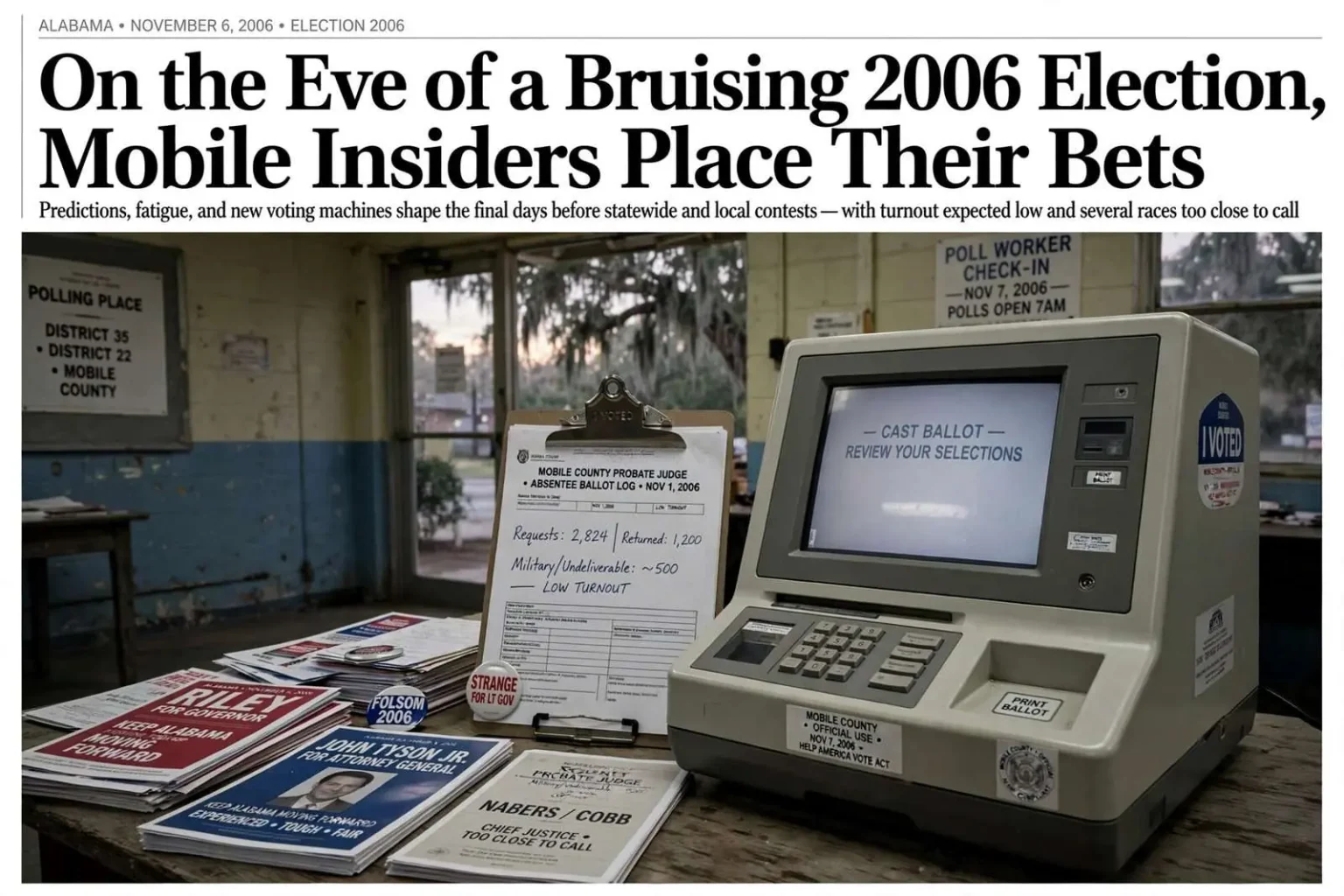
Mobile County Probate Judge Don Davis offered hard numbers rather than predictions. As of the close of business on the Wednesday before the election, his office had received 2,824 requests for absentee ballots, roughly 500 of them tied to active-duty military members or their dependents whose materials had been returned undelivered. About 1,200 absentee ballots had come back. Those figures, Davis said, were “significantly less than expected” and pointed to low turnout. Absentee volume is one of the few measurable indicators available before Election Day, and when it runs below normal, campaigns and election officials alike adjust their expectations downward.
Low turnout cuts in different directions depending on the race. It compresses the advantage of whichever party holds the registration edge, magnifies the power of organized constituencies who vote no matter what, and makes individual precinct-level operations — the church van, the union phone bank, the neighborhood canvass — disproportionately decisive. For the candidates in Mobile’s tightest contests, that meant the final margin might be decided by a few hundred diligent voters rather than the countywide mood.
Several respondents confessed they simply did not know how the down-ballot races would fall. “We are seeing fairly dramatic swings down ballot,” one attorney said. Another, a self-described Poli Sci major, dismissed the value of pre-election polls entirely, comparing them to “heavy parkas in a Mobile winter” and insisting the only survey that mattered was the one taken when the polls closed. The skepticism was widely shared among the insiders surveyed, many of whom had watched polls badly miss the mark in previous Alabama cycles, particularly in judicial races where name recognition and late momentum matter more than party identification.
Adding to the uncertainty were the county’s new voting machines, making their debut on Election Day. Mobile County was transitioning from its old punch-card and paper-ballot systems to electronic tabulation in the wake of the Help America Vote Act, the federal law passed after the 2000 Florida recount that required accessible voting equipment and updated election administration nationwide. New machines mean poll worker training, unfamiliar procedures at the precinct level, and — every campaign’s quiet fear — the possibility that glitches or slow lines at particular precincts shape turnout in ways nobody can predict.
If there was consensus, it was that the outcome would hinge on turnout and mood rather than party loyalty, and that a long night of vote-counting likely awaited the candidates in the tightest contests. With absentee volumes down, new equipment being introduced, and several local races expected to finish within a point, election officials were preparing for precisely the kind of night where counting extends past midnight and margins are measured in dozens of votes.
The mood on the eve of the vote
Beneath the predictions ran a common current of fatigue. The 2006 cycle had featured some of the sharpest television advertising Alabama had seen in years, with statewide campaigns exchanging attacks over records, ethics and personal history through the final weekend. By the last days of the campaign, even the professionals tracking the races were ready for it to end — a sentiment nearly every respondent expressed unprompted.
“Politics not only makes for strange bedfellows,” one Democratic attorney observed, “but strange outcomes as well.” It was as good a summary as any of a campaign season in which the governor’s race looked decided, the lieutenant governor’s and chief justice’s races looked like toss-ups, a Mobile district attorney had a real shot at statewide office, and two state Senate seats and a juvenile judgeship hung on turnout in a handful of precincts.
What the survey captured, in the end, was not a prediction so much as a portrait: an Alabama election at which the statewide outcome felt increasingly foreordained, the local ones did not, and the difference between them would be settled the old-fashioned way — by whoever actually showed up at the polls when they opened on Tuesday.