Brooks Opens Re-Election Bid With Former Rivals Among His Hosts
Mobile City Councilman Ben Brooks launched his District 4 re-election campaign in April 2005 at the Scenic Yacht Basin, with more than 100 honorary hosts including several people who had once run against the seat.
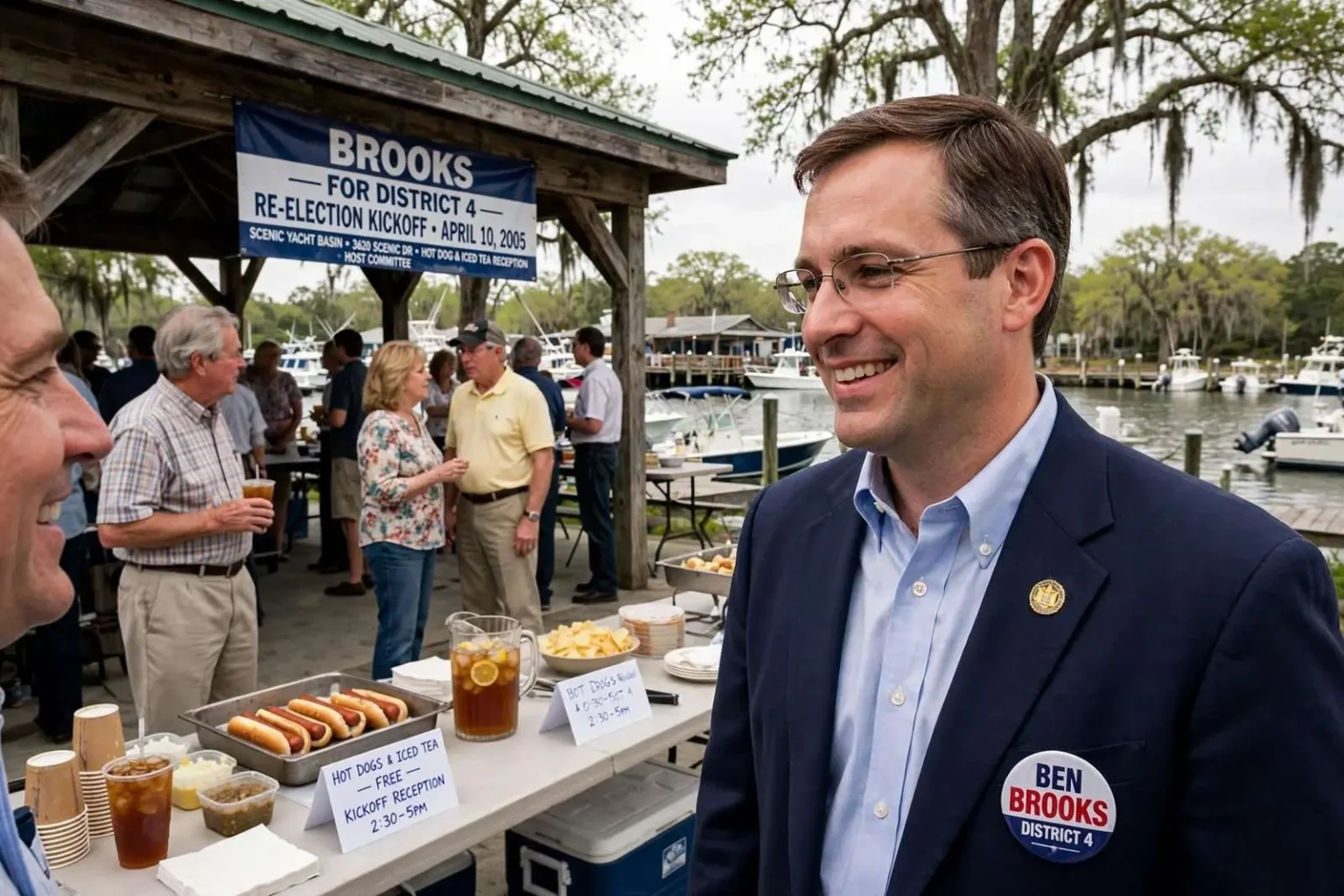
MOBILE — Mobile City Councilman Ben Brooks opened his campaign for a second term in District 4 on Sunday, April 10, 2005, with a hot dog and iced tea reception at the Scenic Yacht Basin — and with a host committee that read less like a campaign roster than a peace treaty.
Among the more than 100 honorary hosts for the kickoff were at least four people who had themselves once sought the District 4 council seat: former City Councilmen Charles Chapman and Mabin Hicks, state Rep. Jim Barton and Ann Deas.
The gesture was the point. In a district that had produced a series of contested council races, Brooks was signaling that the people who had once competed for the job were now content to see him keep it.
Collecting former rivals onto a host list is one of the oldest moves in local campaigning, and it works both ways: for the candidate, it projects an image of a district united behind the incumbent; for the former opponents, it preserves a place in the district’s civic life without the cost of another campaign. A host list with four past challengers on it tells readers both that Brooks faced real competition once and that, four years in, that competition had been reconciled rather than renewed.
The Event
The reception ran from 2:30 to 5 p.m. at the Scenic Yacht Basin, 3620 Scenic Drive, off Dauphin Island Parkway between Clubhouse and Staples roads, not far from B.C. Rain High School — a location squarely in the heart of the district Brooks represented.
The honorary host list stretched across the local political and business establishment. It included Mobile County Commissioners Mike Dean and Stephen Nodine, retired Fire Chief Ed Berger, and a long roll of Mobile business figures, attorneys, physicians and neighborhood volunteers.
Refreshments were, by design, unpretentious. A hot dog and iced tea reception on a Sunday afternoon beside the water is the signature format of Mobile district politics: no dinner tickets, no corporate sponsorships, no dress code. The setting also carried the District 4 identity in it — the yacht basin sits along the waterway corridor that defines the district’s southern half, where bayous, marinas and waterfront neighborhoods run down toward the causeway.
The county commissioners on the list were worth noting on their own. District 4 overlaps the territory of county commission districts whose members control road paving, drainage and park money that flows outside city hall’s budget, and an incumbent councilman who can put both of his county counterparts on the host list is advertising a working relationship across governments — the kind that delivers the unglamorous projects voters actually notice.
A First-Term Record Built on Pavement and Parks
Brooks won the District 4 seat in 2001 and served as chairman of the City Council’s Finance Committee, a post that gave him a hand in the city’s budget decisions. Campaigning for a second term, he pointed to a list of first-term accomplishments concentrated on the unglamorous work that defines a district council seat.
Roads. Roughly $2 million in repaving, including Halls Mill Road, with another $600,000 in county work slated for District 4.
Parks. More than $500,000 in upgrades spread across Trimmier, Newhouse, Skyland, Crestview, Demetropolis, Maitre, Luscher/Navco and Pfc. Howard Johnson II parks, with work at Laun Park still under way.
Tax and budget reform. The repeal of the two percent “out-of-county” tax and the conversion of the city’s collection system from a gross receipts formula to a modern sales tax structure.
Federal block grants. Successful advocacy for District 4’s inclusion in federal block grant funding, which Brooks said delivered repaved roads, improved parks and school enhancements to low- and moderate-income families in the district.
Sidewalks. Planned construction along Dauphin Island Parkway from Clubhouse Road to Boykin Boulevard.
Pay. Raises for municipal employees.
Each item on that list maps directly onto the district’s geography. The repaving money addressed a road network of aging postwar subdivisions and rural-standard streets south of the city’s older core; the park upgrades touched neighborhood playgrounds from Skyland to Navco that had waited years for equipment and lighting; and the sidewalk plan along Dauphin Island Parkway targeted one of the district’s busiest corridors, where pedestrians had long walked along a four-lane road with no safe path. This is the currency of a district seat — visible, local and measurable.
The Finance Committee chairmanship gave the record a second dimension. A councilman who chairs the budget committee speaks with authority on tax policy citywide, and Brooks’s role in the repeal of the out-of-county tax — a levy long criticized as unfair to commuters and residents outside the city who paid it on Mobile purchases — connected his district work to a citywide reform argument he could carry into the campaign.
The Wider Context
The kickoff came as Mobile headed into an unusually consequential municipal election, set for Aug. 23, 2005. Mayor Mike Dow was not seeking a fifth term, and the open mayor’s race — drawing former state Sen. Ann Bedsole, County Commissioner Sam Jones, Councilman John Peavy and former Councilwoman Bess Rich — dominated the city’s political attention that spring.
That contest had a way of overshadowing the council races running alongside it, even though those seven seats would determine how much of any new mayor’s agenda actually got built. An incoming mayor inherits a council as his counterparty, and the members elected in August 2005 would be the ones voting on the budgets, zoning decisions and bond issues of the next four years. For district incumbents, the shadow of a big mayor’s race is double-edged: it depresses attention, but it also pulls occasional voters to the polls who might otherwise skip a council contest.
District 4, running down the Dauphin Island Parkway corridor and south Mobile, had long been a district where the basic municipal services — drainage, paving, parks, police response — carried more weight than any citywide vision statement. The district’s neighborhoods range from waterfront enclaves along the bay and the river delta to working-class subdivisions and rural-flavored stretches near the county line, and the common thread is infrastructure: ditches that flood, streets that need paving, parks that need a fresh set of swings.
Brooks, an attorney, would go on to a longer career in Alabama politics, later serving in the state Senate. But in the spring of 2005 the immediate task was narrower: hold a council seat, in a district he had represented for four years, in front of a crowd of neighbors eating hot dogs beside the water.
Voters in District 4 and across Mobile went to the polls that August. The April kickoff, with its reconciliation host list and its plain-spoken record of pavement and park money, was the opening argument of a campaign built for exactly that audience — and a reminder that in council districts, the ground game of invisible work, not the citywide headline race, decides who holds the seat.
The list of former rivals deserves a closer look, because each name carried its own chapter of District 4 history. Chapman and Hicks were both former councilmen whose tenures predated Brooks’s, meaning the host list reached back across more than a decade of the district’s representation. Barton had moved on to the state House of Representatives, giving the list a legislative presence as well. And Deas was among the district’s most active civic figures. To have all four lending their names to a second-term kickoff was to neutralize, in a single document, the most natural sources of an opposition campaign.
The Aug. 23 election date also framed the calendar. With a kickoff in mid-April, Brooks had more than four months of retail campaigning ahead — neighborhood association meetings, festival appearances, the long slow accumulation of yard signs through a Mobile summer. Campaign finance reports would show whether the early show of unity translated into the money a re-election drive needed, but the venue and the format suggested a campaign that intended to run on its record rather than its fundraising: the same list of road projects, park upgrades and sidewalk plans, presented at church halls and community centers through August.
The open mayor’s race would bring its own drama to District 4 precincts that summer, drawing heavier and more diverse turnout than any municipal election in recent memory, with four well-known candidates competing across the city and each council contest playing out in their shadow. But for the incumbent whose campaign began with hot dogs at a yacht basin, the formula was clear and consistent with the district’s habits: show up with the list of what got done, stand next to the people who once wanted the job, and let the August electorate measure the difference.