Orange Beach Developer Peter Gounares Enters First District Race Again
Orange Beach developer Peter Gounares announced another Republican primary challenge for Alabama’s First Congressional District, pledging a focus on jobs and on resolving lingering damage from the Gulf oil spill.
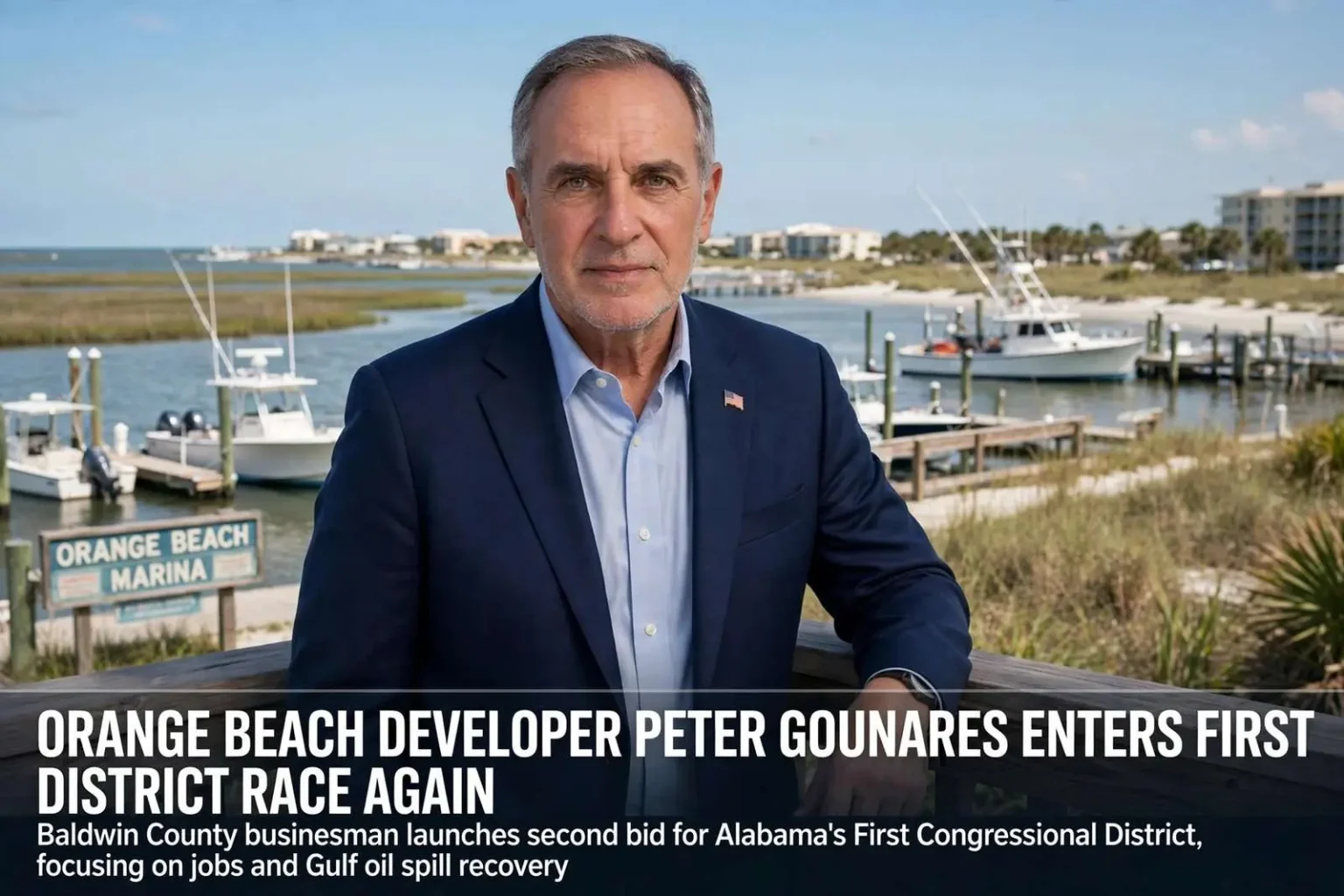
Orange Beach developer Peter Gounares announced that he would once again seek the Republican nomination for Alabama’s First Congressional District, entering a primary field that included several challengers to the incumbent.
The First District seat, covering southwest Alabama from the Mississippi line to the Florida state line, has been held by U.S. Rep. Jo Bonner, a Mobile Republican first elected in 2002. Challenges to established incumbents are rare in Alabama’s congressional delegation, making a contested primary a notable event on the state’s political calendar.
A Familiar Candidate
Gounares had run before, and in launching his renewed bid he leaned on the argument that every congressional seat belongs to the voters anew each election cycle.
“Every two years, each and every seat in the House of Representatives is an open seat regardless of how long it has been held by one person,” he said, framing his candidacy as an invitation for citizens to reassess the direction of the country.
The argument is a standard one for primary challengers — that seniority breeds complacency and that voters should evaluate the officeholder rather than the office. For Gounares, it also recast his earlier defeat not as a loss but as the opening round of a longer argument he intended to keep making.
He cast himself as offering more than partisan talking points.
“It is not enough for a candidate to simply recite party talking points. A leader offers something more,” Gounares said. “Today I am offering a new path.”
The “new path” framing positioned the developer as a candidate of ideas rather than ideology — a pitch aimed at primary voters who might support the incumbent’s party but question the incumbent’s record.
Jobs and the Oil Spill
At the heart of his message were two priorities rooted in the concerns of the coastal district: employment and recovery from the Gulf oil spill.
Gounares promised a focus on “bringing jobs to our district” and on “once and for all resolving the damage done to our district by the oil spill” — an issue that remained raw along the Baldwin County coast, where tourism and fishing had absorbed heavy blows.
The BP Deepwater Horizon spill of 2010 had stained beaches from Dauphin Island to Orange Beach during the height of tourist season, forcing closures, cancellations and a claims process that dragged on for years. For coastal communities whose economies run on summer visitors and seafood, the spill was not a historical event but an open wound — with restoration money, legal claims and ecological recovery all still unsettled when Gounares launched his campaign.
A candidate from Orange Beach, one of the towns hit hardest, spoke to that grievance directly. Promising to push the spill’s unfinished business to resolution connected with residents and business owners who felt Washington had moved on while the coast still measured its losses.
He also struck an ethics note, pledging to ensure that “no elected official will ever again profit from those who have harmed our district while they are supposed to be protecting the citizens they represent.”
The pledge carried an edge. Campaign finance reform groups had been pressing Congress over lawmakers’ ties to industries they regulate, and the BP spill put those questions in sharp relief for Gulf Coast voters — who watched the companies responsible for the disaster spend heavily on lobbying and advertising while claims crawled through the system.
For a challenger, the ethics message does double duty: it draws a contrast with an incumbent’s record of donations and associations, and it gives voters a reason beyond party loyalty to switch sides. Gounares directed voters to his campaign website to learn more about his vision.
A Crowded Primary
Gounares was one of several Republicans lining up to challenge veteran incumbent U.S. Rep. Jo Bonner in the coming primary, a field that also included Pete Riehm and Dean Young.
Riehm, a Mobile-area figure active in conservative politics, and Young, known for his advocacy on social issues, gave the primary a range of challengers rather than a single alternative — a dynamic that generally favors the incumbent, since opposition votes split several ways in the first round of balloting.
Alabama’s primary system requires a majority to avoid a runoff, so a fragmented field can still produce a surprise. Challengers in Bonner’s position have historically needed both money and a message that travels beyond their home base, and Gounares’ business career gave his campaign a self-funding capacity that some primary challengers lack.
The First District stretched across the southwestern corner of the state, taking in Mobile and Baldwin counties and the communities along the coast — Washington, Monroe, Clarke and parts of the Black Belt’s southern edge. Mobile’s port, shipbuilding and aerospace economy and Baldwin’s fast-growing coastal towns give the district two distinct constituencies that candidates must stitch together.
What the Race Meant for the Coast
For Orange Beach and the surrounding Gulf communities, Gounares’ candidacy kept a local name in the mix for the region’s seat in Washington, and his emphasis on the oil spill’s unfinished business spoke directly to residents still measuring the storm’s long economic tail.
Coastal Baldwin County had become the fastest-growing corner of the district, its beach towns and subdivisions swelling with new residents drawn by the same tourism economy the spill had threatened. A candidate from that corner of the district argued, implicitly, that the coast deserved a louder voice in a delegation long anchored in Mobile.
Incumbents respond to primaries by re-engaging with the constituencies challengers target, and Bonner’s position on spill recovery, RESTORE Act funding and coastal restoration became part of the campaign conversation regardless of the outcome.
RESTORE Act dollars — penalties from the spill directed back to the Gulf states — were working through Congress in the same period, and every candidate in the race claimed a stake in making sure Alabama’s share reached the coast rather than disappearing into state budgets.
For voters of the First District, the primary offered a rare contested look at the region’s priorities: jobs, spill accountability and ethics in Washington. Gounares’ second campaign ensured those questions were asked in his hometown’s terms — by a developer whose streets and storefronts sat on the shoreline the spill had stained.
The Developer Behind the Candidacy
Gounares built his career in Orange Beach development, a business that put him at the center of the coastal boom years and gave him a first-hand view of the pressures — insurance, environment, infrastructure and tourism — that shape Baldwin County’s economy. His company’s projects along the beach corridor made his name familiar to locals long before his first campaign.
Developer-candidates bring both assets and liabilities to a race. The assets: practical experience with the permitting, insurance and infrastructure issues that dominate coastal policy, plus the personal wealth to keep a campaign running. The liabilities: opponents questioning whether a developer’s interests align with regulated growth and environmental protection — a tension particularly sharp in a district still recovering from an oil spill.
Gounares’ renewed bid also reflected the realities of challenging an entrenched incumbent. First campaigns build name recognition and donor lists; second campaigns run on what the first one built. His framing of every House seat as an open seat every two years gave the second run its organizing logic.
The Incumbent’s Position
Bonner entered the primary with the traditional advantages of seniority: committee assignments, a established fundraising network and more than a decade of constituent service through his Mobile office. Incumbents in Alabama’s delegation have typically survived primary challenges, and Bonner’s moderate-conservative profile had kept him largely uncontested through successive cycles.
But the political climate of the period favored challengers. Voter frustration with Washington — spending, ethics, the slow recovery of the Gulf — ran through Republican primaries nationally, and local versions of that frustration found expression in crowded fields like this one.
Bonner’s response to the field would shape the race’s tone. Incumbents facing multiple challengers typically run on their record of federal money and projects brought home, a ledger the coast could evaluate against the promises of newcomers offering a new path instead.
The District’s Stake
Whatever the primary’s outcome, the contest put the First District’s core issues on the table in a way uncontested races never do. The district’s economy runs on the Port of Mobile, shipbuilding, aerospace, paper, agriculture and tourism — industries that rise and fall with federal decisions on harbors, defense spending, trade and environmental regulation.
The oil spill’s aftermath touched several of those industries at once, which is why it dominated the candidates’ rhetoric. Tourism revenues on the island and beach communities, seafood landings from Bayou La Batre, and property values along the shore all carried spill-related questions into the campaign.
For residents of Orange Beach, Gulf Shores, Dauphin Island and the working waterfronts of the bay, the primary was a chance to press the district’s next representative — incumbent or challenger — on commitments the coast could hold them to.
Gounares’ announcement ensured those communities had an advocate making the case in his own backyard. Whether voters chose the new path he offered or the incumbent’s record, the campaign made the First District’s race one of the state’s most closely watched contests of the cycle.