Mobile County Judges Say They Have No Power to Erase an Arrest Record
A standing order from Mobile County District Court, reported in March 2005, declared the court had no authority to expunge arrest records and sent petitioners to the Legislature instead.
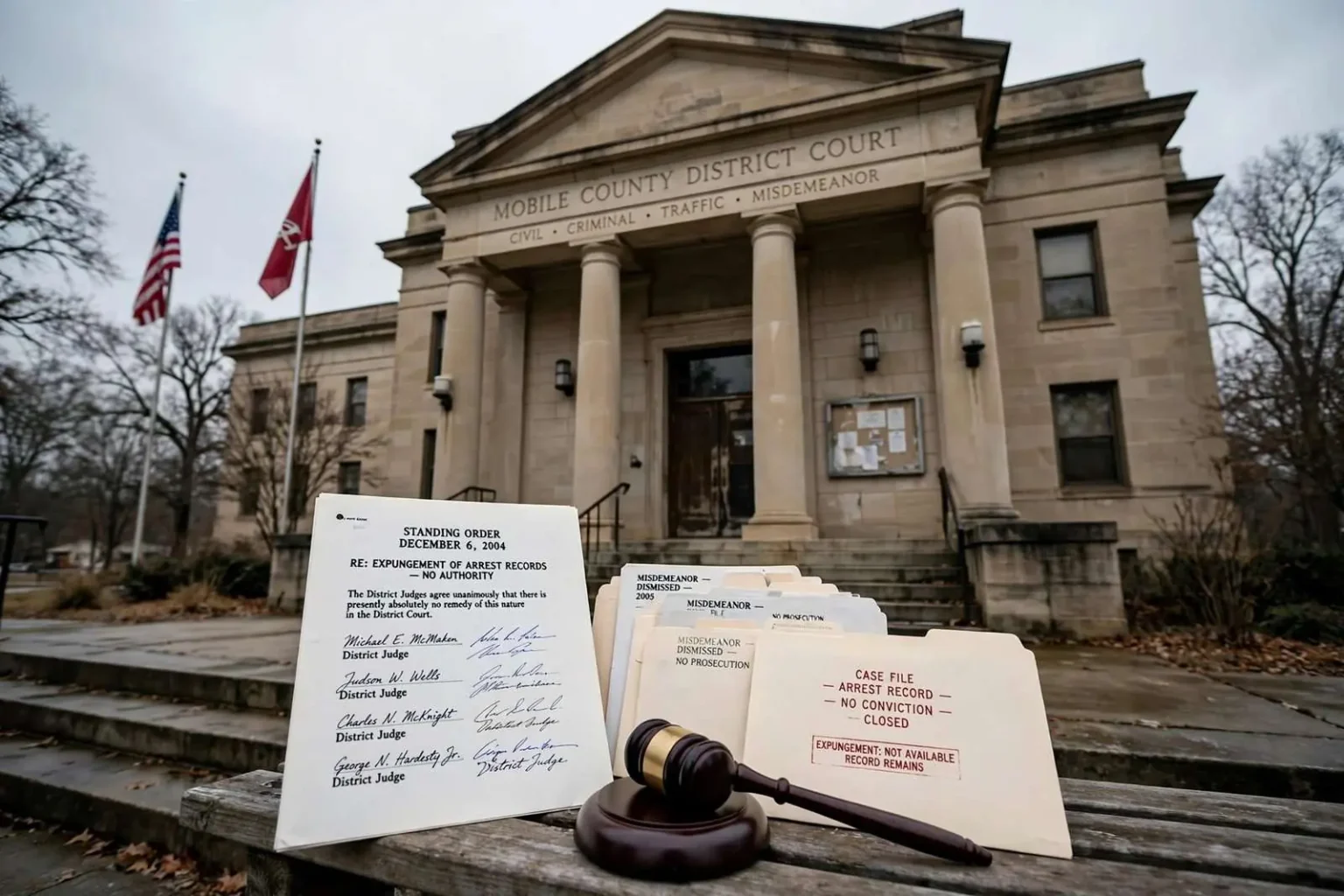
MOBILE — A standing order adopted by the Mobile County District Court and dated Dec. 6, 2004 declared flatly that the court possessed no authority to expunge arrest records in criminal cases — a ruling that came to broader public attention in early March 2005 and that left people cleared of charges with no local remedy for the paper trail left behind. The order was signed by District Judges Michael E. McMaken, Judson W. Wells, Charles N. McKnight and George N. Hardesty Jr. Its central finding was unanimous and unambiguous.
“The District Judges agree unanimously that there is presently absolutely no remedy of this nature in the District Court,” the order read.
The practical consequence was stark for anyone whose encounter with the criminal justice system had ended without a conviction. In Alabama, district courts handle misdemeanors, traffic cases, and preliminary hearings in felony matters — meaning the court where most arrest cases actually play out was declaring itself powerless to erase the record those cases generated. A person arrested in Mobile County, charged, and then released without prosecution had no motion to file and no hearing to request. The arrest record remained searchable, citable and damaging.
Expungement — the legal erasure or sealing of an arrest record — sits at an awkward intersection of criminal law and everyday life. An arrest that never leads to a conviction, or that ends in dismissal or acquittal, nonetheless leaves a record that can surface in background checks by employers, landlords and licensing boards for the rest of a person’s life. In an era when commercial background-check databases compile court records from every county and sell access to anyone with a subscription, an old arrest can follow a person across state lines and decades, affecting hiring for jobs that have nothing to do with the underlying allegation.
The Mobile judges acknowledged that courts around the country had reached different conclusions about whether they could clear such records on their own authority.
“The Court is aware that there exists in this country a considerable split of authority in the various State Courts and in federal courts of the United States on issues related to when, how and where relief … can and cannot be granted,” the order stated.
Some jurisdictions treated expungement as an inherent judicial power — an extension of the court’s authority to manage its own records — while others required an explicit legislative grant before any judge could order one. Alabama fell in the second category, and the Mobile order said so without apology: whatever the equities of an individual case, the court had no statute to apply.
The two hurdles the judges described
Even where such relief was available, the judges noted, a petitioner would ordinarily have to clear two significant hurdles. The first was a final disposition favorable to the petitioner on the criminal charge alleged — in other words, the case had to have ended in the petitioner’s favor. The second was evidence or proof establishing the petitioner’s lack of culpability in the situation from which the charges originally arose — a considerably higher bar than simply not being convicted.
The distinction mattered, and the judges were deliberate in drawing it. A dismissal for lack of evidence, or an acquittal at trial, does not by itself establish innocence. A prosecutor may drop a charge because a witness vanished, because the case was one among many in a crowded docket, or because conviction was unlikely even if guilt was plausible. The judges were signaling that any future expungement scheme would have to grapple with that difference — between a case the state could not prove and a person the state should never have charged.
Having concluded that no remedy existed at the district court level, the order directed anyone seeking relief to pursue the matter through the state Legislature — effectively telling petitioners that their argument was with lawmakers in Montgomery, not with judges in Mobile. The message was procedural rather than hostile, but its effect was to shut the courthouse door and point down the street to the Statehouse.
The judges were careful not to dismiss the underlying grievance. They acknowledged the human cost of a permanent record while flagging the countervailing public interest in preserving criminal history information.
“While defendants may at times need and deserve this relief, the State also has some critical needs which must be addressed by such a statute,” the order stated.
Those “critical needs” are the reason expungement is never treated as routine. Law enforcement agencies rely on arrest histories to identify patterns, build cases and flag repeat offenders. Courts use them in sentencing. Licensing boards, schools and employers performing background checks argue — with some force — that the public has an interest in knowing about prior contacts with the criminal justice system. A statute authorizing erasure has to balance all of that against the reality that a person who was never convicted of anything is not, in the eyes of the law, a criminal.
The 2004 order reflected the legal landscape in Alabama at the time: there was, quite simply, no general expungement statute on the books. Petitions filed in Mobile County had nowhere to go. The court’s response was less a rejection of the idea than an insistence that only the Legislature could create the mechanism. A handful of states had adopted comprehensive expungement or sealing statutes years earlier, and reform advocates regularly cited Alabama’s absence from that list as an economic development and civil liberties problem — a state that punished people indefinitely for allegations that prosecutors themselves had abandoned.
That gap in Alabama law would persist for years after the Mobile judges issued their order, and the question the judges pushed back to Montgomery — when, and on what showing, a citizen should be able to clear an arrest that never resulted in conviction — would remain a live subject of debate in the state’s courts and its Statehouse. Lawmakers introduced expungement bills session after session, and the proposals repeatedly stalled, often over disagreements about which offenses should qualify and how long a petitioner should have to wait before asking.
When the Legislature finally acted, it followed the structure the Mobile judges had sketched. The expungement statute Alabama eventually adopted — codified in the Code of Alabama — limits relief to cases that ended favorably to the defendant, such as charges dismissed, no-billed by a grand jury, or resolved in acquittal, and it excludes convictions from eligibility. Later amendments broadened the classes of cases eligible for relief and shortened some of the waiting periods, moving the state’s framework closer to the reform advocates’ position that non-conviction records should be cleared as a matter of course rather than exception.
The 2004 Mobile order also illustrates how county-level practice can shape statewide policy debates. Because Mobile County’s district judges put their position in writing and signed it collectively, the order became a reference point in later legislative discussions: a documented statement from the state’s second-largest judicial district that expungement could not begin until the Legislature spoke. Judges elsewhere in Alabama faced identical petitions and reached the same conclusion case by case, but Mobile’s standing order made the gap impossible to attribute to one courthouse’s stinginess.
For Mobile County residents in the spring of 2005, the practical effect was straightforward: whatever the merits of an individual case, the district court would not be hearing it. A person cleared of a charge who wanted the arrest off the record had two options — wait for the Legislature, or pursue the kind of individualized court action that Alabama’s case law did not then support. The order closed the second path and documented the first.
Why arrest records outlast the cases behind them
The persistence of non-conviction records is not unique to Alabama, but its consequences are sharpest in states without a sealing mechanism. Background screening companies index court dockets mechanically: an arrest entry appears the same as a conviction entry to a database, and a landlord or human resources department reviewing a report may never see the disposition, let alone understand it. Job applicants routinely discover that a decade-old arrest — one a prosecutor dropped within weeks — is the first thing a potential employer mentions.
The Mobile judges’ order acknowledged that reality implicitly. By conceding that defendants “may at times need and deserve this relief,” the four signatories accepted the premise of the reform argument while maintaining that the fix belonged to the Legislature. It was a modest document with an outsized life: an administrative statement of jurisdictional limits that became, for a period, the clearest public explanation of why Alabama’s arrest records were effectively permanent.
The order also preserved a practical point worth remembering today. Expungement law, where it exists, is not automatic anywhere — even in states with broad statutes, petitioners must file, document their eligibility and sometimes appear in court. What the Legislature can do, and what Alabama’s judges said only the Legislature could do, is create the doorway at all. In 2005 in Mobile County, there was no doorway, and everyone involved in the file knew exactly where the key was kept: in Montgomery.