Fairhope Artist to Complete Trio of Battle of Mobile Bay Paintings at Fort Morgan’s 150th
As Fort Morgan prepared for the 150th anniversary of the Battle of Mobile Bay, Fairhope artist Dean Mosher readied a new portrait of Confederate Admiral Franklin Buchanan to complete a trio begun two decades earlier.
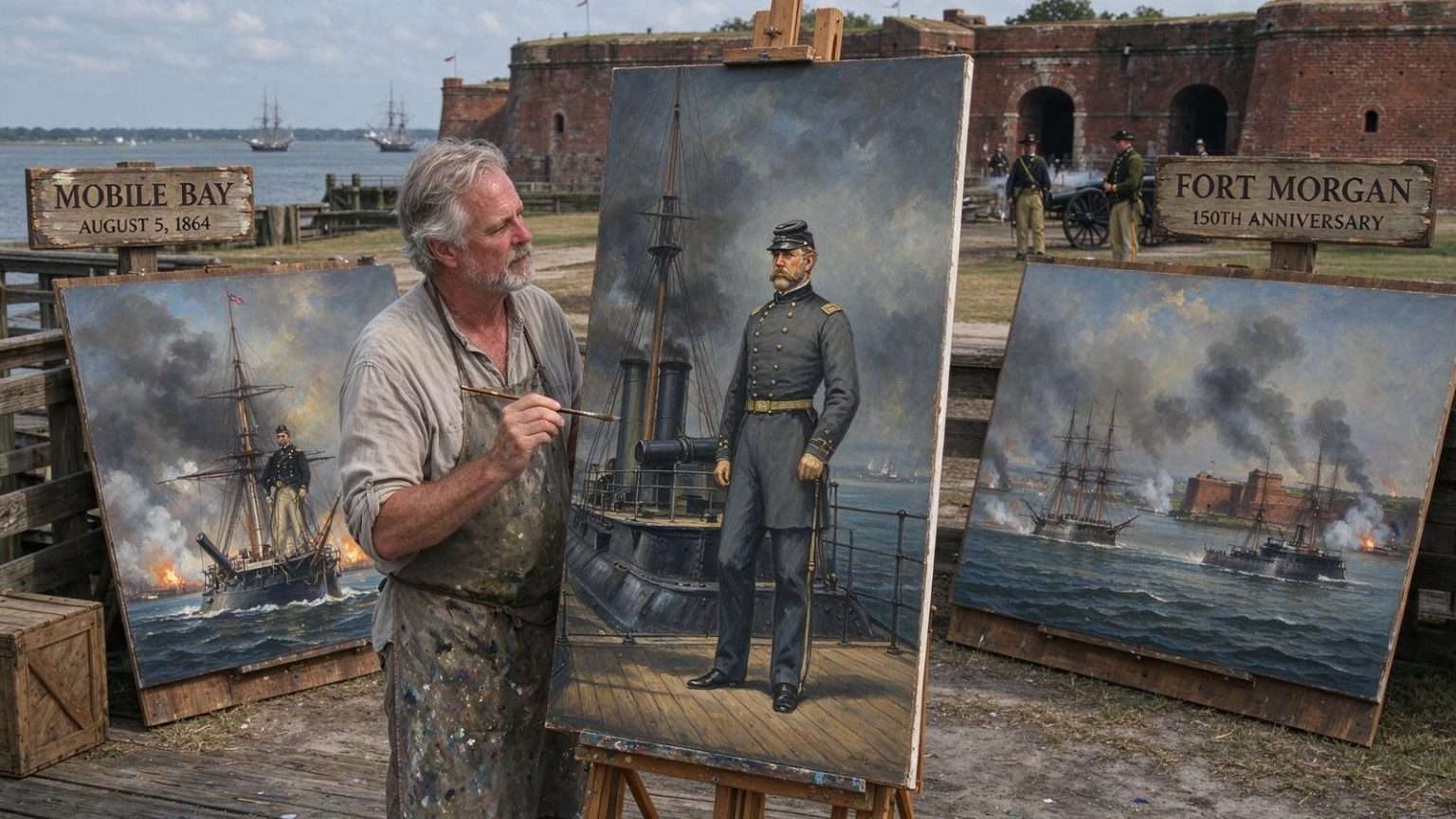
As South Alabama prepared to mark the 150th anniversary of one of the Civil War’s most consequential naval engagements, a Fairhope artist was putting the finishing touches on a work that would bring a pair of paintings begun nearly two decades earlier full circle.
The commemoration of the Battle of Mobile Bay and the Siege of Fort Morgan, organizers said, would not be complete without the involvement of Dean Mosher, the artist who had immortalized the 1864 engagement in two striking oil paintings during the mid-1990s. One depicted the naval battle in all its frightening intensity; the other offered a close-up of U.S. Admiral David Farragut leading his men into the fight.
Almost twenty years on, Mosher planned to unveil a third work on the morning of Saturday, Aug. 2 — a portrait of Confederate Admiral Franklin Buchanan, the adversary whose fleet Farragut had driven into submission at the mouth of Mobile Bay. With it, the artist would have completed a trio that captures the battle from both sides of the line.
“Buchanan represents the gallantry of the South,” Mosher said of his newest subject, whose ironclad CSS Tennessee had faced Farragut’s fleet at the mouth of Mobile Bay.
The unveiling was timed to coincide with a week of activity at Fort Morgan, which was being transformed in honor of the anniversary. Civil War reenactors from across the country were expected to flock to the peninsula to recreate the siege and naval battle across Aug. 1, 2 and 3, filling the old star fort with the sights and sounds of the summer of 1864.
Mosher, though not a reenactor himself, said he welcomed the outpouring of interest.
“I encourage anybody who wants to participate in remembering history, at any level — it is a great thing,” he said. “I’m delighted so many people want to come down to Fort Morgan to celebrate that and take part in that.”
Chosen for His Research
The Alabama Historical Commission approached Mosher about the piece in part because of his exacting research methods, according to Dr. Stephen McNair, the commission’s state director of historic sites.
“Upon first reviewing Dean’s work, the attention to detail and the historical accuracy is the first thing that I noticed,” McNair said.
That reputation did not arrive by accident. Mosher’s method is to build each canvas from the ground up — ship plans, period photographs, weather records, tide tables — so that the rigging on a man-of-war or the angle of morning light across the bay is the one the participants actually saw. For a battle as heavily documented as Mobile Bay, the research burden is enormous, and it is precisely what made him the obvious choice when the commission began planning the sesquicentennial.
The mid-1990s paintings established his standing as the battle’s painter. The first put the viewer amid the naval fight itself, the smoke and shattered timbers of the engagement rendered at close range; the second narrowed the field to Farragut himself, lashed into his rigging, leading his men into the fight. What the pair lacked was the other admiral — the Southern commander whose defiance and eventual surrender completed the story.
Buchanan supplies that missing figure. A Marylander who had resigned his U.S. Navy commission to serve the Confederacy, he commanded the defenses of Mobile Bay and chose to fight his ironclad against an overwhelming Union fleet. Wounded in the action, he was taken prisoner after the Tennessee was forced to strike her colors. To Mosher, the portrait was an act of balance as much as of history: the gallantry of the South had its place in the story alongside Farragut’s audacity.
Why the Battle Still Resonates
The engagement the paintings commemorate remains one of the most celebrated naval actions in American history. On the morning of Aug. 5, 1864, Farragut’s fleet of wooden ships and ironclad monitors steamed past the guns of Fort Morgan, threading the minefield — the “torpedoes” of his famous order — into Mobile Bay. By afternoon the Confederate squadron had been destroyed or captured, the port was closed, and the Union had gained one of its most important victories of the war.
For Mobile, the consequences were profound. The city had served throughout the war as one of the Confederacy’s last working ports, a channel through which blockade runners kept a trickle of supplies moving to the interior. Farragut’s victory shut that channel down, tightening an economic noose that would not loosen until the war ended the following spring.
Fort Morgan itself is the fixed star of the story. Built between 1819 and 1834 on the tip of the peninsula at the bay’s mouth, the masonry star fort was named for Revolutionary War hero Daniel Morgan and designed to stand guard over the main ship channel, working in concert with Fort Gaines across the water on Dauphin Island. In 1864 its guns and the torpedoes moored in the channel were the obstacle Farragut had to run, and its eventual siege — the fort surrendered late in August after days of bombardment — gave the commemoration its second half.
The sesquicentennial reenactment was designed to walk visitors through both phases. Across Aug. 1, 2 and 3, reenactors from across the country were expected to recreate the siege and the naval battle on the peninsula, transforming the fort into a living encampment of infantry, artillery and naval detachments. For the Alabama Historical Commission, which operates Fort Morgan as a state historic site, the anniversary week was the largest event on its calendar and an opportunity to connect a new generation of visitors with the ground where the action actually happened.
Events of that scale reach well beyond the fort itself. Reenactors and their families book rooms and campgrounds along the Eastern Shore and the Gulf beaches; visitors heading out to the peninsula pass through Fairhope, Daphne and Spanish Fort and down the causeway, spending the weekend in communities that trace their own histories to the bay’s steamboat and shipbuilding era. A sesquicentennial, organizers have long understood, is as much an economic and civic occasion as a historical one.
An Artist’s Long Engagement
Mosher’s own connection to the story runs through Fairhope, the Eastern Shore town with a long identity as an artists’ colony. His studio work there has ranged across maritime and historical subjects, but the Battle of Mobile Bay has been a career-defining thread, the two 1990s canvases among his most recognized works. The third painting, born of the same research discipline, closes a circle nearly twenty years in the making: two fleets, two admirals, one morning in August 1864.
The timing carried its own poetry. Mosher’s first two paintings had been completed in the mid-1990s, when the battle’s 130th anniversary passed with far less fanfare, and the artist had spent the years since on other subjects while the canvases traveled through exhibitions and reproductions. Bringing the third work forward exactly 150 years after the fleets met meant the trio would always be tied to the sesquicentennial — the moment when the largest crowds in the fort’s modern history stood on the ramparts where Buchanan’s gunners had stood.
The unveiling on the morning of Aug. 2 placed the new portrait before the public during the height of the anniversary week, when the fort would be at its busiest and the reenactment at full tilt. For Mosher, the setting suited the subject. He has often said that history remembered at any level is a great thing, and the crowd gathering at Fort Morgan that week — reenactors, historians, families, school groups — was the fullest possible expression of that conviction.
The pairing of the works also says something about how the region has come to remember the battle. A generation ago, the story was told largely through Farragut’s order and the Union victory; the sesquicentennial framing gave equal weight to the defenders, to Buchanan and the Tennessee and the garrison at Fort Morgan, whose resistance against a superior fleet became part of the Gulf Coast’s shared inheritance. On canvas, that balance is literal: the Farragut close-up and the Buchanan portrait now face the same battle from opposite bridges.
For the Alabama Historical Commission, the commission of the third painting was a deliberate capstone — a way to mark 150 years with a work of art built to last as long as the fort itself. McNair’s first impression of Mosher’s work, the attention to detail and historical accuracy, was precisely the standard the project demanded. The battle at the mouth of Mobile Bay has been painted many times; it has rarely been painted by an artist who checked the tide tables first.
As the anniversary week opened, the pieces were in place: the fort garrisoned once more by reenactors, the Eastern Shore braced for visitors, and a Fairhope artist preparing to show, at last, the face of the admiral who fought Farragut to a standstill at the mouth of the bay.