Prichard’s District 2 Council Candidates Debate Water Board Takeover, Jobs and Schools at Forum
Four candidates for Prichard's District 2 City Council seat gathered at St. James AME Church to debate the water board takeover, economic development and the push for a middle school.
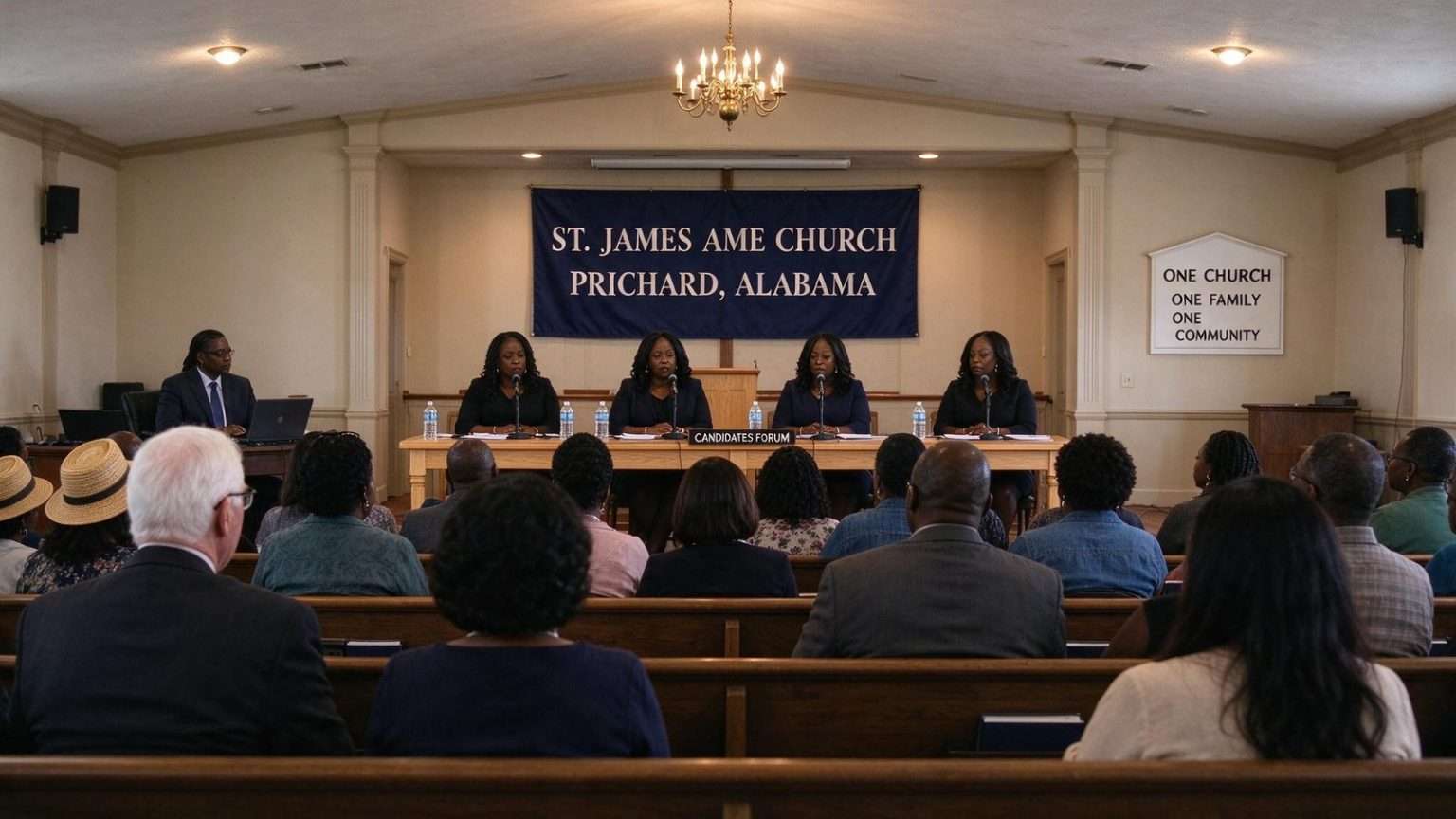
Four of the six candidates competing for Prichard’s District 2 City Council seat squared off at a candidates forum held at St. James AME Church, laying out their positions on the issues that had come to define the race. The two-hour session covered the city’s most persistent wound — the future of its water system — along with economic development, schools, and public safety, and it gave residents of the district one of their few chances to question the field directly before the special election.
The seat was open after Earline Martin-Harris abruptly resigned amid legal questions about her residency. Martin-Harris had faced a challenge alleging that she actually lived in Daphne rather than Prichard and therefore could not serve on the City Council. The allegation struck at the most basic qualification for municipal office — living in the city you represent — and her departure left District 2 without a sitting voice on the council while the special election machinery moved forward.
The contest carried weight beyond a single council seat. Prichard, the second-largest city in Mobile County, has spent decades contending with shrinking population, an eroding tax base, and well-documented fiscal distress, and its council members govern with far thinner resources than their counterparts in Mobile or Baldwin County. Whoever won District 2 would inherit those constraints along with the expectations of a neighborhood-level constituency that had just watched its representation implode.
Who took part
Participating in the two-hour forum were Severia Campbell-Morris, president of the United Concerned Citizens of Prichard; Gwen Williams, a city retiree and longtime public library official; Sheila Poole, a self-employed real estate investor and office manager; and Paula Blevins, a state constable with experience in school counseling. The four represented distinct résumés: a civic activist, a career city employee, a businesswoman, and a law enforcement officer, each proposing a different route to the same set of problems.
The forum’s setting mattered as well. St. James AME Church is one of the district’s anchor institutions, the kind of sanctuary congregation that has historically doubled as a civic hall in Prichard, and the audience that filled its pews skewed toward the voters who actually decide special elections: longtime residents, church members, and neighborhood association regulars with long memories and direct questions. Candidates who could not connect in that room were unlikely to find a friendlier venue before election day.
Two candidates, Carlton Wallace and Tommy James Bendolph, did not attend. Supporters of Wallace, a local barber, circulated fliers on cars outside while the forum went on inside the church — a reminder that even absent candidates had voices in the race, and that the audience understood the field was larger than the head table. The no-shows drew no direct comment from the stage, but the empty chairs spoke to voters about who had chosen to face them.
The water board takeover
Much of the discussion centered on the future of the Prichard Water Works & Sewer Board, an independent utility whose rates and management had become a running grievance in a city where monthly water bills routinely rank among residents’ loudest complaints. The board’s troubled history — years of administrative turnover and billing disputes — had made its governance a live political issue, and the forum’s sharpest exchanges traced to the question of whether the city should fight to keep it or give it away.
Campbell-Morris, a leading advocate for dissolving the board, said the “will of the people” had already been expressed when voters approved dissolution and a takeover by the Mobile Area Water and Sewer System, or MAWSS. In her telling, the referendum had settled the debate, and the council’s job was to carry out the verdict rather than relitigate it. “People are not coming to the city of Prichard because of the water bills,” she said. “Businesses are not coming and people are leaving the city of Prichard because of the high water bills.”
Others were more cautious. Blevins said many questions remained unanswered, including whether the change might ultimately cost residents more, and argued that a decision of that magnitude deserved fuller answers before the city committed. Poole said she respected the referendum’s outcome but worried about replacing lost revenue — a pragmatic concern for a city with few income streams to spare. Williams objected outright to handing over what she called a $50 million asset. “What do we gain? Nothing,” she said, framing the takeover as the surrender of one of the city’s few remaining sources of leverage.
The exchange laid bare the strategic dilemma: the water system was simultaneously a service residents felt gouged by, an asset the city theoretically owned, and a revenue stream the city could not easily replace. None of the four candidates disputed that the bills were a problem; they disagreed violently about whether MAWSS was the cure.
Jobs, land and schools
None of the candidates supported a tax increase, though Williams said residents should have a say if sales taxes were ever to rise. The consensus reflected the city’s fiscal reality: Prichard’s taxpayers had weathered years of strained budgets, and no candidate at St. James AME was willing to campaign on taking more from them.
On economic development, Blevins pointed to recent additions such as a Love’s Truck Stop & Country Store and urged a focus on the Alabama Village and Whistler areas — the district’s older neighborhoods along its northern edges, where commercial activity had thinned and reinvestment had lagged. District 2, candidates noted, had about 100 acres of unused land that some believed could be put to productive use, an inventory that represented both an opportunity and a measure of how much empty ground the district carried.
Campbell-Morris urged leaders to stay current on grants and state programs, suggesting the city use a land bank and the Alabama Trust Fund to clean up abandoned housing. Her pitch was technocratic: Prichard’s problem was less a shortage of programs than a habit of missing the application deadlines, matching funds, and compliance requirements that came with them.
Poole called for enhancing historic districts and floated the idea of an extended-stay hotel, while also proposing re-entry programs for former offenders — pairing a tourism-adjacent economic argument with a social services agenda rarely heard in a council forum. Her varied portfolio mirrored a background spent assembling real estate deals rather than debating policy resolutions.
Education drew strong feelings as well. Several candidates wanted a middle school in Prichard, noting that middle-school students were often bused to schools in nearby cities such as Satsuma — a daily exile of the city’s adolescent students into other systems’ classrooms. “We can fight to get a middle school right here in our city,” Blevins said, turning the issue into a rallying cry that cut across the field’s otherwise distinct platforms.
Policing and Airbus
The candidates were also asked about Mike Rowland, the city’s new interim police chief, who had stepped in after the previous chief left for a post on the East Coast. None offered a full endorsement, with several saying they wanted to know more about him first — a measured stance for a council that would eventually be asked to confirm the appointment permanently. “I would not vote for this person without a thorough investigation,” Campbell-Morris said, drawing the sharpest line of the group and signaling that the police department’s leadership would face real scrutiny rather than a rubber stamp.
Looking outward, some candidates argued Prichard should be doing more to attract Airbus-related suppliers, with the aircraft maker then building a $600 million final assembly plant in Mobile expected to be fully operational by 2016. The project was already reshaping the regional economy, drawing an ecosystem of aerospace vendors into the Mobile area and promising thousands of jobs, and candidates across the field saw Prichard’s proximity as an unexploited advantage. Williams questioned why Prichard had not pursued such opportunities more aggressively. “I want a seat for Prichard at that table,” she said.
The forum closed with no endorsements and no dramatic conversions, but with a clearer map of the field. Campbell-Morris offered activism and the momentum of the water referendum; Williams offered institutional memory and skepticism of giving away city assets; Poole offered deal-making and social programs; Blevins offered public safety experience and a focus on the district’s overlooked neighborhoods.
What united them was a diagnosis almost nobody in Prichard would dispute: a city where high water bills push people out, empty land sits unproductive, adolescents ride buses to other cities’ schools, and the biggest economic story on the Gulf Coast is happening just down the road without them. The special election would decide which of the six — the four on the stage, the barber whose supporters worked the parking lot, or the sixth candidate absent from both — would get the chance to do something about it.