The Village of Spring Hill Extends Old Shell Road’s Walkways With a New Five-Block Stretch
A neighborhood nonprofit began building five blocks of new sidewalk along Old Shell Road in Mobile's Spring Hill, extending a years-long effort to make the area more walkable.
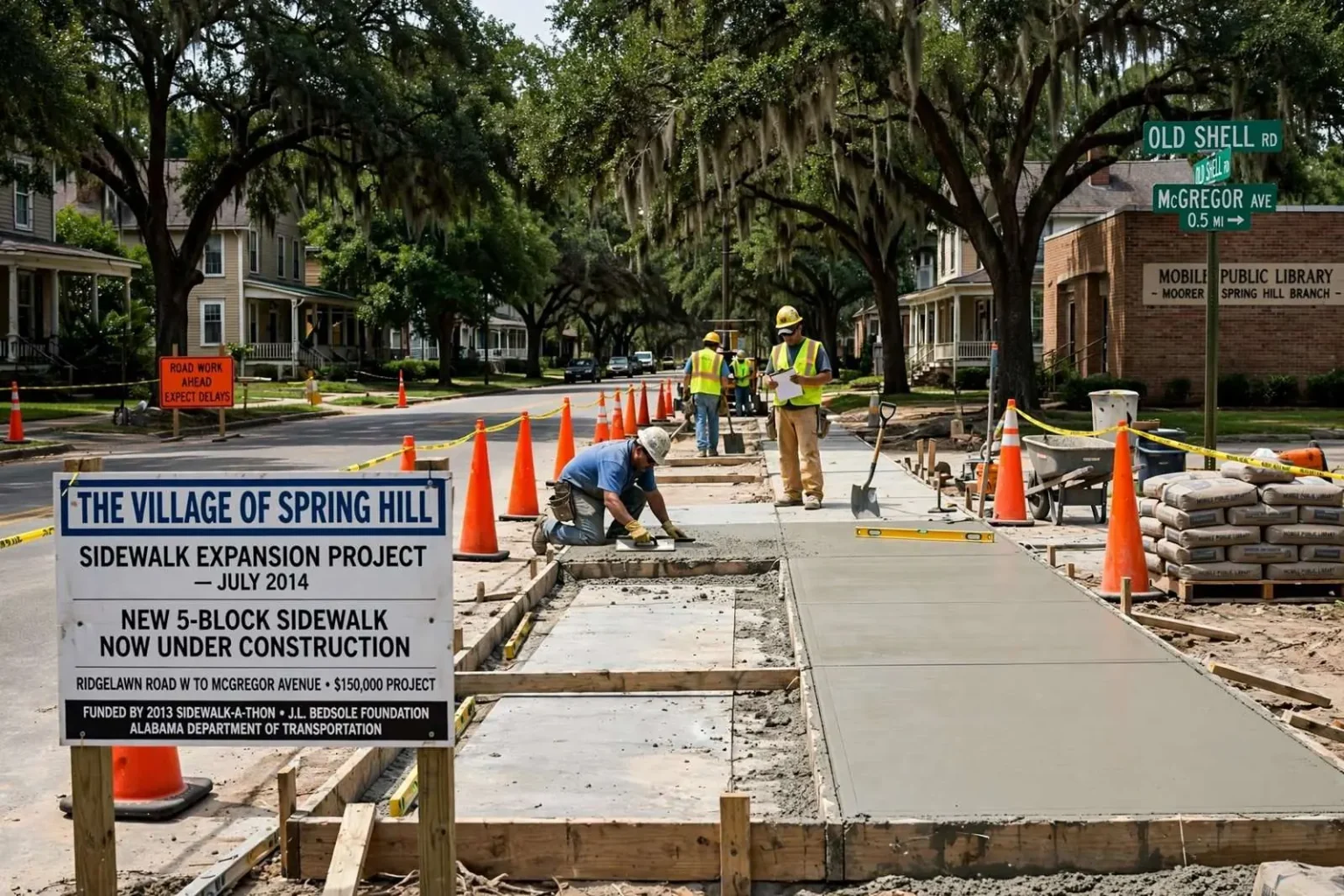
A new stretch of sidewalk was taking shape along Old Shell Road in the summer of 2014, courtesy of The Village of Spring Hill, the neighborhood nonprofit that had spent years steadily widening the area’s network of walkways. For the residents and pedestrians of one of Mobile’s most storied neighborhoods, the construction crews and orange cones of July marked another tangible step in a long-running campaign to make the community’s main corridor a place built for people on foot as well as in cars.
Construction began on July 1 on five blocks of walkway running from Ridgelawn Road West to McGregor Avenue. The $150,000 project was paid for with money raised during the group’s 2013 Sidewalk-a-thon, combined with grants from the J.L. Bedsole Foundation and the Alabama Department of Transportation, according to Linda St. John, director of The Village of Spring Hill.
Turning fundraising into pavement
The Village of Spring Hill, a neighborhood nonprofit dedicated to improving the livability of the area, used the 2013 fundraising to apply for the transportation grant, which required a 20 percent local match, St. John said. The structure is a familiar one in community infrastructure work: state and federal transportation dollars are available for pedestrian improvements, but only to applicants who can put up a share of the cost, and the matching requirement is precisely where small neighborhood organizations usually stumble. By devoting its Sidewalk-a-thon proceeds to the match, the group converted a local fundraising event into the leverage that unlocked the larger grant.
The model has become a template for how civic groups across Mobile and the rest of Alabama stretch private giving. A Bedsole Foundation grant or a state transportation allocation goes farthest when it lands on top of demonstrated community commitment, and a nonprofit that can show neighborhood donations already in hand stands a far better chance of winning competitive awards. The five blocks of new walkway represented exactly that layering — neighborhood money, foundation money and state money converging on a single half-mile of Old Shell Road.
The sidewalk was expected to be finished within two to three weeks. “We’re really excited they’re going all the way to McGregor Avenue,” St. John said. McGregor Avenue, one of the neighborhood’s principal north-south arteries, serves as a natural terminus and connecting point for pedestrians, and reaching it meant the east-west walkway network along Old Shell Road now met the intersections where residents actually cross and gather.
The effort had been under way for roughly eight years. In that time, more than 63,360 square feet of sidewalks had been installed along Old Shell Road, gradually transforming a busy corridor into a more inviting place to walk. The figure, accumulated block by block and project by project, is the most concrete measure of the organization’s persistence: an acre and a half of poured concrete, each section financed and scheduled separately, each one extending the reach of the last.
Why sidewalks matter in Spring Hill
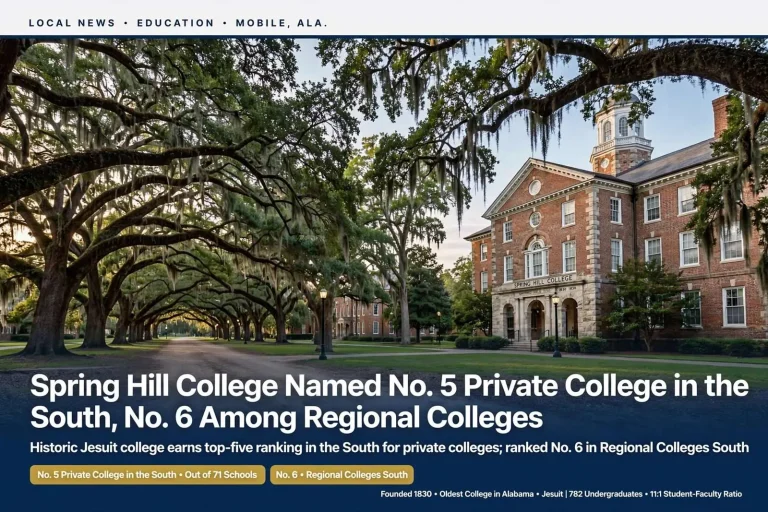
Old Shell Road carries a daily mix of commuters, students and delivery traffic through the heart of Spring Hill, the leafy neighborhood that climbs the hills west of Mobile’s midtown. The corridor is home to churches, schools, shops and the branch library, and it sits between two institutions that generate constant pedestrian traffic: Spring Hill College, the Jesuit school founded in 1830 whose campus anchors the neighborhood’s historic core, and the University of South Alabama just to the north. Residents walking to services, students crossing between campuses and bus stops, and families out for exercise all share a road whose design long predates modern ideas about pedestrian infrastructure.
Before the walkway campaign began, stretches of Old Shell Road forced pedestrians into grass shoulders or the roadway itself — a hazard in a corridor where traffic moves quickly and sight lines are interrupted by curves and driveways. Every block of new sidewalk changes that calculation. For an elderly resident walking to a physician’s office, a student walking to a bus stop, or a parent pushing a stroller, a continuous concrete path is the difference between a safe trip and a gamble.
The benefits compound across the neighborhood. Walkability studies across the country have linked connected sidewalk networks to higher property values, stronger small-business foot traffic and better public health, and Spring Hill’s real estate market — among Mobile’s most desirable — benefits from every improvement that makes the neighborhood more navigable without a car. The sidewalk program also serves the neighborhood’s older population, many of whom settled in Spring Hill decades ago and now depend on being able to reach services nearby.
Part of a larger vision
The new construction was one piece of a broader master plan to improve the neighborhood’s walkability and visual appeal. Over the years, The Village of Spring Hill had taken on a series of projects aimed at making the area both more functional and more attractive:
Planting trees throughout the neighborhood, adding canopy to streets where age and storms had thinned the old oaks and magnolias that give the area its character. Funding the giant chess set in front of the Moorer/Spring Hill branch of the Mobile Public Library, an amenity that turned the library’s front lawn into a destination and a gathering point. Working with the city of Mobile and the library in the fall of 2012 on improvements at the front of the Moorer/Spring Hill branch. Partnering with Regions Bank in 2011 on work at the corner of the Spring Hill branch’s property.
Together, those projects reflected a philosophy that small, tangible improvements — a length of walkway, a row of new trees, a public chessboard — accumulate into something larger: a neighborhood identity and a standard of care that residents can see and visitors can feel. None of the individual projects was dramatic on its own. Together they amount to a sustained reinvestment in a public realm that cities across the South spent half a century neglecting.
The choice to concentrate on the library corridor was deliberate. The Moorer/Spring Hill branch serves as an informal town square for the neighborhood — a place where children’s programs, computer access and community meetings draw people every day — and improvements to its grounds and approaches multiply the value of the branch itself. The 2011 corner project with Regions Bank and the 2012 front-of-branch work with the city and library system treated the library block as the anchor of the pedestrian network, with sidewalk extensions like the current one radiating outward along Old Shell Road.
The Sidewalk-a-thon model
The 2013 Sidewalk-a-thon deserves its own account, because it illustrates the fundraising culture that makes the rest possible. Rather than a gala or a conventional appeal, the event turned the organization’s mission into its method — participants walking the very corridor the money would improve, neighbors sponsoring miles the way runners’ charities sponsor laps. The event produced both dollars and visibility, and the visibility mattered as much: every grant application The Village of Spring Hill submitted was stronger for the demonstration of broad local support that the Sidewalk-a-thon represented.
How the grants fit together
The financing of the Ridgelawn-to-McGregor project — local fundraising, a foundation grant and a state transportation grant with a 20 percent local match — is a case study in how neighborhood infrastructure actually gets built in Alabama. The Alabama Department of Transportation administers federal transportation enhancement and similar programs that fund sidewalks, landscaping and pedestrian amenities, projects that cities and nonprofits often overlook because the application and match requirements seem daunting. The J.L. Bedsole Foundation, a Mobile-area philanthropy with a long record of supporting education, health and community development projects across the Gulf Coast, provided the kind of institutional backing that validates a nonprofit’s credibility with public agencies.
That three-way structure also spreads risk and builds durable relationships. The state agency sees a community partner that delivers; the foundation sees its dollars matched and multiplied; the neighborhood sees its own donations turned into permanent infrastructure it can point to for decades. Each completed project makes the next application easier, which is how a volunteer organization sustains an eight-year, 63,000-square-foot construction program without a permanent public works department of its own.
The neighborhood and its institutions
Spring Hill’s capacity for this kind of self-help is rooted in its history. One of Mobile’s oldest suburbs, annexed into the city in the twentieth century, it developed as a streetcar and later automobile suburb for the city’s professional class, with Spring Hill College at its heart and a residential fabric of modest historic homes, mature oaks and neighborhood schools. Its institutions — the college, the library branch, its churches and its long-established businesses — gave the neighborhood both the leadership and the meeting places from which an organization like The Village of Spring Hill could grow.
The organization itself operates on the model of the modern neighborhood conservancy: a nonprofit that works alongside, and sometimes in front of, city government on the small public-realm improvements that municipal budgets routinely defer. Sidewalks, street trees, landscaping, pocket parks and public art all fall into the category of projects that are everybody’s priority in principle and nobody’s line item in practice. The Village of Spring Hill’s eight-year run shows the alternative — a standing organization that keeps a master plan, cultivates funders, applies for grants and shepherds construction until the cumulative result is visible from one end of the corridor to the other.
What the five new blocks mean
The Ridgelawn Road West to McGregor Avenue stretch closes a significant gap in the Old Shell Road walkway system. With construction beginning July 1 and completion expected within two to three weeks, the five blocks were scheduled to be in service before the start of the school year, when pedestrian traffic along the corridor rises with students and families returning to their routines.
The completion of this project leaves the organization’s attention, as always, on the next section of the master plan. A corridor is improved the way the organization has approached it — block by block, grant by grant, match by match — and the eight-year record suggests the mapping of the next phase was already under way as the July concrete cured.
For the neighborhood, the meaning of the project is easy to state and easy to see: a mother walking a child toward the library branch, an older resident making a doctor’s appointment on foot, a college student crossing toward McGregor Avenue — all of them now on concrete rather than a road shoulder. The $150,000 spent on five blocks of sidewalk bought precisely that, and the layering of a neighborhood fundraiser, a Bedsole Foundation grant and state transportation dollars bought it without asking city taxpayers for a dollar. That is the model The Village of Spring Hill has spent eight years proving, one Sidewalk-a-thon at a time, one block at a time, until a corridor that was built for carriages and early automobiles has been refitted for the people who actually live along it.