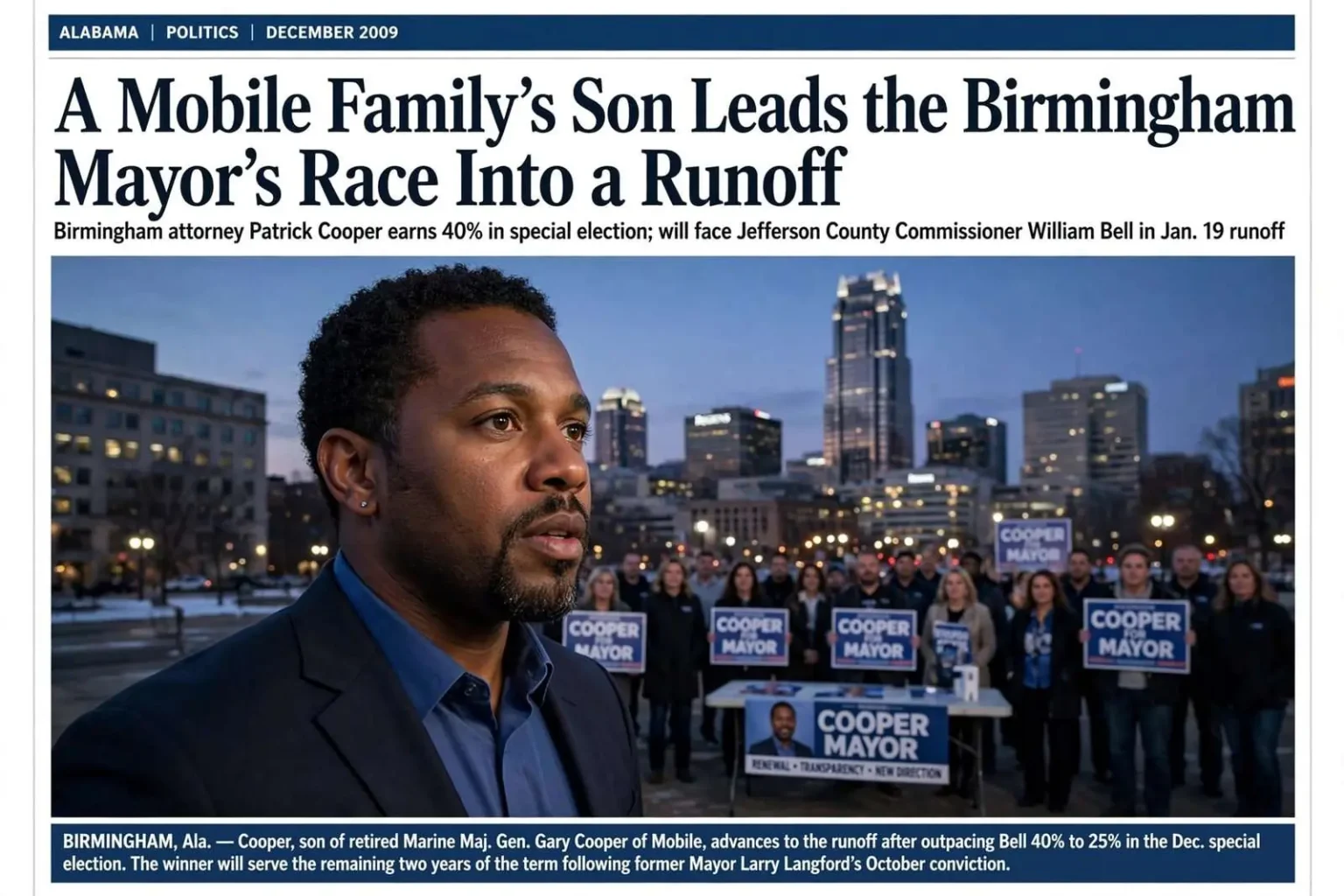
The race to finish out a term cut short by a federal bribery conviction moved to a runoff in December 2009, and the man leading it had deep roots in Mobile. Birmingham attorney Patrick Cooper polled just over 40 percent of the vote in the special election, outpacing Jefferson County Commissioner William Bell, who drew about 25 percent. The two advanced to a runoff set for Jan. 19, 2010, with the winner inheriting a city whose government had been shaken to its core.
The Mobile Connection
Cooper is the son of retired Maj. Gen. Gary Cooper and Beverly Cooper of Mobile. Gen. Cooper is among the most distinguished figures Mobile has produced: a Marine Corps officer, a business executive and a former U.S. ambassador, from a family long prominent in the city’s Black civic and business life. His Marine career spanned more than two decades before he built a business career in Mobile, and his diplomatic service placed a Mobile name in the capital of a foreign country — a distinction few Alabamians of any background can claim.
The family’s political history reaches further still. Patrick Cooper’s uncle, Jay Cooper, who now practices law on the Eastern Shore, served as mayor of Prichard roughly three decades ago — among the earliest Black mayors elected in Alabama, and a figure whose administration remains part of the political memory of Mobile County. Prichard’s city government in that era was breaking new ground across the South, and the Cooper name carried weight in the region’s Black political leadership long before Patrick Cooper entered a race of his own.
That lineage made the Birmingham contest something more than a race 250 miles down the road. Mobile families with standing in the city’s civic life watched the runoff with a personal stake, and the outcome mattered to anyone who tracked Alabama’s political talent across the state.
What Was at Stake in Birmingham
The winner of the runoff would serve the remaining two years of the term of former Mayor Larry Langford, who was removed from office on Oct. 28, 2009 — the same day a federal jury convicted him of taking bribes while serving on the Jefferson County Commission. The speed of that fall was stunning even by the standards of Alabama politics: a sitting mayor convicted and removed in a single afternoon, with the governor’s office moving immediately to install a successor.
Langford’s fall came as Jefferson County was buckling under a multibillion-dollar sewer debt whose origins lay in the same web of financings and fees that produced his prosecution. The county’s sewer refinancing deals, built on exotic interest-rate swaps and sold through some of the biggest names on Wall Street, had collapsed into what would become the largest municipal bankruptcy filing in American history at the time it eventually came. The city his successor would inherit was one whose finances, reputation and civic confidence had all been badly shaken.
The Candidates
Cooper campaigned on a promise of renewal. “There is going to be a renaissance in this city,” he told supporters, speaking of “a new direction, a new approach and new vision” for Birmingham. A business attorney who had never held elective office, Cooper ran as the outsider candidate — untainted by the county commission’s scandals, framing the city’s problems as solvable with new leadership and transparent government rather than another round of familiar faces.
Bell, a veteran of Birmingham politics with long service on the City Council and the county commission, thanked his supporters for “putting together a campaign on a shoestring.” The phrase was not modesty. Bell raised $37,900 for the campaign; Cooper raised $246,550 — a better than six-to-one advantage that had not translated into a first-round victory, and that would now be tested in a low-turnout January runoff, where organization tends to matter more than money.
The spending gap told only part of the story. Birmingham’s mayoral races are decided ward by ward and church by church, and Bell’s decades of relationships in city politics — from council district clubhouses to the county commission — gave him an infrastructure that money alone could not buy. Cooper’s challenge was to convert a broad, loosely organized coalition into actual voters on a cold Tuesday in January, when turnout would be thin and every vote organized would count double.
Why Mobile Watched
Birmingham’s municipal elections are not ordinarily front-page news 250 miles down the road. But the Cooper family’s standing in Mobile made this one an exception, and the outcome carried a broader interest as well: the two largest metropolitan areas in Alabama have long competed for state resources, corporate investment and political attention, and the health of Birmingham’s government affects the whole state’s standing with the ratings agencies and site selectors.
When Birmingham’s city government stumbles, the tremors reach Huntsville’s recruiting pitches and Mobile’s port negotiations alike. Industrial recruiters selling Alabama to automakers and aerospace companies have to explain away the headlines, and a stable city hall in the state’s largest metro makes every other pitch in the state easier. That was the quiet stake beneath a runoff that, on its surface, concerned only one city’s charter.
The runoff was set for a Tuesday in January, in the dead of an Alabama winter, when turnout would be thin and every vote organized would count double. Birmingham had been through a fall it would remember for a generation — a mayor convicted, a county drowning in sewer debt, a national reputation in tatters. The question before the city’s voters, and the one that gave the Cooper family’s Mobile supporters reason to watch the returns, was whether renewal meant another familiar hand or a new name with a new direction.
How Birmingham Reached This Point
The special election itself was Birmingham’s second mayoral vote in a short span. When Langford was removed from office following his conviction, the city council’s president stepped in as acting mayor, and the city scheduled the special election to choose a replacement who would serve out the remaining two years of the term. Special elections in Birmingham have historically produced low-turnout, high-variability results — a handful of motivated precincts can decide the outcome, which is precisely why the field fractured across so many candidates in the first round and why the runoff math mattered so much.
The first-round result left Cooper with just over 40 percent, short of the majority needed to win outright, and Bell with about 25 percent. Between them stood a spread of candidates — council members, pastors, businessmen and community figures — whose supporters now had to pick a second choice. In runoff politics, the trailing candidate’s coalition often determines the outcome, and both camps spent the weeks before Jan. 19 courting voters whose first-round favorites had fallen short.
The dynamics of a January special election compounded the uncertainty. Holiday travel, winter weather and the absence of a national race on the ballot all pointed toward a turnout floor far below a regular election, which historically favors whichever campaign has the deeper list of committed voters — the people who can be called twice, driven to the polls and checked off a tally sheet. Birmingham’s church networks, neighborhood associations and senior centers do that organizing as well as anyone, and both candidates counted on them. City hall watchers also noted that a special election winner would face another full campaign within two years, meaning whoever won the runoff would immediately begin governing as a candidate for re-election.
Bell’s path ran through the city’s established political machinery, and his argument was continuity with a twist: he knew the city’s books, its department heads and its creditors, and at a moment of crisis Birmingham could not afford on-the-job training in the mayor’s office. Cooper’s argument was the mirror image: the crisis itself was the product of a generation of insider leadership, and the city needed someone with no debts to the old networks and no appetite for business as usual.
The Bigger Picture for Alabama
Whatever Birmingham chose, the resolution of its mayoral vacancy marked a step toward stability for the state’s largest city — and Alabama had reasons beyond civic pride to want that stability. The Jefferson County sewer crisis was still working its way through the courts and the bond markets, and the eventual county bankruptcy, when it came, would reshape how municipal finance was practiced across the country. A functioning city hall in Birmingham, working alongside county officials and the state, was part of the story investors and rating agencies would read.
For Mobile, the runoff also offered a reminder of how connected Alabama’s cities are through people. A Mobile family’s son led the race; an uncle who had been a Prichard mayor was part of his political inheritance; and the outcome would be tallied not only in Birmingham’s neighborhoods but in the conversations of civic clubs and dinner tables 250 miles south. The runoff was set for Jan. 19, 2010 — a Tuesday in the dead of an Alabama winter, when turnout would be thin and every vote organized would count double.