Mobile Water Board Keeps Service Policy Unchanged Under New Immigration Law
As Alabama’s tough new immigration law took hold, the Mobile Area Water and Sewer System said it saw no need to change how it signed up customers, even as utility boards elsewhere in the state revised their policies.
MOBILE, Alabama — As Alabama’s sweeping new immigration law reshaped daily transactions across the state, the Mobile Area Water and Sewer System told customers it had no plans to alter the way it established service — setting the region’s largest water utility apart from some of its counterparts to the north.
A law with wide reach
The law, among the strictest in the nation, was designed to identify people living in the state illegally and criminalized a range of business transactions involving them. Its breadth left utilities, landlords and other service providers scrambling to determine whether their routine practices for signing up customers needed to change to stay in compliance.
The statute reached far beyond law enforcement. It touched contracts, leases, licenses and everyday interactions between residents and the businesses and agencies that serve them, and it placed the burden of interpretation on institutions — school systems, municipal offices, utility boards — that had never before been asked to think about immigration status in the course of routine business.
In Decatur and Huntsville, utility boards had revised their service policies within days of the law taking effect. The Board of Commissioners of MAWSS, however, concluded that its existing procedures already met the mark.
What MAWSS requires
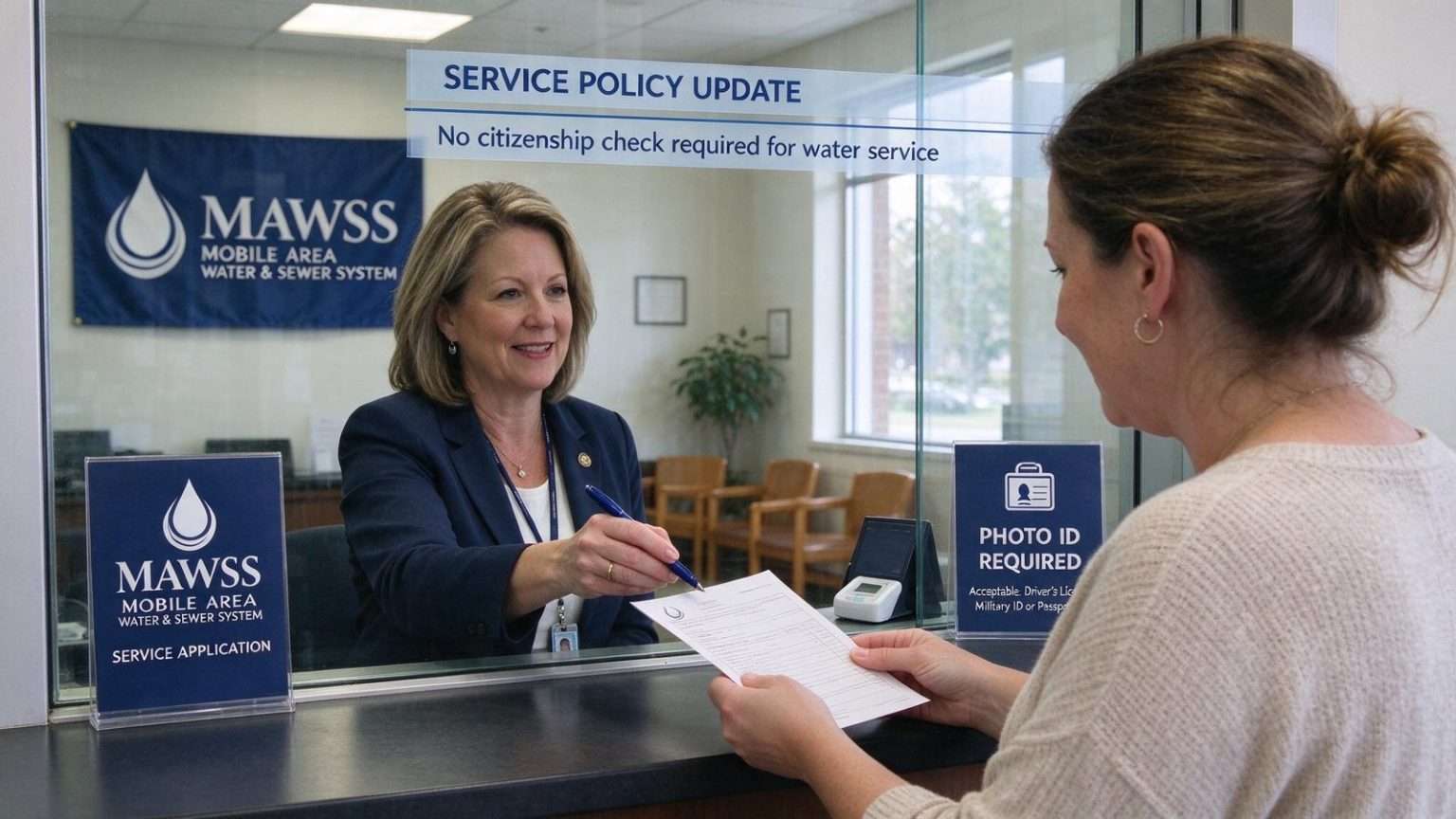
“We do not request proof of citizenship to establish service, but we require a photo ID and Social Security number,” said MAWSS spokeswoman Barbara Shaw. Acceptable identification, she said, included a driver’s license, military card or passport.
For MAWSS, that combination of a government-issued photo ID and a Social Security number was deemed sufficient without adding a citizenship check to the sign-up process. The utility’s position reflected a judgment that its long-standing intake practices did not run afoul of the new statute, sparing customers along the coast the added documentation hurdles that were surfacing elsewhere.
The utility’s reasoning was practical as much as legal. Water service is not an ordinary commercial transaction: it is a health and safety necessity, delivered to every occupied dwelling in the service territory, and utilities have long structured their requirements around identity and billing rather than residency status.
MAWSS serves hundreds of thousands of people across Mobile County, making it one of the largest water systems in Alabama. Any change to its establishment-of-service rules would have rippled through thousands of new accounts a year — renters moving into apartments, homeowners closing on houses, students, retirees and military families transferring to the region’s bases.
A patchwork response across the state
The differing approaches among Alabama utilities underscored the uncertainty the law had introduced. With little established guidance on how far providers needed to go, boards in different cities reached different conclusions about what compliance required. Some tightened their rules out of caution; others, like MAWSS, held steady.
The result was a patchwork in which the paperwork needed to turn on water depended on where in Alabama a customer lived. In some cities, applicants faced new documentation demands that had not existed weeks earlier; in Mobile, the process looked exactly as it had before the law passed.
Legal challenges to the statute were already moving through the federal courts during the same period, with judges blocking portions of the law while allowing others to take effect. That ongoing litigation added to the uncertainty, since providers drafting policies could not know which provisions would ultimately survive.
For south Alabama residents, the practical effect was that turning on water service in the Mobile area continued without added documentation hurdles. Customers establishing new accounts kept presenting the same photo ID and Social Security number they always had, and MAWSS’s commissioners saw no reason to change it.
Why utilities sat at the center of the debate
Water service became one of the law’s most closely watched test cases because utilities occupy a unique position: they are public-serving monopolies with a health mission, and every household in their territory needs them regardless of circumstance. A policy change at a water board does not affect a niche market — it affects every address in the county.
The utilities that revised their policies did so on the theory that the law’s provisions on business transactions could reach the signing of a service agreement. The utilities that stood pat, including MAWSS, argued that their requirements — identification and a Social Security number — were exactly the kind of verification the law contemplated, and that adding citizenship checks would serve no compliance purpose.
Public utility boards are also answerable to the customers they serve, and commissioners weighed the practical consequences of their decisions. Tighter documentation rules meant longer sign-ups, more staff training, more disputes at the counter, and the risk of occupied homes sitting without water while paperwork was sorted out.
Advocates on both sides of the immigration debate watched the utility decisions closely, seeing in them an early measure of how far the law’s reach would extend into ordinary life. The divergence between Huntsville, Decatur and Mobile became part of the broader picture of a state feeling its way through an unprecedented statute.
The law’s broader footprint
The immigration statute that prompted the utility reviews was the subject of national attention from the moment it was signed, with supporters calling it the toughest law of its kind in the country and critics warning of constitutional collisions to come. Federal courts quickly became the venue where its real scope would be decided.
Provisions touching contracts, harboring and transport were among those challenged, and early rulings blocked key sections while the litigation continued. For service providers, the practical guidance was to follow the provisions actually in effect and to avoid overinterpreting the statute — advice that led different boards to different conclusions, depending on how conservatively they read the risk.
The MAWSS board’s decision to keep its existing process meant no retraining of customer service staff, no new forms, and no change to the counter experience for the thousands of customers who establish service each year. In a period when so much around the law was changing week to week, the utility’s stability was itself a notable outcome.
For households across Mobile County, the episode passed largely without notice: water kept flowing, accounts kept opening, and the documentation at the window stayed the same. The moment is remembered now mostly as an illustration of how a sweeping law lands differently across a state — and of how one large utility along the coast decided the rules it had were already the rules it needed.
How a water utility establishes service
The requirements MAWSS kept in place are standard for water systems across the country. A photo ID establishes who is asking for the account; a Social Security number supports credit checks, deposit decisions and collections if an account goes unpaid. Together they give the utility what it needs to run a billing system — and nothing more than that.
New customers typically establish service by visiting the utility’s offices or calling ahead of a move-in, paying any required deposit, and providing the identification on file. For renters, the account usually follows the lease; for owners, the closing date. The process is designed to be completed in a single visit so that water is running when a family moves in.
Utility officials note that the same requirements apply to every applicant, whatever their background. Uniform requirements are the system’s administrative backbone: every account is created the same way, which keeps the process fast and keeps the utility’s decisions consistent and defensible.
The alternative — requiring proof of citizenship for new accounts — would have put MAWSS staff in the position of adjudicating immigration documents at the service counter, a job for which customer service representatives are neither trained nor equipped, and one the utility’s board concluded the law did not require of it.
What residents should know about their utility
MAWSS is governed by a board of commissioners that sets policy for the system independently of city hall, which is why its response to the new law was its own decision rather than the city’s. The board structure gives the utility insulation from political swings — a feature that proved relevant when utilities in other cities moved in different directions on the same question.
The system delivers drinking water across Mobile County and operates the sewer infrastructure for much of the county, funded through rates and bonds rather than taxes. Its policies on service establishment apply to the whole service territory, from downtown Mobile to the county’s outlying communities.
Customers with questions about establishing service — what identification to bring, what deposits apply, how to transfer an account from one address to another — can contact the utility directly. The requirements have remained stable through the years since the immigration law episode: photo ID and a Social Security number, and the water is on.
The episode remains a useful case study in how large institutions respond to sudden legal change. Some boards reacted within days; Mobile’s, after review, decided its existing practices already fit the law. Both approaches were defensible readings of an ambiguous statute — but only one of them left customers on the Gulf Coast turning on water exactly as they always had.