Mobile Begins Enforcing Nighttime Teen Curfew Across the City
Mobile police began enforcing the nighttime portion of the city’s new juvenile curfew for teens 17 and younger, a measure Mayor Sam Jones framed as a push for parental accountability rather than arrests.
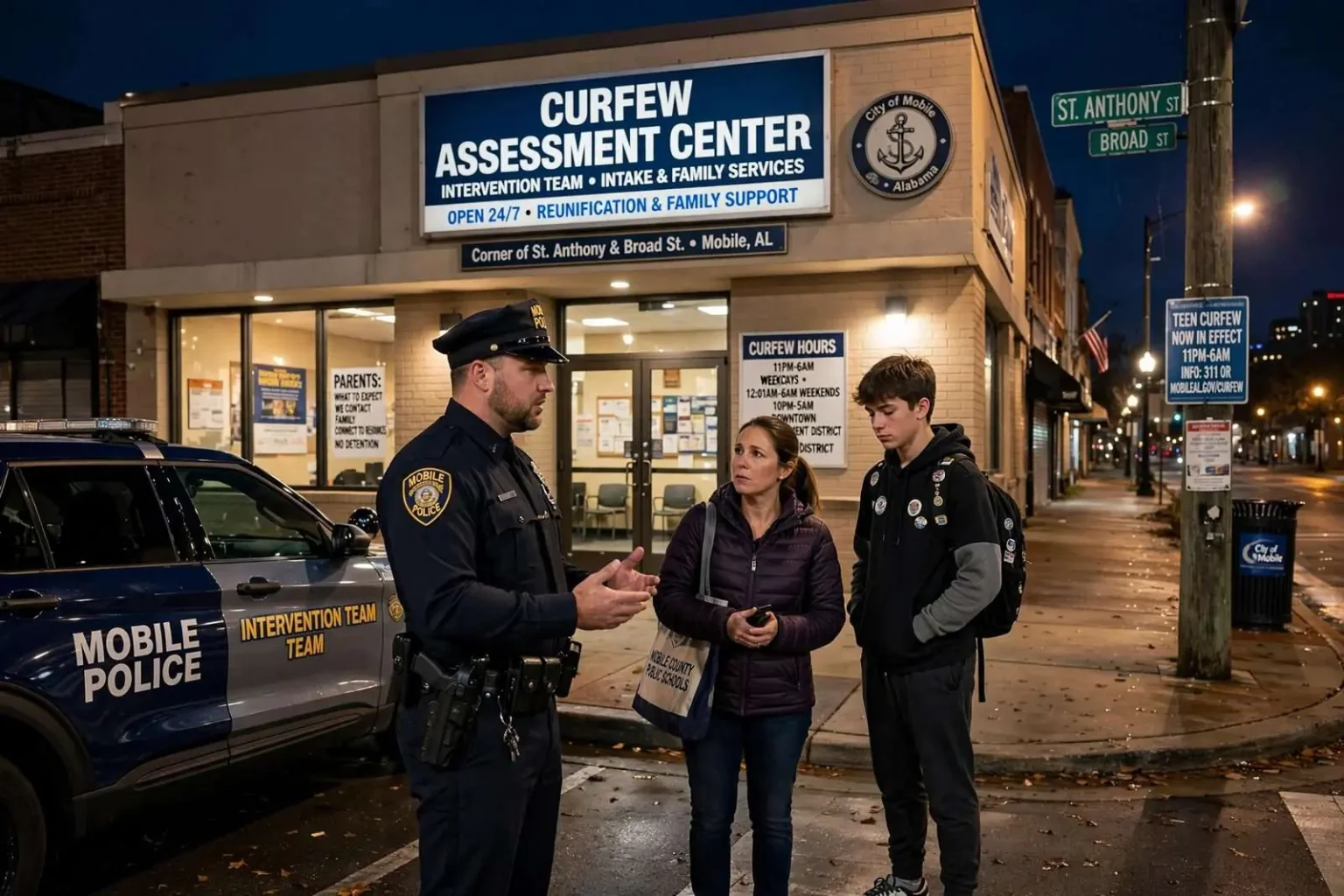
Mobile police began enforcing the nighttime portion of the city’s new juvenile curfew on Tuesday, Nov. 1, opening a closely watched effort to keep teenagers 17 and younger off the streets during late hours. The ordinance, debated at City Hall for months before its adoption, made Mobile one of the larger cities in the region to pair a broad curfew with a dedicated intake facility designed around families rather than detention.
How the curfew works
Under the ordinance, the citywide nighttime curfew ran from 11 p.m. to 6 a.m. on weekdays and from 12:01 a.m. to 6 a.m. on weekends. In the downtown entertainment district, the hours were tighter still, beginning at 10 p.m. and lasting until 5 a.m. The distinction recognized that Dauphin Street and the blocks around it draw late-night crowds on weekends, and city officials wanted a tool to address juveniles in the busiest bar and restaurant corridor an hour earlier than elsewhere in the city.
A daytime curfew, aimed at school hours between 9 a.m. and 2:30 p.m., was scheduled to take effect on Jan. 1. The daytime provision targeted truancy as much as crime — keeping students in classrooms during the school day — and its later start date gave schools and families additional time to prepare for a rule that would reach into every school morning across the city.
Mayor Sam Jones, who recommended the measure, cast it as a matter of shared responsibility rather than punishment. “Everyone must do their part to ensure the safety of our children and the community,” Jones said. “This curfew is not about arresting children, but about parental accountability, a change in behavior and a sincere desire to see youngsters live a long and prosperous life.”
That framing shaped how the ordinance was written and how officials introduced it to the public. Rather than treating curfew violations as entries into the juvenile justice system, the city built its enforcement around returning young people to their families and connecting households with services — an approach officials said distinguished Mobile’s program from the arrest-first curfews of earlier decades.
The assessment center
Central to the program was a Curfew Assessment Center at the corner of St. Anthony and Broad streets. The mayor stressed that it was not a jail but a holding facility where young people would wait until a parent or responsible adult could be reached. Officers who picked up a curfew violator would bring the juvenile to the center rather than to a booking desk, and staff would begin immediately trying to locate a family member and understand the circumstances that put the young person on the street.
Run by the Police Department’s Intervention Team, the center was designed to connect families to additional services when needed, drawing on links to the Mobile County Public School System, the Department of Human Resources, the Strickland Youth Center and other social service organizations. A teenager repeatedly picked up after hours, for example, might be connected with school counselors or family services, while a runaway situation could be routed to the appropriate protective resources.
“By working closely with our partners, we can develop a proactive and far-reaching approach to helping our children stay in school and become productive members of the community,” Jones said. The network of agencies behind the center was the program’s answer to critics who argued a curfew ordinance merely shuffles young people through the system; in the city’s design, the encounter at the center was meant to be the beginning of an intervention, not the end of one.
Getting the word out
To make sure families understood the new rules, the city launched a broad awareness campaign. Officials planned to distribute 70,000 informational fliers to public and private schools, Boys and Girls Clubs, the Mobile Housing Board and community meetings, along with 300 posters placed at movie theaters, skating rinks, area restaurants, supermarkets and recreation centers. The distribution list deliberately followed young people through their own routines — school, after-school programs, weekend hangouts — so the message reached teens directly and not just their parents.
The outreach also included billboards throughout the city, radio announcements, a recorded message from the mayor posted to YouTube and shared on social media, and a dedicated page on the city website with answers to frequently asked questions. Awareness messages were even slated to appear on cable channels popular with younger viewers, a placement chosen so the rules were explained in the media teenagers actually consumed.
City officials said the scale of the campaign reflected a simple principle: a curfew cannot be enforced fairly if families do not know it exists. Before the first citation, the city wanted every household with a teenager to understand the hours, the exceptions and the consequences, and to know where to call with questions. The city said it would schedule open-house information sessions at the assessment center for parents and teens who wanted to learn more, letting families see the facility and meet the Intervention Team staff before any enforcement encounter brought them there.
City officials pointed those with questions to the mayor’s community affairs office, which served as the coordinating point for the campaign and the public’s feedback. That office fielded inquiries from parents, school administrators and neighborhood groups in the weeks leading up to enforcement, and its staff relayed recurring concerns back to the police department and the city attorney’s office as the rollout approached.
Why the city acted
The curfew emerged from a period of concern about late-night violence and truancy in Mobile, with city officials pointing to incidents involving young people during overnight hours as the impetus for the ordinance. Supporters on the council argued that a clear, enforceable standard — no unsupervised minors on the streets after midnight — gave police a tool to intervene before trouble started, and gave parents a city-backed rule to lean on when setting boundaries at home.
Critics raised familiar objections during the debate: that curfews criminalize ordinary teenage activity, that they fall unevenly on young people who lack reliable transportation or supervision, and that enforcement could strain police-community relations. During the council’s review, members had also pressed the administration with detailed questions about enforcement, liability, cost and constitutionality, including how the assessment center would be staffed without pulling officers from other calls and who would be responsible for a minor’s safety and needs while in city custody. The Jones administration’s answer was the design of the program itself — the assessment center instead of a jail intake, the network of social services, and an awareness campaign meant to prevent violations rather than punish them.
The rollout marked one of the more visible public-safety initiatives of the Jones administration, and its emphasis on reuniting young people with their families rather than booking them into custody drew notice as the enforcement period began. How the program performed in its first weeks — how many juveniles were picked up, how many families were connected to services, and whether late-night incidents declined — would determine whether the council’s gamble on a family-first curfew became a model for other Alabama cities or a cautionary tale.
Life under the curfew for Mobile families
For most families, the practical effect of the ordinance comes down to a handful of hours. A sixteen-year-old working an evening shift, attending a late game or coming home from a relative’s house has until 11 p.m. on a weeknight to get indoors — and the city’s ordinance, like most curfews, carries exceptions for emergencies, work travel and accompanied activity, so a teen walking home with a parent is not the enforcement target. The weekend rules give a slightly later start after midnight, but the downtown entertainment district’s 10 p.m. start applies to the corridor where the city sees its densest late-night crowds.
Parents, meanwhile, face their own accountability under the program. The mayor’s language about “parental accountability” was deliberate: when a juvenile is picked up, the assessment center’s first task is reaching a parent or responsible adult, and repeated violations are treated as a family issue that may warrant services rather than a series of isolated offenses. That design places the burden of the second and third encounter on the household, with the Intervention Team following up rather than simply releasing the teen back to the same circumstances.
The program also gives schools a stake in the outcome. The Jan. 1 start of the daytime curfew directly supports attendance efforts by the Mobile County Public School System, which loses funding and instructional time when students are absent, and which can refer chronic truancy cases through the assessment center’s partner network instead of the juvenile court system.
Measuring success
City officials have framed the program’s success in terms broader than citation counts. A curfew that produces hundreds of pickups but no change in late-night incidents, truancy or family stability would be enforcement without results; the city’s stated goal is behavioral — fewer teenagers on the streets in the first place, because families understand the rules and the risks. The awareness campaign’s 70,000 fliers, 300 posters, billboards and broadcast spots were all built toward that preventive end.
The assessment center’s partnerships provide the second measure. Every juvenile who passes through the facility represents a chance to connect a household with help — from the Department of Human Resources to the Strickland Youth Center to school-based counselors — and the Intervention Team’s casework in the months after enforcement began would show whether those connections were actually being made.
The open-house sessions at the center were intended to reinforce both goals before enforcement ramped up: parents who tour the facility see that it is a place for reunification and referral, not detention, and teens who see it understand that a curfew stop ends with a ride home rather than a jail cell. For a program whose legitimacy depends on public trust, those first impressions matter as much as the ordinance’s text.
As enforcement began that November week, patrol officers across Mobile’s precincts carried the new rules into neighborhoods from Tillman’s Corner to Toulminville, and the assessment center at St. Anthony and Broad opened its doors as the program’s operational hub. Whether the ordinance achieves what the mayor promised — safety for children, accountability for parents and a city that reclaims its late-night streets — will be written not in the ordinance’s language but in the months of enforcement, outreach and family contact that follow it.