Tea Party Crowds Fill Five South Alabama Towns, Organizers Report 1,000 Members
Common Sense Campaign counted 500 in Mobile and close to 600 in Daphne at Tax Day rallies, with events also in Evergreen, Brewton and Monroeville. The group says it topped 1,000 dues-paying members.
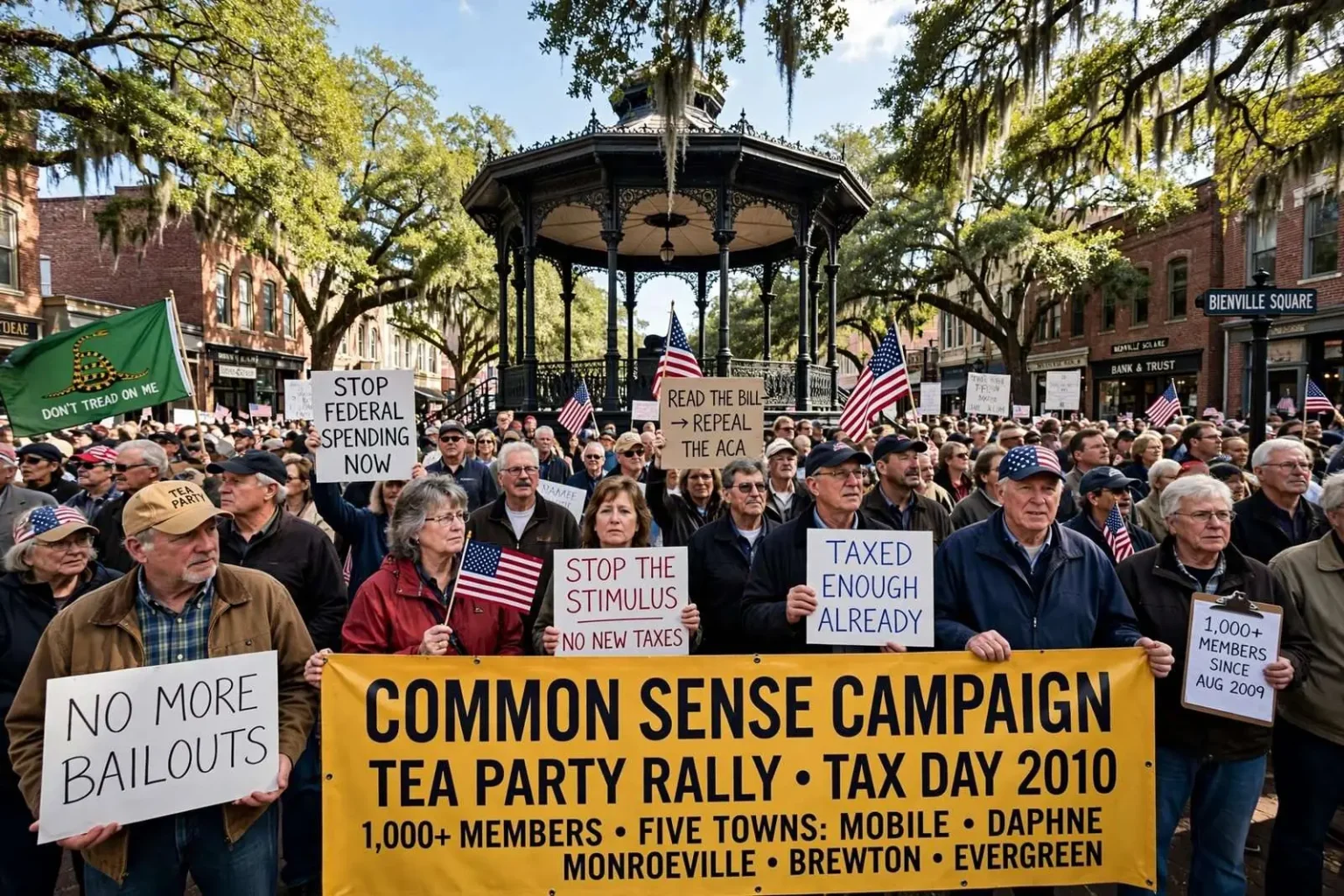
Five Tea Party rallies held across south Alabama on Tax Day were significant successes, according to Pete Riehm of the Common Sense Campaign, the group that organized them. The events, staged in county seats and population centers from the pine belt to the bay, marked the young movement’s first coordinated show of force in the region — and, by the organizer’s account, exceeded expectations at every stop.
The count Riehm reported attendance as follows: Evergreen, 80 or more; Brewton, 60 or more; Monroeville, 125 or more; Mobile, 500 or more; and Daphne, 500 or more. In Mobile, where the rally was held at Bienville Square, the “crowd grew and peaked about noon,” Riehm said. Turnout was even stronger across the bay in Daphne, he added, “pushing 600.”
The Geographic Spread
The geographic spread is worth noting. Evergreen, Brewton and Monroeville are small county seats in Conecuh, Escambia and Monroe counties, well away from the coastal population centers. Drawing dozens to a weekday political rally in towns that size takes organization, and it suggests the movement’s reach in 2010 extended beyond Mobile and Baldwin into the rural stretches of south Alabama where political machinery has traditionally run on personal networks and courthouse relationships.
Those three courthouse towns anchor counties that have long been reliably Democratic in local races even as federal elections shifted Republican, and a visible conservative protest movement organizing there signaled that the Tea Party wave was washing into places where party switchers and reform-minded activists were already reshaping the electorate. A rally of 60 or 125 people in a town of a few thousand is proportionally a larger event than 500 in a city of nearly 200,000.
Bienville Square, the downtown Mobile park where the largest city rally gathered, sits in the heart of the business district, a traditional site for public gatherings. The midday timing put the event in front of downtown office workers and lunch crowds, and Riehm’s account of a crowd that built toward noon suggests the rally drew steady arrivals rather than a single wave.
A Growing Membership
Although a final count was not in, the Common Sense Campaign enrolled roughly 200 new members at the Thursday events, lifting the organization above 1,000 dues-paying members in the eight months since its founding. Internet traffic to the group’s online presence has also been climbing sharply, Riehm said.
That number is modest against the population of the region, but dues-paying membership is a different measure than a crowd at a rally. It represents people willing to sign their names and hand over money to a political organization — the raw material of a volunteer base. Organizations that can convert rally energy into memberships and dues survive between events; those that cannot, fade when the news cycle moves on.
The eight-month timeline matters as well. Founded in the summer of 2009, in the first wave of Tea Party organizing nationally, the Common Sense Campaign reached four figures of dues-paying members without the benefit of established infrastructure, lists or donors — evidence, its leaders would argue, of genuine demand rather than top-down direction.
From Protest to Primary
The more consequential news for candidates is what the group intends to do next. Riehm said the Common Sense Campaign is now “focusing on candidate vetting” with an eye toward making endorsements before the June 1 party primaries. That shifts the organization from the business of protest to the business of politics, and it puts a new set of questions in front of every candidate on the south Alabama ballot: who fills out the questionnaire, who attends the forum, and who is willing to be measured against a checklist drawn up by activists who did not exist as an organized bloc eight months earlier.
The primaries feature contested Republican races for governor, attorney general, lieutenant governor, Congress and district attorney in both Mobile and Baldwin counties. In a low-turnout June primary, an endorsement that moves a few thousand motivated voters can matter a great deal.
Historically, low-turnout Alabama primaries have been decided by organization rather than persuasion: who can identify supporters, turn them out and staff the polls. A dues-paying membership spread across five counties, with a vetting process that generates questionnaires, forums and candidate scorecards, is precisely the kind of infrastructure that converts enthusiasm into votes. Candidates reading the Tax Day attendance figures faced a choice between courting the new group and hoping it stayed on the sidelines.
The vetting announcement also signaled a seriousness of purpose that distinguished established-leaning Tea Party groups from loosely organized protest pages. Endorsing in district attorney races — local law enforcement’s top office — showed the movement intended to reach down the ballot, not merely to weigh in on marquee statewide contests.
What the Rallies Were About
The Tax Day theme was national — federal spending, the stimulus, the bailouts, the health care law passed the previous month. The rallies came just weeks after Congress passed the Affordable Care Act, and the anger over that vote gave the 2010 Tax Day protests a sharper edge than the previous year’s events.
But the local grievances were never far from the surface, particularly in Mobile, where the city council had days earlier rejected a one-percent sales tax increase after a flood of calls and emails from residents who said they had been taxed enough already. The line between the national movement and the local revolt was, in April 2010 in Mobile, almost impossible to draw.
The Sales Tax Fight as Local Context
The city council’s rejection of the sales tax increase gave Mobile’s rally a concrete local anchor. Tax debates at city hall and anger at federal spending share a common language — the sense that government reaches too deep into household budgets — and rally speakers could point to the council fight as proof that the sentiment was not abstract. For attendees, the connection between a federal health care law and a municipal sales tax proposal was less about policy detail than about a mood: government at every level was asking for more, and a significant slice of the public was done giving.
Organizations like the Common Sense Campaign thrived on exactly that crossover energy. A movement that could turn out crowds against federal legislation and simultaneously weigh in on city tax votes had a claim on attention at both ends of the ballot — and both ends mattered to the dues-paying members it was recruiting.
The 2010 Political Landscape
Tax Day 2010 fell in the middle of a year that would prove transformative for Alabama politics. The June primaries that the Common Sense Campaign aimed to influence would set up a November election in which Republicans would sweep every statewide office and win majorities in the legislature for the first time in modern history, upending a Democratic order that had governed the state for more than a century.
The Tea Party wave was one current in that larger shift, supplying energy, candidates and pressure on the right at the precise moment the state’s partisan alignment was tipping. Groups such as Riehm’s did not cause the realignment alone, but the rallies and the membership rolls gave newly activated voters somewhere to organize, and the vetting-and-endorsement strategy gave the movement a vehicle to matter within the Republican primary rather than against it.
For south Alabama specifically, the five-rally day demonstrated that the energy was not confined to Mobile’s parks or Daphne’s bayfront. From Monroe County’s courthouse square to the streets of Evergreen and Brewton, the movement’s first Tax Day was, by its own accounting, a rolling success — and a preview of the political season that followed.
Reading the Attendance Numbers
Riehm’s figures, even taken as rough estimates, sketch a map of the movement’s support. Mobile and Daphne each drew crowds in the 500-to-600 range, anchored by the region’s two population centers on either side of Mobile Bay. Monroeville’s 125-plus reflected a smaller town turning out at remarkable scale for a weekday, while Evergreen and Brewton drew committed crowds of 80 and 60 in counties with some of the smallest populations in the state.
Rally counts are always contested — organizers see a movement growing, skeptics see inflated math — but the pattern across five towns in three hours’ drive of each other is harder to dismiss than any single figure. The Common Sense Campaign had built a network capable of staging simultaneous events across rural south Alabama within eight months of its founding, and the crowd sizes suggested that each local node had real people behind it.
The Tax Day timing was itself strategic. April 15 gave the rallies a built-in theme and a national spotlight, with protests planned across the country that day. Local groups plugged into that calendar, drawing press attention they could not have generated alone and giving their members the sense of participating in something larger than a single courthouse-square gathering.