Lights Return in Brewton, but Rural Escambia and Conecuh Counties Brace for Long Isaias Recovery
Alabama Power expects Brewton and Monroeville restored by Wednesday, but rural Escambia and Conecuh communities like Pollard, Lenox and Appleton face a longer Isaias recovery as Sen. Tommy Tuberville plans a crop and timber damage tour.
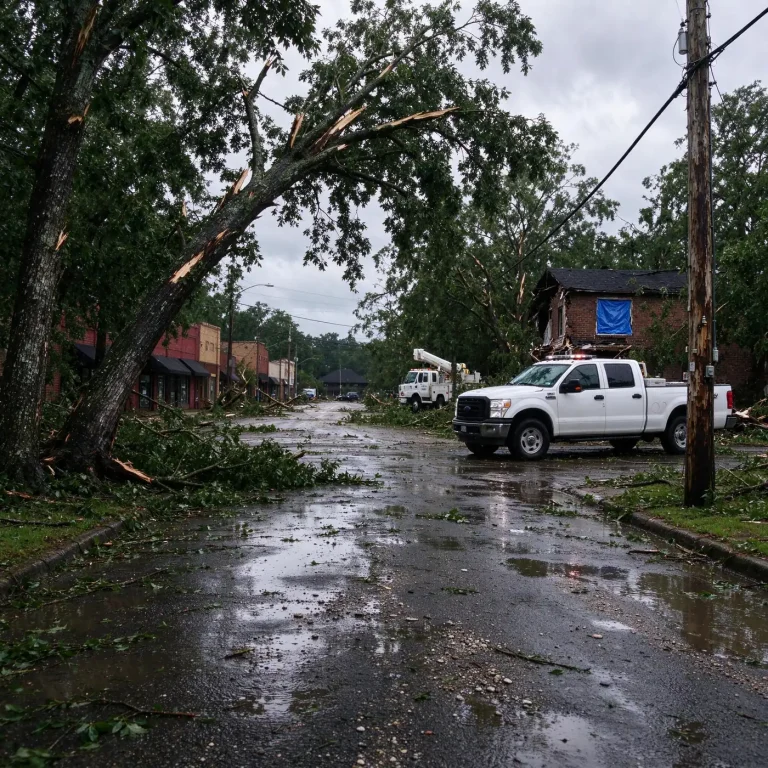
BREWTON, Ala. — The lights are coming back on in Brewton and Monroeville, but rural Escambia County and neighboring Conecuh County are bracing for a longer Hurricane Isaias recovery. Alabama Power has said it expects to restore electricity in both towns by the end of Wednesday, Oct. 14, yet questions remain about how long the scattered homes and farms beyond the city limits will wait.
Randy Hildreth has seen the gap up close. Every day since the storm, he has driven from Andalusia to Brewton to help residents clear debris from their yards as a volunteer with Samaritan’s Purse, documenting the damage along the way.
“It’s devastating, I can tell you that,” Hildreth said. “The power crews, and there are a ton of them here, they are working. But there will be some areas, I am sure, that will be without power until next week.”
Small communities took a heavy blow
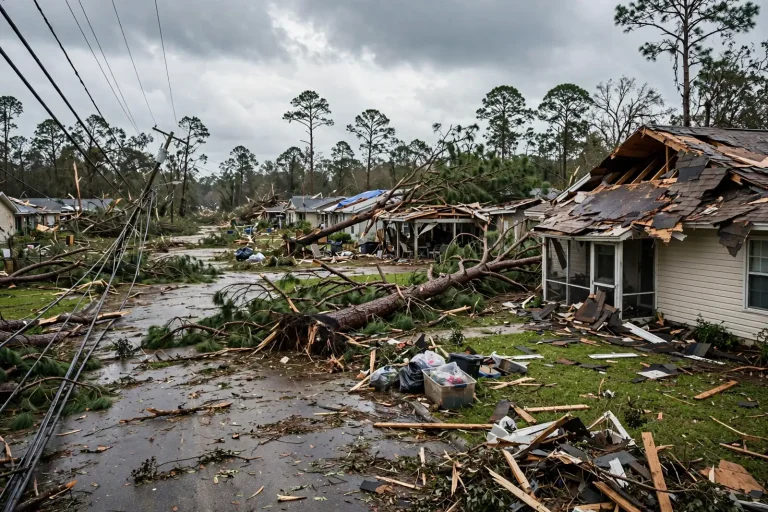
Isaias made landfall near Destin, Fla., late Friday, Oct. 9, and cut a destructive path north through part of South Alabama. Small communities such as Pollard in Escambia County and Lenox in Conecuh County were among those hit especially hard.
Pollard, a small town southwest of Brewton, is home to Pollard-McCall, one of the two Escambia County schools that Superintendent Michelle Collier said suffered the heaviest damage. Lenox is an unincorporated community in Conecuh County, where outage data showed nearly every customer in the county without power at one point over the weekend.
Hildreth said many of the rural areas surrounding Brewton, whose downtown business district was badly damaged, could be digging out from under storm debris for weeks.
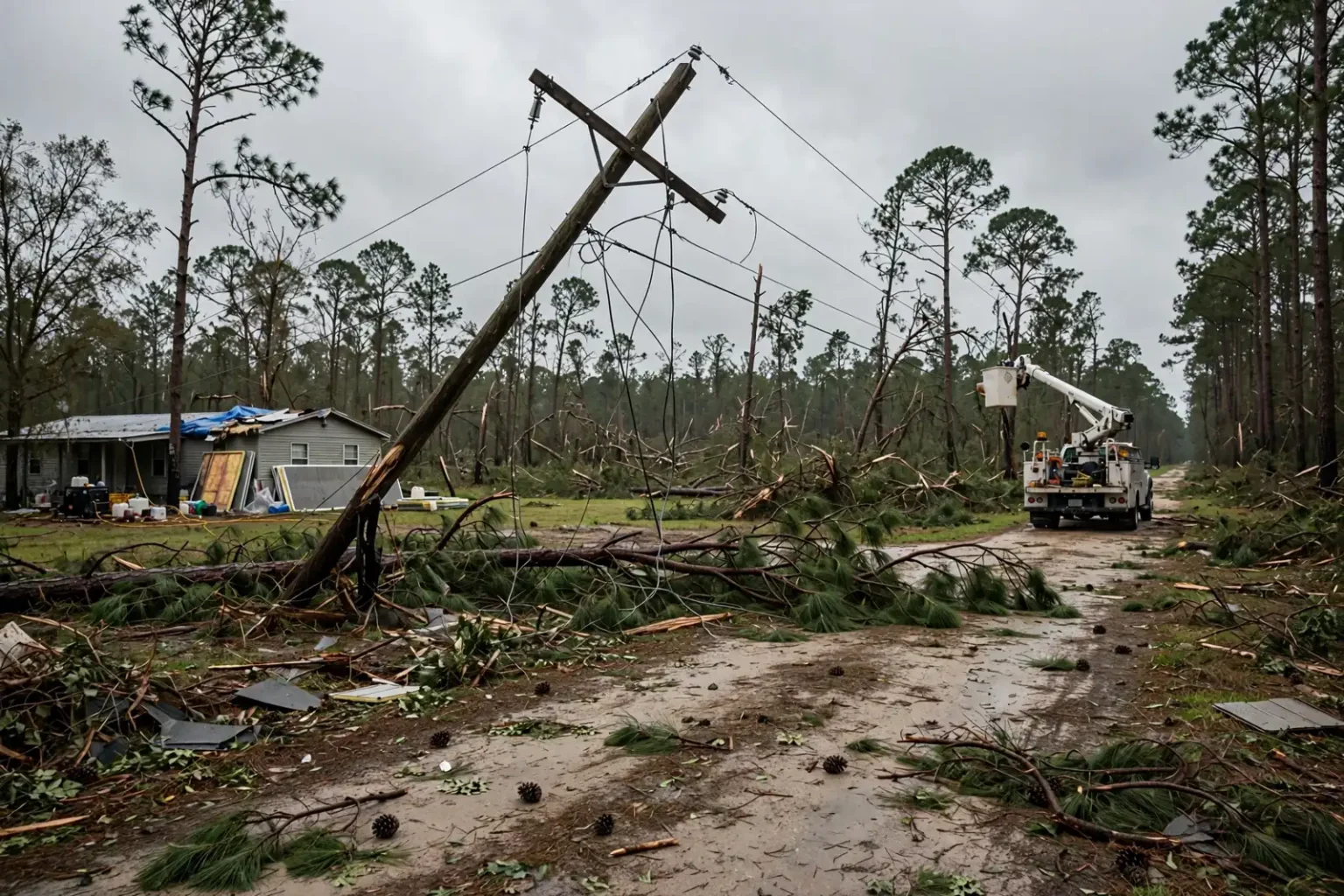
Rural power systems face a tougher rebuild than city grids. Lines run long distances through pine forests and along dirt roads, often serving only a few customers per mile, so each broken pole or tangled span restores fewer homes. Much of rural Escambia County is served by Southern Pine Electric Cooperative, which reported about 5,000 members still without power on Tuesday, down from 18,000 after the storm, according to Escambia County EMA Director Justin Jordan.
‘We are making the most of it’
Bailey Riddle lives in unincorporated Appleton, several miles northwest of Brewton, and she is preparing for a long stretch without electricity.
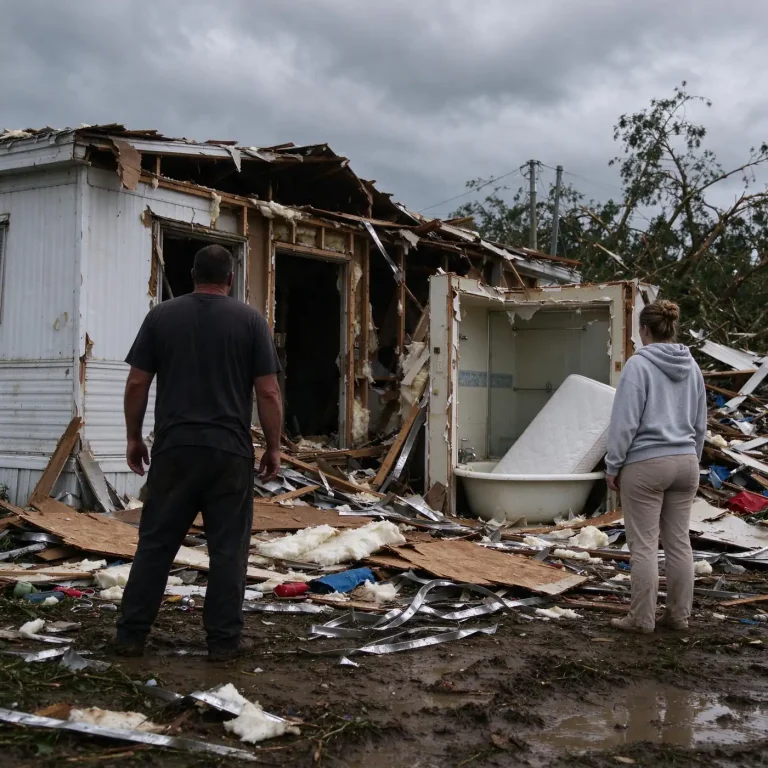
Her mobile home was damaged by the storm. Since Friday, she has been installing insulation and sheetrock, donated by the community, in the damaged sections of the house. A generator provides electricity and running water, and her family stocked up on food and water before Isaias arrived.
“We’re grilling at night for the family and working during the day to get insulation and sheet rock (installed),” Riddle said. “Our house is livable. It’s there. We can shower and flush our toilet. We are making the most of it.”
Riddle’s generator matters more than it might in town. Many rural households in Escambia County draw water from private wells, and without power the pumps do not run. County Commissioner Raymond Wiggins said this week the county is working on ways to get water and MREs, or Meals Ready to Eat, to rural residents who cannot get to distribution sites.
Tuberville: ‘Escambia County was really bad’
U.S. Sen. Tommy Tuberville, speaking with reporters Tuesday in Daphne, said more than 1,000 linemen are working in the area with Alabama Power to restore downed lines.
“Escambia County was really bad,” Tuberville said.
Tuberville is scheduled to tour hurricane-related crop and timber damage Thursday, Oct. 15, in Castleberry, a Conecuh County town, as part of an Alabama Farmers Federation gathering. Monica Carroll, state director of the USDA Farm Service Agency in Alabama, is also expected to attend.
“There are a lot of farmers with a lot of salt on their crops and that’s not good,” Tuberville said. “We’ll assess what we can do on the state, federal level. Our farmers are already hurting.”
Tuberville, a Republican, is running for governor in the Nov. 3 general election against Democrat Doug Jones, a former U.S. senator. The Alabama Farmers Federation, known as Alfa, has endorsed Tuberville in the race.
Crop and timber losses
Agriculture and forestry are central to the economy of this part of Alabama. Escambia and Conecuh counties are heavily wooded, and Brewton built its identity as a lumber town. Hurricane-force winds can snap or uproot pine stands that took decades to grow, and salt spray carried inland by a hurricane can burn leaves and damage crops still in the field, which is what Tuberville described.
Farmers and forest landowners with storm losses are generally advised to contact their county USDA Farm Service Agency office. Depending on the type of loss and whether a disaster designation is made, FSA programs can include:
- Emergency Forest Restoration Program, which helps eligible private forest landowners restore land damaged by natural disasters.
- Emergency Conservation Program, which helps farmers and ranchers repair damage to farmland, including debris removal and fence repair.
- Livestock Indemnity Program, which covers livestock deaths above normal mortality caused by eligible adverse weather.
- Noninsured Crop Disaster Assistance Program, for producers of crops not covered by federal crop insurance who bought coverage in advance.
- Emergency loans, available in counties covered by a qualifying disaster designation.
Producers with federal crop insurance should also notify their crop insurance agent of losses promptly. Keeping photographs, receipts and records of damaged acreage, timber stands and livestock will help with any claim or application.
What rural residents can do now
- Call 211 to connect with local resources for unmet needs, including food, water and shelter.
- Request cleanup help from Samaritan’s Purse, which is coordinating debris removal, chain saw work and temporary roof tarping for people with little or no insurance. Visit the mobile unit on Belleville Avenue in Brewton, between First Baptist Church and the Escambia County Courthouse, or call 833-747-1234 and press option 4.
- Pick up water and tarps at county distribution sites, including Brewton Middle School, W.S. Neal High School and Catawba Springs Church.
- Report outages directly to Southern Pine Electric Cooperative or Alabama Power, depending on your provider.
- Run generators outdoors only, far from doors, windows and vents, to avoid carbon monoxide poisoning.
- Drive slowly on county roads, where debris still lines the shoulders and crews are working near the pavement.
For families like Riddle’s, the recovery is happening one wall and one meal at a time. In town, the power trucks are wrapping up. Out in the country, people are settling in for the long haul.