Mobile Convention Center Hosts Statewide Teacher Gathering Focused on Graduation Gains
Thousands of Alabama educators gathered in downtown Mobile for a statewide conference highlighting classroom innovation and rising graduation rates.
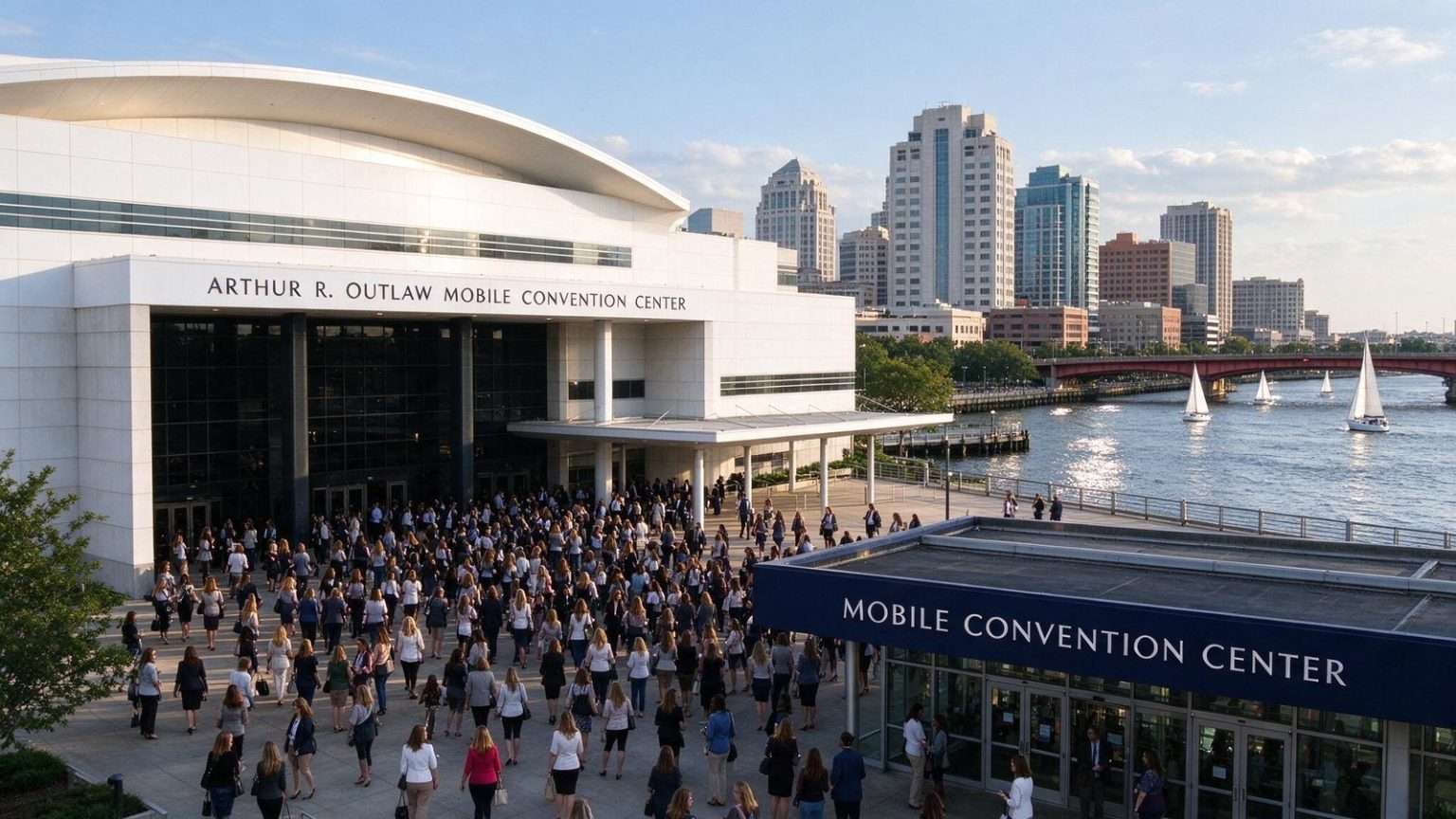
Downtown Mobile welcomed thousands of teachers and school administrators this week as the Arthur R. Outlaw Mobile Convention Center hosted a major statewide professional development conference for educators. The gathering, one of the largest annual events of its kind in Alabama, drew an estimated 2,700 attendees from across the state along with more than 100 vendors showcasing classroom tools and technology.
For four days, the convention floor functioned as a working cross-section of Alabama’s public education system: veteran superintendents comparing notes on budgets, first-year teachers hunting for lesson ideas, curriculum specialists testing interactive whiteboards, and vendor representatives demonstrating everything from digital assessments to school bus routing software. The event’s size put it among the largest conventions Mobile hosts all year.
The venue itself is a familiar anchor of the city’s visitor economy. The Arthur R. Outlaw Mobile Convention Center, named for the city’s former mayor, sits on the Mobile River waterfront downtown, and events of this scale fill hotel rooms and restaurants from Government Street to the interstate exchanges. City officials have long counted conference business among the steadiest contributors to downtown’s economy, and an educators’ gathering — thousands of attendees staying multiple nights — is among the most valuable bookings the center can land.
A keynote built around a statewide goal
The keynote address focused on the state’s multi-year push to raise the high school dropout rate and lift the high school graduation rate to 90 percent, a goal tied to a broader improvement initiative launched a few years earlier. Speakers pointed to measurable progress, noting the statewide graduation rate had climbed from the low seventies to roughly 80 percent in a short span, translating into well over a thousand additional graduates.
The improvement initiative, adopted by the State Board of Education, set out a slate of statewide targets covering readiness, achievement, graduation and school support, and it reframed the conversation in Alabama’s schools around a simple question: is every student leaving with a credible plan for what comes next? The 90 percent graduation target became the initiative’s most visible number, the one cited in superintendent meetings and legislative hearings across the state.
The gains celebrated at the conference were not abstract. A graduation rate that rises from the low seventies to around 80 percent means thousands of additional Alabama students each year walk across a stage with a diploma in hand — students who, statistically, face far better employment and earnings prospects than those who leave school without one. Economists and workforce officials have hammered that point for years in a state trying to raise its labor force participation: the difference between a high school graduate and a dropout, over a working lifetime, is measured in hundreds of thousands of dollars.
Reaching students at risk of dropping out, speakers stressed, is work that happens school by school and classroom by classroom — through mentoring, credit recovery, career-technical programs and early outreach to families. The conference’s sessions on those tools were among the best attended, a signal of how urgently practitioners wanted practical answers rather than slogans.
Empowering teachers to experiment
Much of the discussion centered on empowering teachers to experiment with new instructional approaches rather than sticking rigidly to traditional classroom formats. Presenters encouraged educators to take creative risks in their lesson planning and reassured the audience that standardized test results should guide instruction rather than dictate it, a message that drew strong applause from the crowd packed into the convention hall.
The applause said as much as the message. Teachers in Alabama, as elsewhere, have spent years working under accountability systems that rank schools on test scores, and the pressure to teach to the test has been a chronic complaint in faculty lounges across the state. Hearing state-level speakers give explicit permission to teach with imagination — and to treat assessment data as a compass rather than a cage — landed with an audience that rarely hears it stated so bluntly.
Workshops throughout the conference pushed the same theme in practical terms: project-based learning units, flipped classrooms, cross-disciplinary lessons that fold math into science and writing into social studies, and technology tools that let students demonstrate mastery in ways a multiple-choice sheet never captures. Presenters repeatedly made the argument that engagement is the leading indicator of graduation — that the student who is hooked on a robotics challenge or a research project is the student who stays enrolled.
Local schools as examples
Local schools were held up as examples of the kind of innovation state leaders want to see more of. A Mobile County elementary school was cited for introducing young students to basic computer coding, illustrating how even elementary-age children are being exposed to technology skills once reserved for much older students.
The example reflects a national movement that reached Alabama’s classrooms in those years: coding instruction migrating down the grade levels, pushed by employers who warned that software skills would be baseline requirements across the economy. For a port city working to diversify beyond shipping, chemical plants and shipbuilding, the sight of Mobile elementary students writing simple programs was framed as early workforce development — the pipeline argument that has since become standard in regional economic planning.
Attendees also saw a showcase featuring students from Mobile and Baldwin county schools, giving the conference a distinctly local flavor even though it draws participants from every corner of Alabama. The student demonstrations — from the two counties that together make up the Gulf Coast’s population center — gave visiting educators from north and central Alabama a look at what Gulf Coast classrooms are producing, and gave local students an audience far larger than any school assembly.
A boost for downtown Mobile
For a week, hotels, restaurants, and downtown businesses saw a boost from the visiting educators, underscoring the economic ripple effect that large conventions bring to the port city. Restaurant staffs planned for the crowds, downtown parking garages filled, and the convention center’s exhibit hall hummed with the particular energy of ten thousand conversations about homework.
Convention business is a quiet pillar of Mobile’s downtown revival. Every large booking sets off the same chain: hotel occupancy and sales tax revenue, restaurant shifts, museum and attraction admissions, and the citywide impression — reinforced every time — that Mobile can host major events competently. Conference organizers choose cities that deliver, and repeat bookings of this size are a signal that the city’s hospitality infrastructure passed the test.
The conference theme emphasized preparing every graduate for what comes next, whether that means college, a trade, or the workforce. That framing — college and career readiness, in the vocabulary of the day — marked a deliberate shift away from measuring schools solely by how many seniors enrolled in four-year universities. Alabama’s manufacturing employers, including the automotive and aerospace operations that transformed the state’s economy, need technicians and tradespeople as urgently as they need engineers, and school systems that ignore that reality do their graduates no favors.
Organizers framed the event as more than a training session, describing it as a chance for teachers to recharge and reconnect with the purpose behind their work. Professional gatherings serve a psychological function that session agendas rarely capture: teachers who spend the year isolated in their classrooms meet colleagues facing identical struggles, swap solutions that actually worked, and return to their buildings with the sense that the work is shared. Veterans of such conferences say the hallway conversations matter as much as the scheduled sessions.
Several speakers urged the audience to put students first even when new approaches face resistance from parents or administrators, framing classroom risk-taking as essential to reaching the state’s ambitious graduation targets. The message acknowledged a tension every reform-minded teacher knows: innovation draws complaints before it draws results, and school leaders who punish every misstep guarantee that nothing changes.
Mobile’s growing event profile
The convention center’s role as host again highlighted Mobile’s growing profile as a destination for statewide gatherings, adding to a calendar of conferences, sporting events, and festivals that regularly bring visitors downtown throughout the year. City leaders have spent years courting exactly this kind of event, pairing the waterfront venue with an expanding downtown of restaurants, hotels and entertainment options within walking distance.
For the teachers heading home after the final session, the takeaway was the one organizers intended: Alabama’s graduation rate is climbing because schools are trying new things, and the people in that hall are the ones trying them. The 90 percent goal remains ahead — several points above where the state stood — but the trajectory demonstrated in the data, and celebrated in the convention hall on the Mobile River, suggested the state believes the target is within reach. The educators boarding buses and heading back down I-65 and Highway 98 carried that assignment with them, one classroom at a time.