
Mobile County Schools Win National Recognition for Communications Campaign
Mobile County's school system earned a national Golden Achievement Award for its community outreach campaign.
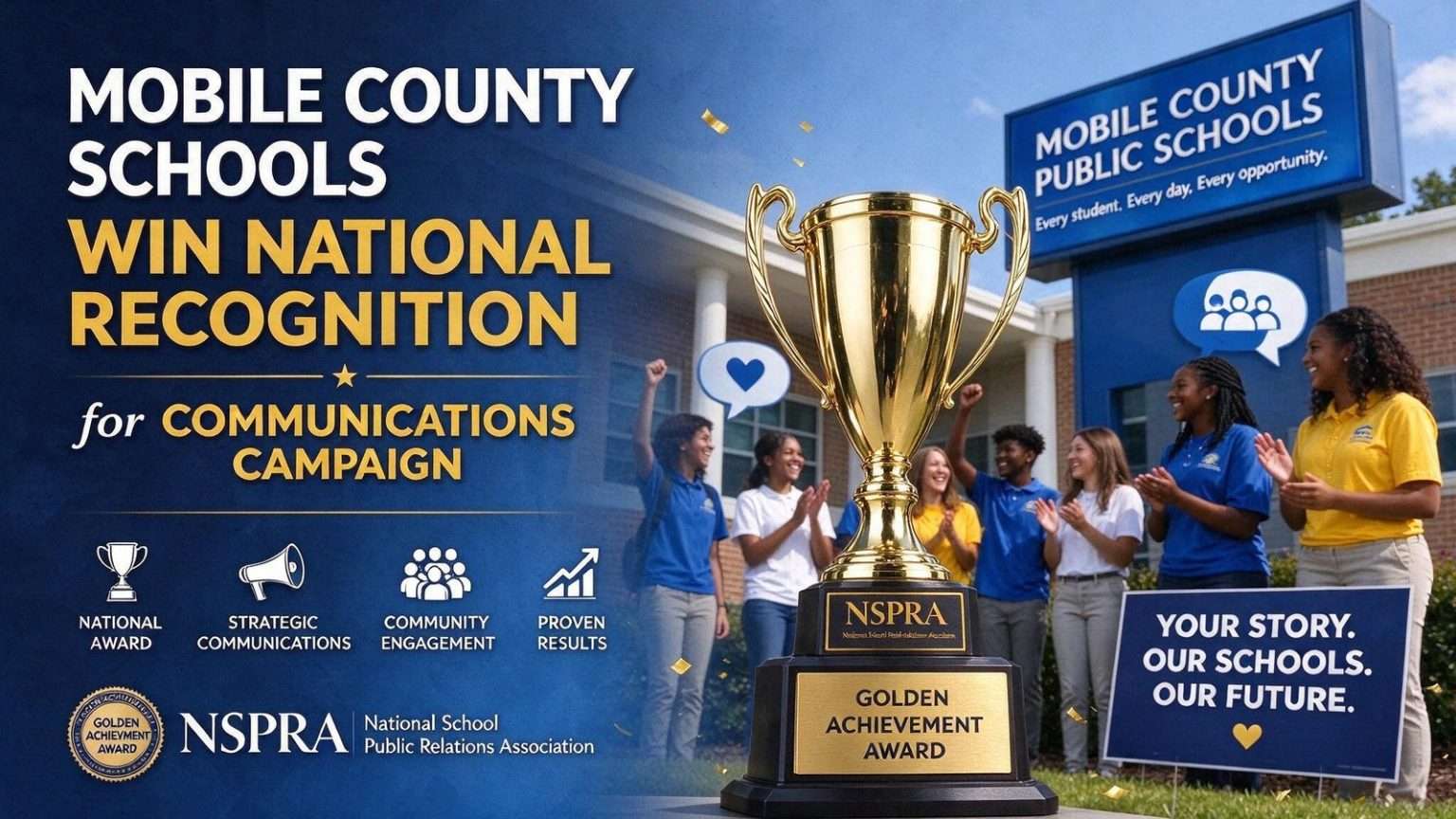
Mobile County’s public school system has picked up a top national honor recognizing its efforts to better communicate with parents and the broader community, adding another accolade to a district that has drawn increasing attention for its public outreach in recent years.
The Mobile County school system received a Golden Achievement Award from the National School Public Relations Association, a group that annually recognizes standout work across the country in school communications, marketing and community engagement.
According to the district’s marketing supervisor, the award recognized the system’s multi-year community engagement campaign, which launched roughly a year earlier. That effort included an overhaul of the district’s website, a stepped-up presence on Facebook and Twitter, partnerships with local businesses to sponsor billboards promoting the schools, and volunteer-driven community initiatives.
A Campaign Built to Change the Story
The campaign was aimed at a straightforward problem with deep roots: the state’s largest school district had spent years defined by outdated perceptions, and officials concluded that the story parents heard about Mobile County schools — in yards, workplaces and online comment sections — lagged far behind what was actually happening inside classrooms. The answer was not a single advertisement but a sustained drumbeat across every channel families use, from the website they check for bus schedules to the billboards they pass on Government Street and Interstate 10.
The website overhaul put the district’s information architecture in line with modern expectations, reorganizing everything from enrollment guidance to school menus so that parents could find answers without calling a central office. The social media expansion, meanwhile, took the district’s daily life directly to the community — classroom celebrations, athletic victories, scholarship announcements — building the kind of steady positive presence that changes minds one post at a time.
The campaign also incorporated contests designed to get students directly involved, including a jingle competition tied to the campaign’s branding and a naming contest for the district’s summer feeding program.
Those contests reflected a deliberate choice: a campaign about students works best when students make it. The jingle competition turned the campaign’s theme into music written by the young people it described, while the naming contest gave the summer feeding program — which provides free meals to children through the summer months — an identity chosen by the families it serves. Both generated the organic local coverage that paid advertising cannot buy.
National Attention Follows
The push for better public communication brought Mobile County schools national attention earlier in the year when the district’s superintendent appeared on the cover of a national school board publication, which highlighted her use of social media to connect directly with the public.
That visibility put Alabama’s largest school system in front of school board members and administrators nationwide as an example of how a big-city district talks with — not just to — its community. Superintendents who engage directly on social media remain a relative rarity among the nation’s large districts, and the national publication framed Mobile County’s approach as part of a generational shift in how school leaders communicate.
District officials plan to formally present the campaign’s strategy and results at the National School Public Relations Association’s annual conference in Baltimore this month, giving Mobile County educators an opportunity to showcase their work to a national audience of school communications professionals.
Conference presentations of this kind carry weight beyond the honor itself. Districts selected to present are effectively being held up as models, and the sessions draw communications directors from systems across the country looking for approaches they can adapt. For Mobile County’s staff, the Baltimore trip is also a recruitment of sorts — a chance to benchmark their operation against the best in the field and bring home ideas tested in districts of comparable size.
A Haul of Honors
Beyond the top award, the district also collected three additional Awards of Merit from the association for public service announcements featuring notable graduates of Mobile County schools, along with marketing materials and a special district publication.
The PSAs followed a proven format: graduates who have made their mark — in business, public service, the military and the professions — telling their own stories of where a Mobile County education took them. The spots gave the district’s success rate a human face, and the merit awards for marketing materials and the special publication recognized the print side of an effort often assumed to be purely digital.
The system’s in-house television studio separately earned two Honorable Mention recognitions, one for a student-produced show and another for a public service announcement focused on reducing violence.
The studio’s honors point to one of the district’s quieter assets. Operating its own television production facility gives a school system the capacity to produce broadcast-quality programming on a working budget, and putting students behind the cameras turns the operation into a training ground for careers in media. The violence-reduction PSA, produced in-house, also showed the campaign extending into the district’s most serious subject matter — speaking to students about safety in a voice and format built for them.
District officials credited staff across multiple departments, including communications, transportation, technology and the print shop, along with an outside web management partner, for contributing to the campaign’s success.
The list of credited departments is telling. Campaigns that win national awards usually look effortless in the finished product, but a district the size of Mobile County’s runs communications through every corner of its bureaucracy — buses that carry advertising and visibility, a technology division that keeps websites and data systems running, and a print shop that produces everything from the publications judges reviewed to the materials sent home in backpacks. The acknowledgment of an outside web partner also reflects the modern reality that most school districts buy their digital infrastructure rather than build it.
Officials said the Baltimore conference will also serve as a chance to highlight other recent achievements within Mobile County’s schools, including its Blue Ribbon-designated campuses, specialized high school academies and improving graduation rates.
Why the Recognition Matters at Home
For a district of its size, Mobile County Public Schools operates on a scale that most Alabamians underestimate: it educates more students than any other system in the state, spread across the city of Mobile, the suburbs of west Mobile County and the communities stretching to the Mississippi line. Communicating with that many families — across dozens of campuses and a wide range of neighborhoods — is a logistical task comparable to running a mid-sized city, and the awards recognize an operation built to do it well.
The stakes of the campaign are practical as well as reputational. School systems compete for enrollment, for teachers and for the tax support that follows public confidence. A district that tells its story effectively holds families who might otherwise choose elsewhere, recruits educators who want to work where morale is visible, and builds the community goodwill that bond referendums and budgets ultimately depend on.
The Golden Achievement Award now sits alongside the growing case the district has been making to its own community: campuses earning national Blue Ribbon recognition, high school academies that pair classroom learning with career pathways, and graduation rates that have climbed steadily as the system has focused on keeping students on track to the diploma.
For the communications staff who built the campaign, the trip to Baltimore closes a loop that began a year earlier with a website redesign and a Facebook page. It ends with their work being studied by peers nationwide — and with Mobile County’s schools, long the subject of conversation, doing the talking themselves.
The Golden Achievement Award itself carries a specific meaning within the school communications profession. NSPRA’s award tiers separate work that simply competes from work that changes practice, and the Golden Achievement designation has historically gone to campaigns judged exemplary in strategy, execution and measurable results rather than polish alone. Winning it places Mobile County alongside suburban and big-city districts with far larger communications budgets — a point district officials have made in describing what the honor says about how far the operation has come.
The timing also reflects how quickly the expectations placed on school communications have risen. A decade earlier, most districts posted menus and closure notices and called it public relations. The explosion of social media, combined with rising school choice and declining trust in institutions generally, forced systems to communicate continuously and persuasively or watch the narrative be written for them. Mobile County’s campaign — with its billboards, contests, video operation and executive-level social engagement — belongs squarely to that new era, and the national recognition suggests the district built it correctly.
Behind the campaign’s public face sits the question every district faces when it invests in outreach: what changes? District officials have pointed to a growing sense of pride reported on campuses, better turnout at school events and a feedback loop in which families who feel heard engage more — volunteering, attending board meetings and supporting referendums. Hard numbers are harder to attribute; graduation rates and enrollment are moved by many forces. But the communications professionals who judge such campaigns credit consistent, honest storytelling with exactly those long-term civic returns.
The awards will return home to a district office that has assembled a growing collection of them, and to staff members whose work usually reaches the public anonymously. For the students who wrote the jingle, named the summer feeding program and produced the television show, the honors are proof that the campaign’s central premise was right all along: the best messengers for Mobile County’s schools are the people inside them.