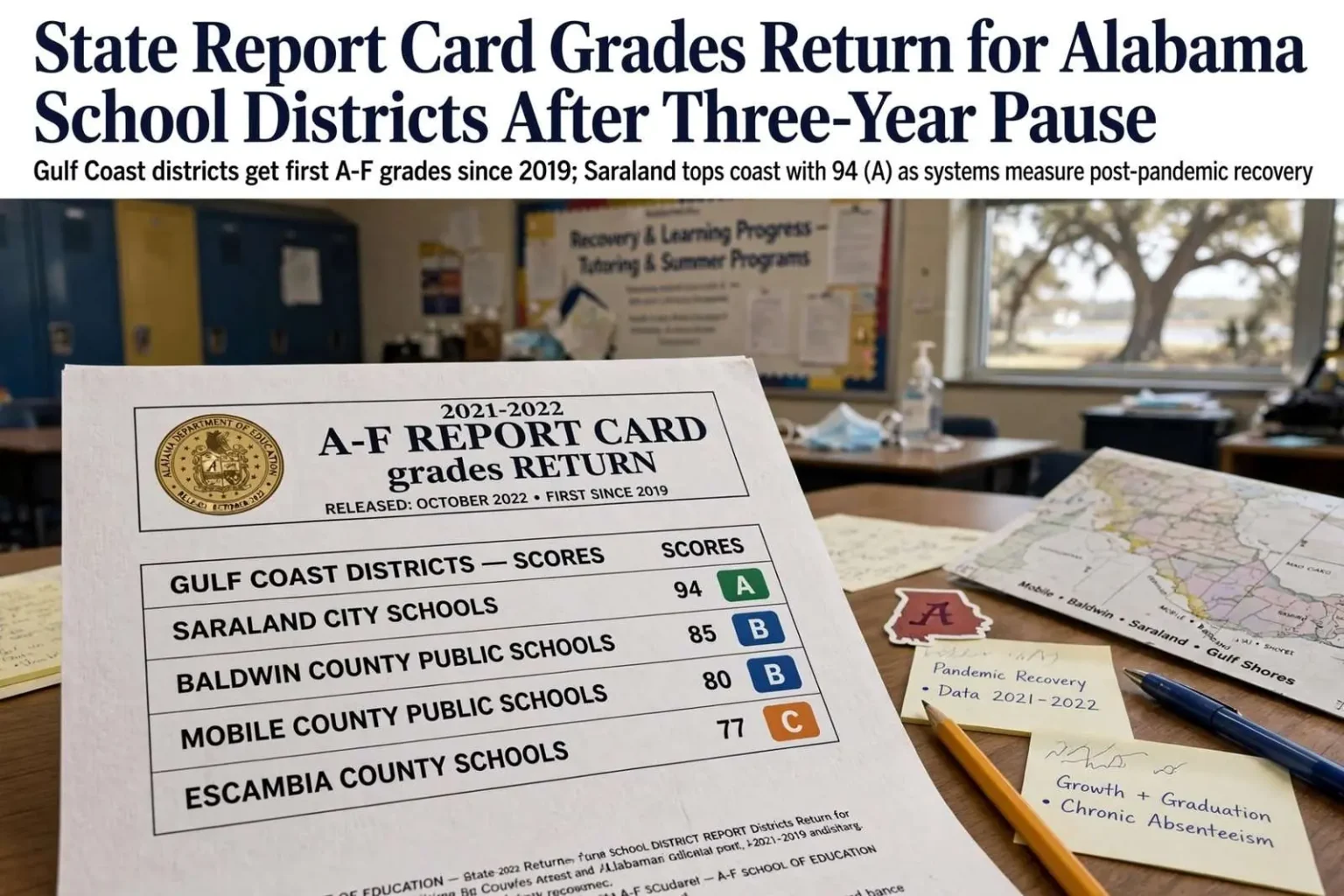
Alabama school districts are seeing how they measured up after the state Department of Education released its A-F report card grades for the first time in three years, giving Gulf Coast families their first look at post-pandemic district performance. The 2021-2022 release was the first since 2019. Federal reporting requirements had been waived during the COVID-19 pandemic, when remote learning and school closures disrupted accountability data nationwide — a gap that left parents, educators and taxpayers without the annual scoreboard that Alabama had used since the A-F law took effect.
The return of the grades carried more weight than a routine publication. The 2021-2022 data captured districts mid-recovery, testing how much ground students had lost to disrupted schooling and how effectively systems had clawed it back. For south Alabama, the release answered a question residents had been asking since classrooms went dark in March 2020: how did our schools actually come through it?
Saraland Tops the Coast
Saraland City Schools earned the highest mark along the Gulf Coast — a score of 94, an A — ranking fourth among Alabama’s 145 districts. Superintendent Dr. Aaron Milner credited a system-wide effort for the result. “It’s really a tribute to all of our employees, our support staff — it takes every single person in the school system,” Milner said. “It’s extremely rewarding knowing that we came through COVID and were able to not only maintain but exceed at each of our schools.”
Saraland’s standing is the product of a distinctive history. The city broke away from the Mobile County Public School System in 2012 to form its own city system, one of a handful of communities across Alabama that have separated from larger county systems in recent decades. The split left Saraland with a smaller, more concentrated student body and a tax base devoted entirely to its own schools, and the system has since become one of the state’s consistent top performers — regularly placing among the highest-scoring districts in Alabama and growing through annexation as nearby families sought the system’s schools.
Baldwin County Public Schools earned a B with an overall score of 85. The Baldwin system, one of the largest geographic districts in the state, spans the entire county from the Eastern Shore to Gulf Shores, serving communities that have boomed with coastal growth while absorbing the operational strains that come with rapid enrollment and wide distances. A B at 85 placed the system in solid standing as it continued to manage some of the fastest-growing school populations in Alabama.
Mobile County Public Schools, the state’s largest district, also received a B with an 80 — just a few points below its pre-pandemic grade from the 2018-2019 school year. For a system of roughly 53,000 students spread across urban, suburban and rural attendance zones, holding a B through the pandemic years was a performance that district leadership framed as resilience rather than decline — though the few-point slip from the pre-COVID mark showed the measurable cost of the disrupted years.
Where South Alabama Districts Landed
Escambia County Schools posted the lowest regional score at 77, a C, while Chickasaw City Schools, Clarke County Schools and Conecuh County Schools also received C grades. The cluster of C districts in the region told a familiar story of rural and small-town systems facing the pandemic with thinner means: narrower tax bases, older facilities, and less capacity for the rapid pivot to remote instruction that wealthier suburban systems managed. Chickasaw, which became a city school system after its own split from Mobile County, and the rural Clarke and Conecuh county systems each serve student populations with high levels of economic need.
The grades also reflected how the A-F formula weighs factors beyond raw test scores. Alabama’s report card system incorporates academic achievement and growth, chronic absenteeism, graduation rate and college- and career-readiness measures, meaning a district’s letter reflects a portfolio of outcomes rather than a single testing day. In a pandemic-affected year, those secondary measures — particularly graduation and readiness — worked in some districts’ favor, cushioning scores against the dips in achievement that testing showed statewide.
Mobile County Points to Scale and Pandemic Losses
Mobile County Superintendent Cresal Threadgill said she is proud the district maintained its B average despite steep obstacles, noting that the system still is working to close learning gaps for students who missed as much as a full year of school. The loss Threadgill described was uneven across her district: students with reliable internet and support at home lost months; students without them lost far more. Recovering those gaps has driven tutoring programs, extended learning time and summer programming across the system in the years since.
Threadgill also pointed to the district’s size — roughly 20,000 more students than the second-largest system in the state — and its high proportion of Title I schools serving families hit especially hard by the pandemic. Title I designation, which brings federal funding to schools where large shares of students come from low-income households, marks both a need and a support: Mobile County’s Title I schools received the federal support that helped fund recovery staffing and intervention, but the underlying economic conditions the designation measures were exactly the ones the pandemic deepened.
She highlighted an 88 percent four-year on-time graduation rate and noted that 82 percent of graduates are certified by the state as college- and career-ready. The readiness figure carries particular significance in Alabama’s accountability system, which in recent years has required students to demonstrate college- or career-readiness — through benchmarks like a qualifying ACT score, industry credentials, dual enrollment, military enlistment or career tech pathways — to graduate. The state’s phased increase in that requirement has pushed districts to broaden course offerings and credential opportunities, and Mobile County’s 82 percent placed it well ahead of the graduation line alone.
“Even though I am proud of everyone, I am not satisfied,” Threadgill said. “We will not become complacent; we will keep striving to become an A district.” The aspiration frames the system’s next target: converting a resilient B into the A that only a handful of Alabama’s largest districts have reached, against the headwinds of scale, poverty concentration and a multi-year academic recovery still underway.
What the Grades Do — and Don’t — Measure
Alabama’s A-F law was passed with the aim of giving families a single, understandable measure of school performance, replacing a patchwork of federal designations that many parents found opaque. The letter grades were first issued statewide in 2017, and they have been controversial ever since — championed by reform advocates as honest and demanded by parents, criticized by educators as an oversimplification that penalizes systems serving high-poverty populations. The state’s formula has been revised more than once, adding growth measures and adjusting weights in response to that criticism.
The three-year suspension of the grades, driven by federal waivers that also suspended national testing consequences, meant the 2021-2022 release functioned as both a report card and a research snapshot. Education officials cautioned against direct comparisons with 2019, since the learning conditions of the pandemic years had no precedent. Still, the release gave districts the first formal benchmark for recovery planning, and it gave families a fresh data point at a moment when questions about learning loss had become a national preoccupation.
For Gulf Coast communities, the regional picture was one of relative stability with familiar contours: Saraland’s A confirming its post-split trajectory, Baldwin’s B reflecting a growing suburban-coastal system, Mobile County’s B at the state’s largest scale, and the rural systems of the region clustered in the C range with their chronic challenges intact. The grades will return on the annual cycle from here, and each subsequent release will show whether the 2021-2022 numbers were a trough, a plateau, or the beginning of a climb — in Threadgill’s words, a reason to keep striving rather than a place to rest.
Behind the district-level letters sit the school-level grades that families often consult first, and the release renewed attention to the gap that can exist between a system’s overall mark and the performance of its individual buildings. A large district like Mobile County’s spans schools scoring at the top of the state and schools struggling at the bottom, and the average that produces a single letter can obscure both. Parents choosing schools, real estate agents fielding questions and school boards weighing budget decisions all read the school-level data more closely than the district summary, which is why the state publishes both.
The return of the grades also reconnected south Alabama’s systems to the accountability conversation that had been on pause since 2019. Boards that had deferred contested decisions while the data pipeline was dark now had fresh numbers to justify them, and superintendents across the region spent the days after the release doing what report cards always prompt: explaining the results, defending the trajectory and setting targets. In a year when every district in the country was navigating the same storm, Alabama’s letter grades offered its communities a local answer to a national question — and a reminder that the recovery from the pandemic classroom would be measured, publicly, one release at a time.