Mobile County School Board Weighs Adding E-Cigarettes to Tobacco Ban
Mobile County school officials considered expanding their tobacco use policy to explicitly prohibit e-cigarettes on campuses and at school events.
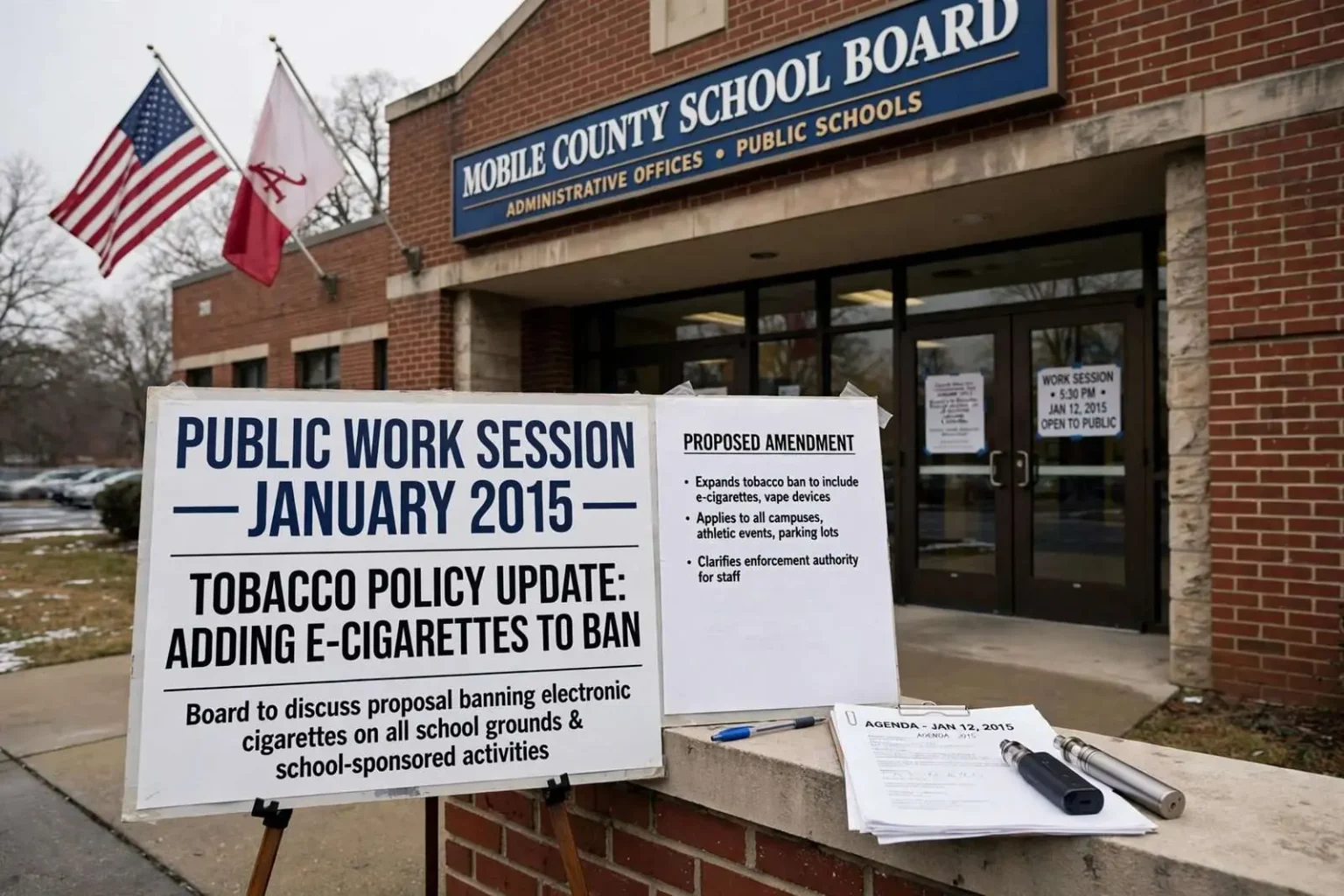
The Mobile County school board weighed a change to its tobacco use policy in January 2015 that would add electronic cigarettes to the list of products banned from school grounds and school-sponsored activities. Board members were scheduled to discuss the proposal during a work session before a possible vote at a later meeting, a process that put Mobile County’s largest school system in line with a growing number of Alabama districts rethinking rules written before vaping devices existed.
The existing policy already prohibited smoking and tobacco use across all campuses, but it did not specifically address e-cigarettes, the battery-powered devices that heat a nicotine-laced liquid into a vapor that users inhale. The revised wording would make clear that all forms of e-cigarettes fall under the same restrictions as traditional tobacco products, closing what administrators described as a loophole that made enforcement difficult when staff or visitors used the devices in parking lots, at athletic events or inside school buildings.
School officials said the ambiguity mattered in practice. Because e-cigarettes produce a visible cloud and often carry fruit or candy flavorings, teachers and coaches had reported uncertainty about whether they could confiscate devices or discipline students found with them. A policy that explicitly names the devices, administrators argued, gives principals clear authority and gives students and parents clear notice of the rules.
A Market Booming, and a Youth Warning Sign
E-cigarettes have often been marketed as a safer alternative for adult smokers trying to quit, and the national market for the devices had grown to roughly $3 billion by the time the Mobile County board took up the issue. Vape shops had multiplied along commercial corridors in Mobile and across the Gulf Coast, selling devices and flavored liquids in a retail landscape that barely existed half a decade earlier.
But public health researchers were also raising alarms about youth use. A National Institutes of Health report released in December 2014 found that e-cigarettes had overtaken conventional cigarettes in popularity among teenagers, a trend that added urgency to school policy discussions across the country. The finding marked a turning point in the public debate: for decades, teen cigarette smoking had been declining, and health officials worried that flavored vapor products were reversing that progress by reintroducing nicotine to a new generation.
Health educators in Alabama schools had begun adjusting their prevention curricula in response, adding lessons on nicotine exposure and the unknown long-term effects of inhaling vaporized flavoring compounds. Teachers reported that students often believed the devices were harmless because they contained no tobacco leaf, a misconception that educators and school nurses said made early policy clarity all the more important.
Under Alabama law, e-cigarette sales are already restricted to buyers 19 and older, the same age threshold the state applies to tobacco products. Retailers statewide were required to check identification, and violations carried penalties, giving Alabama one of the stricter age standards in the region even before local governments and school boards began crafting their own rules.
A Gray Area in the City’s Smoking Ordinance
Local officials noted that e-cigarette use had become increasingly visible in places around Mobile where traditional smoking was already prohibited, including retail stores and public venues such as the Mobile Civic Center. Workers and patrons had complained about vapor clouds in indoor spaces covered by the city’s smoking rules, leaving venue operators without a clear answer when confronted with the devices.
The city’s broader smoking ordinance, adopted in 2012, restricts smoking in most public places but does not explicitly mention e-cigarettes, leaving something of a gray area that the school board’s proposed policy aimed to close, at least for its own campuses. The gap meant that Mobile’s rules were stricter for a pack of cigarettes than for a nicotine vaporizer, an inconsistency city leaders acknowledged but had not yet acted to fix in the wake of the school board’s discussion.
Mobile County would not have been the first South Alabama school system to take this step. The Baldwin County school board updated its own tobacco policy back in November 2013 to explicitly cover e-cigarettes, water vapor cigarettes and other nicotine delivery devices, treating possession by students as a policy violation. Baldwin’s action, taken a full year earlier, gave Mobile County administrators a nearby precedent and a model of the kind of language they could adapt.
Beyond schools, some Baldwin County municipalities had also begun grappling with e-cigarette regulation: the Foley City Council voted in June 2014 to ban the devices in public places and workplaces, while Orange Beach officials discussed a similar measure without taking formal action. Foley’s ordinance made the south Baldwin County city one of the first in Alabama to extend its smoke-free rules to vaping indoors, and it prompted councils across the region to place the question on their own agendas.
The differing responses across South Alabama illustrated how uneven the regulatory landscape had become. A person could use an e-cigarette legally inside a Mobile retail store, face penalties for the same act in Foley, and be disciplined at a Baldwin County school while a Mobile County campus had no explicit rule — a patchwork that local officials on all sides said begged for consistency.
Washington Weighs In
At the federal level, the Food and Drug Administration had proposed rules earlier in 2014 that would subject e-cigarettes to agency review, ban sales to minors nationwide and require warning labels, though the timeline for finalizing those regulations remained uncertain. The proposed rule extended the FDA’s tobacco authority to cover the devices for the first time, and stakeholders on both sides — public health groups and vape industry representatives alike — flooded the agency with comments on how far the rules should reach.
The uncertainty in Washington was itself part of the argument for local action. School attorneys advising districts across Alabama noted that until federal rules took effect, the only enforceable standards were state law and local policy, which meant boards like Mobile County’s were effectively writing the front line of regulation for the students in their care.
Industry representatives, for their part, argued that e-cigarettes could be a legitimate tool for adult smokers and pushed back against regulations that lumped the devices with tobacco. Public health officials countered that whatever the merits for adults, flavored products and youth-oriented marketing created risks that demanded the stricter treatment now spreading through school systems and city councils.
What the Policy Change Means in Practice
For Mobile County’s roughly 59,000 students and thousands of employees, the practical effect of the policy change would be to treat a vape pen the same way a pack of cigarettes is treated under existing rules: possession by students draws disciplinary consequences, and use by anyone is prohibited on campuses, in stadiums, on buses and at any school-sponsored activity. Administrators said that consistency simplifies training for staff, who would no longer need to sort devices into categories before acting.
The policy would also cover visitors. Sporting events at Ladd-Peebles Stadium, graduations, concerts and other gatherings on school property all fall within the district’s tobacco-free umbrella, and adding e-cigarettes to the policy closes the same gray area for spectators that it does for employees. District officials noted that signs and handbooks would need updating once the board acted, a modest cost compared with the enforcement questions the current ambiguity creates.
Student health advocates pointed to the broader context for the timing. The NIH report’s finding that vaping had surpassed smoking among teens arrived just as Alabama’s students returned from winter break, and school boards across the state spent the winter reviewing their own policies against the new data. Guidance from state school administrators encouraged districts to name e-cigarettes explicitly, arguing that courts and hearing officers look for specific language when discipline is challenged.
Mobile County’s discussion also reflected the pace of change in the marketplace. When most Alabama districts wrote their tobacco policies, the phrase referred to cigarettes, smokeless tobacco and cigars — products with a century of regulation behind them. The devices now sold in vapor shops didn’t exist when those policies were drafted, and boards have had to play catch-up as product categories multiplied from pens to mods to small, discreet devices that are easy to conceal.
A Regional Reckoning
The Mobile County school board’s discussion reflected a broader reckoning among South Alabama institutions over how to treat a product that didn’t exist when most tobacco policies were originally written. Within a span of months, a county school board in Baldwin, a city council in Foley and federal regulators in Washington had each moved to close the gap, each at its own pace and with its own scope.
If the board approves the change, Mobile County would join the majority of Alabama’s large districts in treating e-cigarettes as tobacco under school policy, aligning its rules with the Baldwin County precedent and with the direction of state law. Administrators said they would pair the new language with education for students and parents, emphasizing that the goal is prevention rather than punishment alone.
For now, the board’s work session represented the first formal step in Mobile County’s response to the vaping trend. Whether the final vote comes at the following meeting or later, the direction was clear: policies drafted in a cigarette era are being updated for a vapor one, and the largest school system in South Alabama was moving to make sure its campuses were no longer in the gray area.