Teachers’ Union Demanded Mobile County School Board Open Its No-Bid Contracts
The Mobile County Education Association asked the school board president to release records on hundreds of thousands of dollars in no-bid contracts, questioning whether vendors who donated to the system got preference.
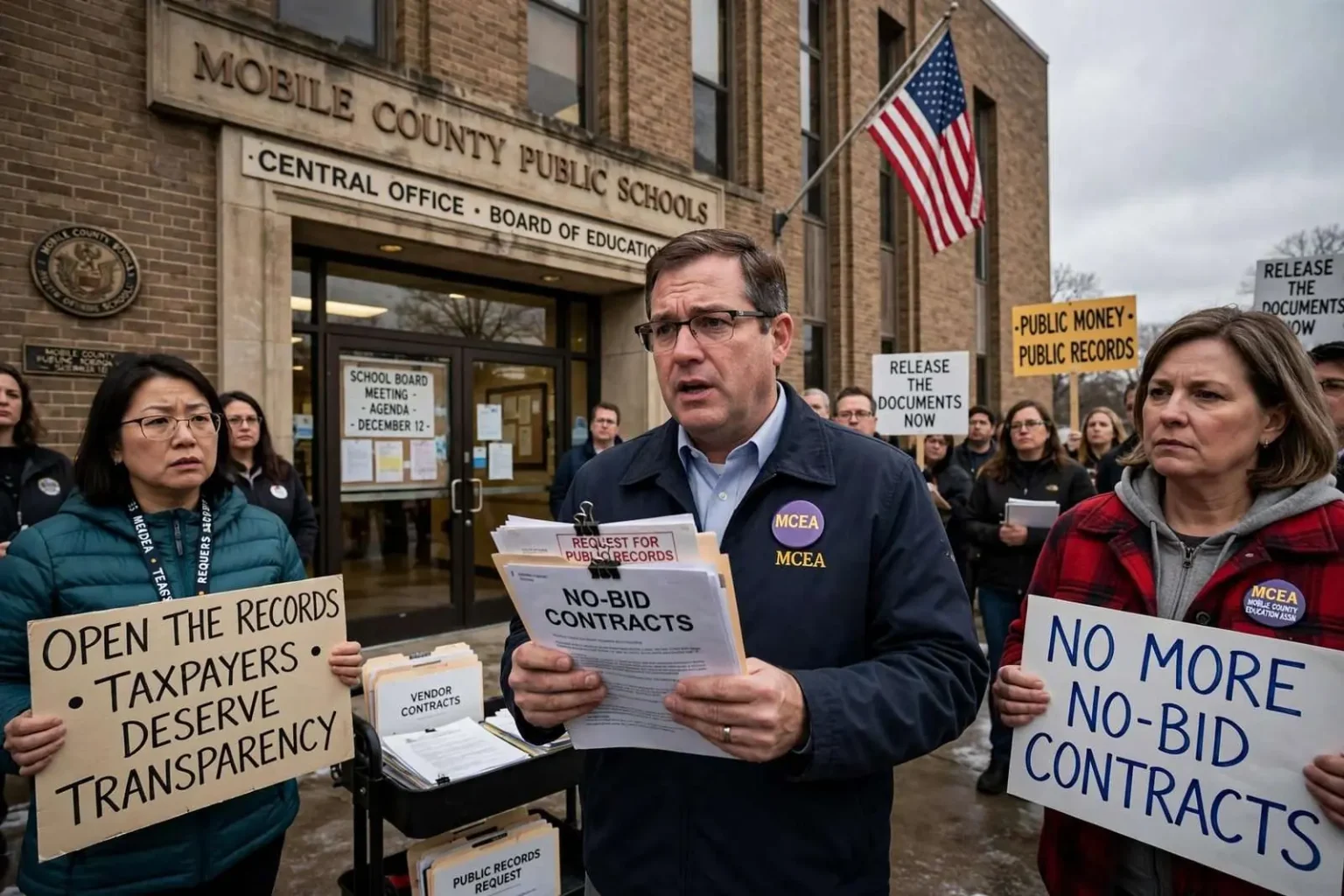
The Mobile County Education Association demanded that School Board President Judy Stout release public documents detailing what the teachers’ organization called “the hundreds of thousands of dollars in taxpayer funds being doled out in the form of no-bid contracts paid by the Mobile County Public Schools.” The demand followed what the association described as the revelation of an ethically questionable practice: the solicitation of funds from vendors who were doing business with the school system.
The system at the center of the demand was the largest public school employer in Alabama, an operation of some hundred schools stretching from downtown Mobile to the fast-growing suburbs of west Mobile and the small towns of the county’s northern tier. Its purchasing decisions ran from janitorial services and bus contracts to textbooks, technology and construction, and its board — five members elected by district — controlled that spending with little day-to-day oversight beyond its own administration.
The Core Allegation
MCEA Director Wade Perry laid out a sequence that, if accurate, described a closed loop. The school system solicited contributions from companies. Some of those companies received contracts. Many of those contracts were awarded without competitive bidding.
Perry wanted to know whether the two facts were connected. Specifically, the association questioned whether the firms that contributed funds to the school system received preferential treatment when they were selected for thousands of dollars in public school work, and, as Perry put it, “more importantly, whether or not the school system and the tax-payers could have gotten a better deal if these contracts had been competitively bid.”
The logic of the accusation was simple enough to fit on a handbill. A company that gives money to a school system is either a generous neighbor or a vendor courting the agency that buys its goods; the record cannot distinguish between the two unless the contracts are shown. And a system that both solicits from its vendors and exempts their contracts from bidding has, at minimum, a conflict it must explain — whatever the auditors eventually find.
“It is time for Judy Stout and the school board to come clean and publicly release any and all information regarding the solicitation of vendors and the board’s approval of thousands and thousands of dollars in no-bid contracts,” Perry said. “It’s the tax-payers’ money, not the school board’s, and the tax-payers deserve to know the truth.”
He added the line that always accompanies such demands and always puts the recipient on the defensive: he anticipated prompt disclosure “if there is nothing to hide.”
The Board’s Response
In a letter to Perry, Stout said the request had been conveyed to School Superintendent Harold Dodge and that “the mechanics of the system’s response will be determined.”
It was, in the careful language of institutional correspondence, neither a yes nor a no. The board’s president had acknowledged receipt, identified the official who would handle the matter, and promised a process — while declining to commit to the disclosure itself. For the association, the phrase “will be determined” was precisely the problem: a records demand that ends with an undetermined response is a demand that can be managed indefinitely.
The routing of the request to the superintendent was also telling. The contracts at issue had, on the association’s account, been approved through the administration and the board together; referring the question to the administration meant asking the office closest to the transactions to decide what the public would learn about them. School systems commonly handle records requests that way, and no one had suggested Dodge would do anything improper — but the optics of the custodian investigating his own filing cabinet were not lost on the teachers.
Why No-Bid Contracts Draw Fire
Competitive bidding exists to accomplish two things: to get the taxpayer the lowest responsible price, and to remove the awarding official’s personal discretion from the transaction. Alabama’s competitive bid law requires public entities to seek bids for purchases above a statutory threshold, with carve-outs for professional services and certain other categories. Those exceptions are where the trouble usually lives.
Professional service contracts, consulting agreements and specialized purchases can be awarded on judgment rather than price, which is defensible in principle and difficult to police in practice. A system needs architects who can design a school and lawyers who can negotiate a bond issue, and neither service is sensibly bought the way plywood is bought. But the same exception can shelter a catering invoice, a training contract or a communications campaign whose vendor was never tested against the market — and once an agency develops a habit of choosing among favored firms, the line between judgment and patronage exists only in the awarding official’s memory.
Layer onto that a school system that had been asking its vendors for donations, and the appearance problem becomes acute regardless of whether any individual contract was improper. A vendor asked for a contribution by an agency that also decides who gets its business is not operating in a neutral market.
The economics of the school-vendor relationship made the solicitation practice harder to defend than it might have looked from the boardroom. The system was the dominant purchaser in its categories across the county — the school bus contractor, the copier supplier and the food vendor each lived or died by the district’s renewals — so a “request” for a contribution carried the weight of an invoice. Vendors who gave could expect the relationship to continue; vendors who declined had no way to prove that declining cost them nothing. The donation itself might be small. The leverage was not.
There was also a public-money question underneath the ethics one. Donations solicited from companies doing business with the system were, in a meaningful sense, an off-budget revenue stream: money the system extracted from vendors came from the same economy of taxpayers who funded the system’s appropriations, and it flowed back into spending that no appropriation and no bid had ever authorized.
An Unusual Antagonist
The identity of the accuser gave the episode extra weight. This was not a taxpayer watchdog group or a defeated contractor. It was the teachers’ organization, the body that represents the system’s own employees, publicly accusing the board that employs them of mishandling public money.
Teacher organizations in Alabama had substantial political muscle. The local associations operated under the umbrella of the Alabama Education Association, one of the most effective lobbying operations in the state, and their endorsements, campaign workers and turnout machinery mattered in every Mobile County school board race. A public break between the MCEA and the school board signaled a rupture that went beyond a records request — it meant the employees’ organization had concluded that its relationship with the board’s leadership was worth spending.
That calculation told outside observers something about the state of the relationship. Local education associations rarely confront the board that signs their members’ paychecks unless the membership is angry, the evidence is uncomfortable, or both. Perry’s statement read as the work of an organization that had run out of the private channels — the phone calls, the meetings, the quiet questions — through such disputes are usually absorbed.
The Wider Climate
The demand arrived in a year when the stewardship of public education money in Mobile County was already under sustained scrutiny, with questions swirling around board members, administrators and the two-year college system across town.
The two-year college scandal had made school finance a standing front-page subject across Alabama. Investigations into the state’s community college system had exposed payroll arrangements, contract awards and legislative interconnections that reached into nearly every county, and the trials and disclosures flowing from those investigations had taught the public a vocabulary — dual roles, contract steering, no-bid work — that made every new allegation easier to understand and harder to dismiss.
Mobile County’s own institutions were not insulated from the mood. The county school board had drawn criticism in recent years over administrative spending and personnel decisions, and the daily paper’s coverage of the system’s finances had primed readers to treat a no-bid contract story as part of a pattern rather than an anomaly. Into that atmosphere, the MCEA’s demand landed as confirmation rather than surprise.
The episode also fed a longer-running argument about how the board did its business. Critics had long complained that the system’s budget process was opaque — that contracts, supplements and departmental spending moved through board agendas as consent items, grouped and approved in minutes, with the real decisions made in the administration building before the public ever saw them. A demand for the complete no-bid contract record was, in that light, a demand for the ledger behind the consent agenda.
Who asked: Mobile County Education Association, through Director Wade Perry.
Who was asked: School Board President Judy Stout.
What was sought: A full accounting of all no-bid contracts for the past several years.
The suspicion: That vendors solicited for donations received preferential treatment.
The answer so far: The request was passed to Superintendent Harold Dodge.
Whether the documents would be produced, and what they would show, remained to be seen. What was already established was the stakes: a school system that touches the largest local budget in the county, an employees’ organization willing to accuse its own employer in public, and a board whose answer — disclosure or delay — would define how the story was understood. In the vocabulary the era had taught Alabama’s taxpayers, the question was no longer whether the practice looked bad. It was whether anyone would be made to show the paper.