An Odd GOP Primary for a Mobile County School Board Seat
A GOP primary for a Mobile County school board seat pitted appointed incumbent Judy Stout against John Holland, who had resigned the same seat a year earlier after an ethics complaint, in a race full of oddities.
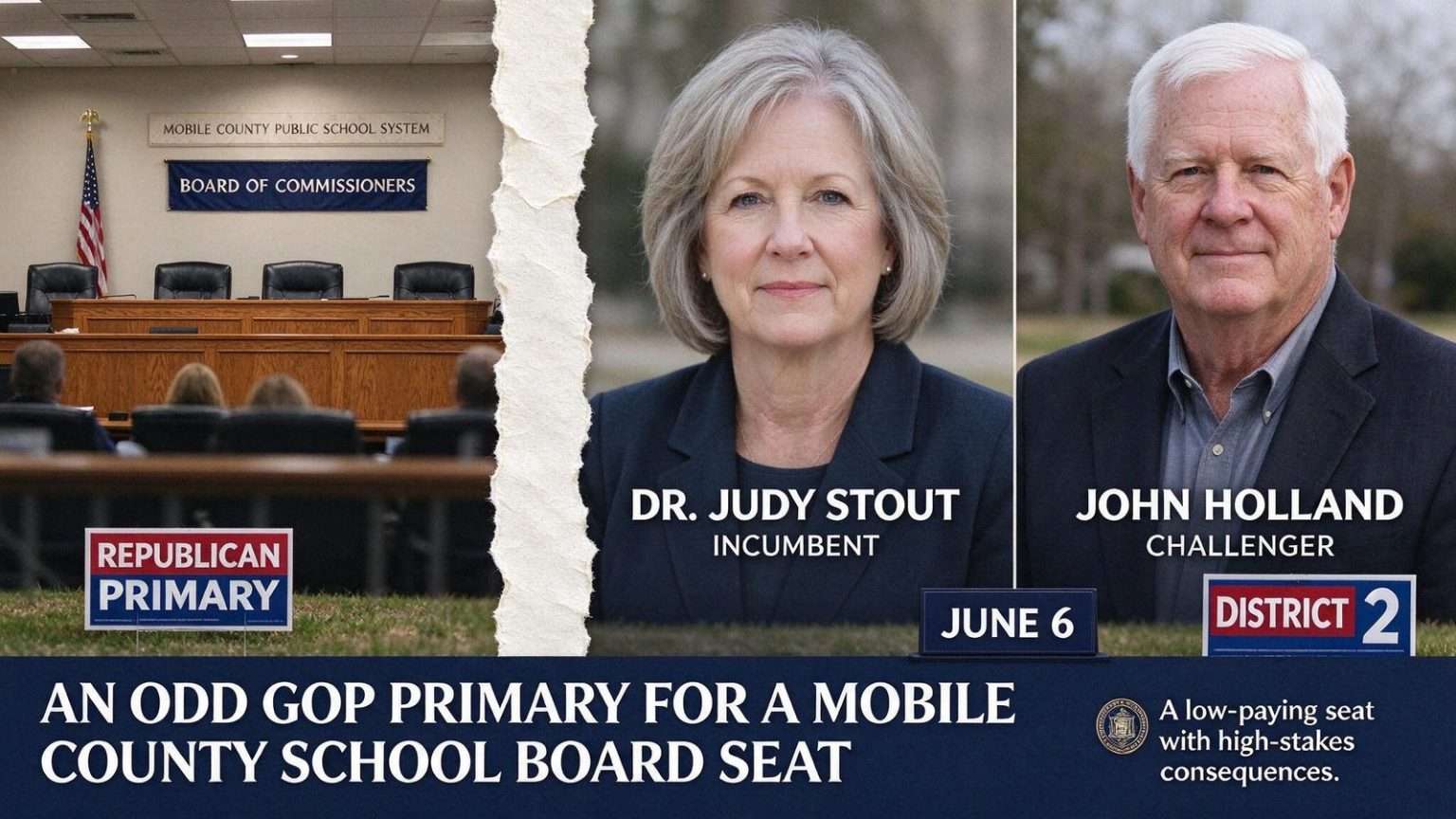
The Republican primary between Dr. Judy Stout and John Holland for a seat on the Mobile County Public School System’s Board of Commissioners was, by almost any measure, an unusual contest — and perhaps fittingly so, given that the winner’s prize was six years of service for less than $1,000 a month. The District 2 primary was scheduled for June 6, and while school board races rarely attract much attention in a busy Alabama election year, this one had accumulated enough oddities to keep political watchers in Mobile County talking from the moment qualifying closed.
It was odd, first, because the challenger was the candidate with the winning track record. Holland had succeeded at the ballot box before; Stout, the incumbent, had never run for or won public office. She had been appointed to the board rather than elected, stepping into a vacancy that only existed because the man now running against her had given it up. In a race where the conventional wisdom held that incumbency is the strongest asset a candidate can carry, the incumbent was in many ways the political newcomer, and the challenger was the one with the history of winning county-wide approval from Republican primary voters.
A resignation, and a return
Holland was seeking the very seat he had won in the previous election, only to resign it after an ethics complaint. The complaint centered on his votes in favor of projects involving Volkert Engineering, a firm with which he had a family connection: his son-in-law was employed there. After his departure from the board, Stout was selected to fill the vacancy, giving her the incumbent’s perch even though she had never faced the voters of the district.
Holland said he regretted stepping down, comparing his offense — the votes involving Volkert — to “a speeding ticket that didn’t get expunged.” The characterization was an attempt to frame the episode as a minor blemish rather than a disqualifying scandal, and it set up the central question of the campaign: whether Republican primary voters in the district would treat the ethics complaint as old news, forgiven and forgotten, or as a reason to stick with the woman who had replaced him.
The Ethics Commission process that produced the complaint is a routine part of Alabama government, but it rarely touches local school boards, and the episode made the District 2 race a genuine curiosity. Board members in Alabama are generally barred from voting on matters in which they or close family members have a financial interest, and questions about how strictly those conflicts are policed have surfaced repeatedly over the years in districts across the state. Holland’s case became a local example of how quickly a family connection can turn a routine contract vote into a career problem.
There were other quirks. Stout was running as a Republican in the same cycle in which her husband, Circuit Judge Rick Stout, was set to keep his seat on the bench, unopposed, as a Democrat. That arrangement — a husband and wife appearing on the same ballot under opposite party labels, one facing no opposition and the other locked in a primary fight — underscored just how unusual the race was. Alabama’s judicial races have long blurred party lines, and a circuit judgeship in Mobile going unchallenged by Republicans is hardly rare; a school board member married to a sitting Democratic judge running as a Republican most certainly is.
And Holland, who billed himself in campaign materials as “The Republican,” was drawing more than half of his financial support from political action committees tied to the local teachers’ union — an organization whose longtime leader, Paul Hubbert, ranked among the most powerful Democrats in Alabama. Hubbert served as executive secretary and treasurer of the 94,000-member Alabama Education Association, and for decades the AEA was a force in state politics, with a track record of influencing legislative races and local campaigns across Alabama regardless of the party label on the ballot.
The image of a self-styled conservative financed in significant part by union-linked PACs gave Stout plenty to work with on the campaign trail, and it gave voters one more layer of contradiction to sort through. In south Alabama, where the AEA’s influence has often been a talking point for primary voters, the money trail was as likely to be a campaign issue as the ethics complaint itself. Holland’s camp, for its part, could point to his previous win in the same district as evidence that voters cared more about the candidate than the source of the checks.
The money race
Campaign finance disclosures underscored the gap between the two candidates’ war chests. Holland reported an ending balance of $19,634.80. He listed itemized cash contributions totaling $19,375 and a $4,000 loan to his own campaign, and after $3,740.20 in spending he had just short of $20,000 available in the weeks before the primary.
Those are meaningful numbers for a school board race in which the job pays less than $1,000 a month. In a typical Mobile County school board contest, candidates frequently spend only a few thousand dollars, and many win with far less. Holland’s ability to approach the $20,000 mark reflected both the PAC money flowing in from the education-union network and the urgency of a candidate who had to reintroduce himself to the voters who had last seen him resign in controversy. The loan he made to his own campaign also signaled that he considered the seat worth pursuing with real money, whatever the salary.
The disclosures were filed under Alabama’s campaign finance laws, which require candidates to report contributions and expenditures in the weeks leading up to an election. The reports give voters a window into who is bankrolling a campaign, and in races like this one — where the salary is symbolic but the influence over a large school budget is not — the source of the money often says more than the amount.
Why the seat matters
The low pay and the odd politics should not obscure what the job actually is. The Mobile County Public School System is the largest school district in Alabama, serving tens of thousands of students across Mobile, Prichard, Chickasaw, Saraland and the surrounding communities, and its Board of Commissioners sets policy for a system with thousands of employees and an annual budget that runs into the hundreds of millions of dollars. Board members vote on construction contracts, superintendent evaluations, school zoning questions and the sort of building and maintenance projects that kept companies like Volkert Engineering busy across the county.
District 2 covers a slice of the county whose voters know the school system intimately, from the crowded-growth corridors in the western part of the county to the older established neighborhoods closer to the city. Decisions made at the board table — which schools get renovated, where new classroom wings go, how the system responds to shifting enrollment — land directly on the families of the district. That is part of why the race’s strange circumstances drew attention: the prize is modest in salary but substantial in consequence.
The six-year term means the winner will help steer the system through multiple budget cycles and, quite possibly, through a change in the superintendency and any number of state policy shifts coming out of Montgomery. School board service is famously unglamorous — night meetings, long agendas, constituent complaints about bus routes and rezoning — and the sub-$1,000 monthly compensation reflects the expectation that members are motivated by civic duty rather than income.
What comes next
With the June 6 primary approaching, both campaigns had reasons for confidence. Holland had the money, the name recognition from his previous term and a winning history with the same electorate. Stout had the incumbent’s platform, a clean record in the seat and a campaign narrative built on stability after a resignation. The cross-currents of party, family and union money made the race one of the more closely watched down-ballot contests in Mobile County’s June balloting.
How the vacancy was filled in the first place also shaped the contest. When a school board seat opens mid-term in Mobile County, the remaining members are the ones who choose a replacement, which means Stout arrived in the job with the endorsement of the very board she was joining rather than the blessing of the electorate. Appointment by the board is a standard mechanism under state law, but it leaves the new member answering to colleagues rather than constituents until the next election gives voters the final word. That is precisely the moment this primary represented: the first time the district’s voters would pass judgment on the arrangement, and the first time Stout would stand before them as anything other than an appointee.
The winner of the primary would carry the Republican label into the general election in the fall, where the seat’s ultimate fate would be settled for the next six years. Whatever the outcome, the race stood as a reminder that in Alabama local politics, the path to a school board seat can run through an ethics complaint, a resignation, an appointment, a husband’s judgeship and a flood of union-linked PAC money — sometimes all at once. For the voters of District 2, the June 6 primary offered a rare chance to settle the whole tangled story with a single trip to the polls.