Final Pre-Primary Filings Show a Cash Sprint in Mobile County’s Commission and School Board Races
The last campaign finance reports before the June 1, 2004 primary showed Mobile County Commission and school board candidates burning through cash, with big PAC checks and a late surge from Ralph Buffkin.
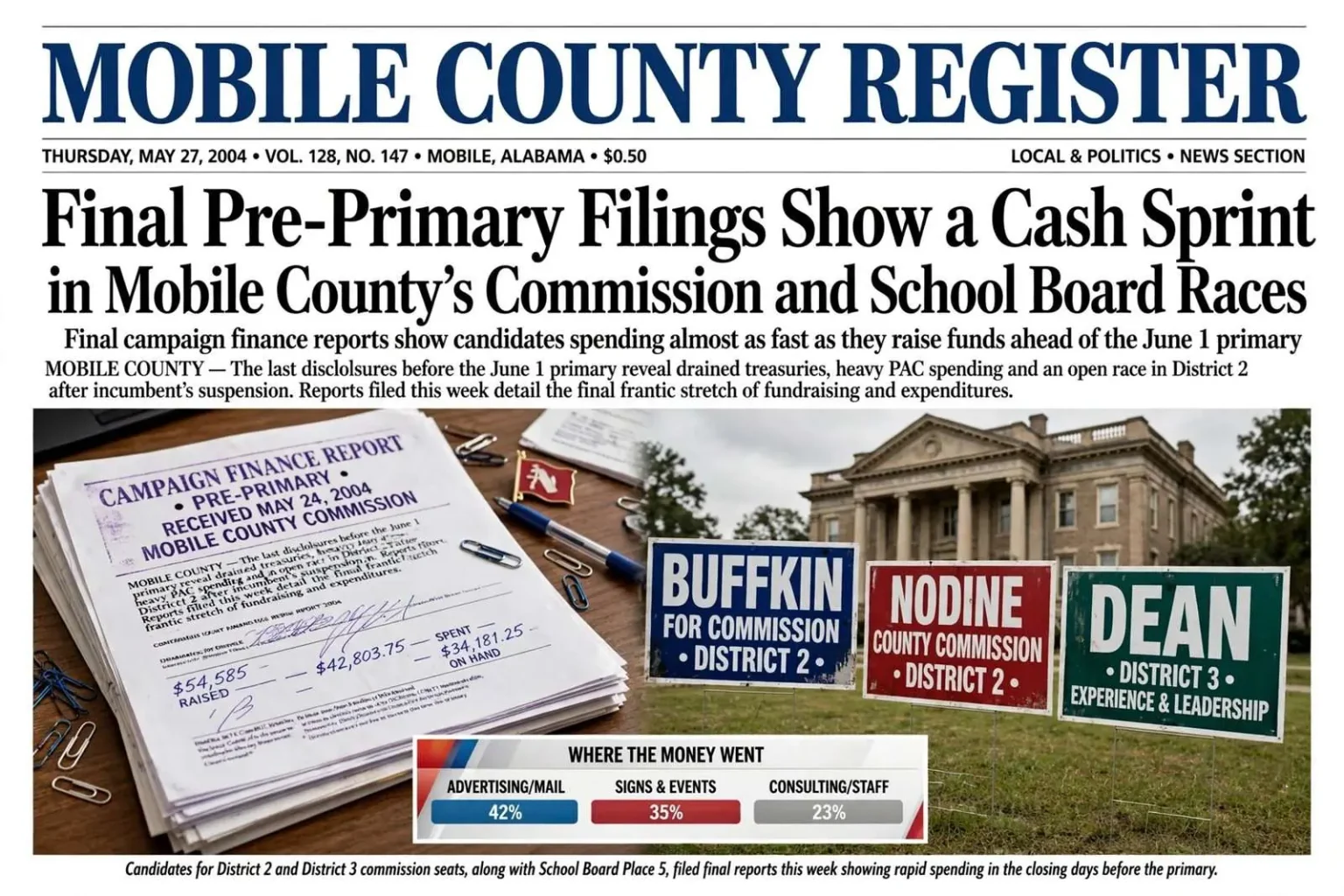
The last campaign finance disclosures before the June 1, 2004 primary landed with candidates for the Mobile County Commission and the Board of School Commissioners of Mobile County spending money almost as fast as they could take it in. The five-to-ten-day pre-election reports covered the final frantic stretch of the campaign, when television time, direct mail and last-minute sign blitzes consume whatever a candidate has left. In several cases, they showed treasuries that had been drained nearly to the bottom by election eve.
The filings read like ledgers of a sprint. Primaries in Alabama’s largest county are decided largely by advertising and name recognition, and the final weeks are when a campaign either surges or stalls. The 2004 reports captured that dynamic in dollar-for-dollar detail, race by race, from the commission’s riverfront district to the south Mobile County seats on down the ballot.
County Commission, District 2
Stephen R. Nodine opened the period with $33,822.78 and raised another $28,412 in cash, plus $3,500 in in-kind support — the latter including catering and restaurant contributions from Wintzell’s, Naman’s Catering and MH3 LLC. He spent $42,019.31, closing with $19,275.47. Among his larger backers: the Mobile Firefighters Association at $5,000, RSVP PAC at $2,550, Steve Windom LLC at $2,000, William Lyon at $1,500, and $1,000 checks from Lyons and Crane Attorneys and Mobile Auto PAC. Anheuser-Busch, the Lamar Companies and a long roster of Mobile business figures rounded out the list.
Nodine’s report reflected the profile of an established Mobile politician: fire-service money, downtown business names, and the in-kind support that comes from a city’s restaurant and hospitality world. Wintzell’s — the storied oyster house on Dauphin Street — and the caterers named on the report supplied the fundraisers and events that made up a visible slice of his final push.
Ralph Buffkin posted the period’s most striking numbers. The first-time candidate opened with $22,400 and pulled in $54,585 in fresh cash — nearly double what either rival raised. He spent $42,803.75 and entered the home stretch with $34,181.25, the largest war chest in the race. The single biggest item on his report was $15,200 from South Alabamians for Good Government. Other five-figure support came in $1,000 to $3,000 increments from physicians, attorneys, shipping and construction interests, including MOJO Partnership at $2,000 and Canpac at $2,000.
For a candidate with no prior office, Buffkin’s haul was the kind of showing that turns a first campaign into a serious one. The bundle from South Alabamians for Good Government alone rivaled what some rivals raised in total, and the breadth of the professional interests behind the rest — doctors, lawyers, shipping and construction — suggested a challenger whom Mobile’s established donors had decided to back.
Austin L. Rainwaters opened with $29,826.18, raised $37,321.25, and he and his wife loaned the campaign a further $15,000. Then he spent nearly all of it: $74,507.77 in expenditures left him with just $7,639.66 on election eve. His donors included Bizpac and Fair PAC at $2,500 each, the Central Alabama Republican Council at $2,000, AEM LLP at $5,000 across two contributions, and a Free Enterprise PAC check for $1,000.
Rainwaters’ filing was the picture of a candidate holding nothing back. The loans from the candidate and his wife pushed the campaign’s total resources past $80,000, and the expenditures consumed virtually all of it — a all-in strategy that bet the outcome on whatever the last mailers and media buys could accomplish.
Freeman Jockisch, the incumbent, filed as a suspended campaign. He had been convicted in federal court in connection with the handling of his campaign money and had asked to be removed from the ballot. His absence reshaped the District 2 contest into an open race among the remaining candidates — and put the others’ spending at the center of a field suddenly without a front-running officeholder to run against.
County Commission, District 3
Mike Dean, the incumbent, opened with $23,992.24, raised $28,550 in cash and $4,249.88 in in-kind support, and spent $40,787.23 — leaving $11,830.01. His report was thick with political action committee money, including four separate $2,500 checks from IMPAC, FAXPAC, LEGPAC and CANPAC, all listing the same Montgomery post office box, plus $2,500 from the Alabama Builders PAC.
The cluster of Montgomery post-office-box PACs was a signature of Alabama campaign finance in the era — industry-backed committees with parallel names, some sharing filing addresses, contributing in matching amounts to friendly candidates. Dean’s report collected them in neat, repeated $2,500 increments, alongside the builders’ PAC money that tracks construction interests in every Alabama county race.
Michael Burdine, the Mobile police officer challenging Dean, opened with $11,513.78 and raised $8,618 in itemized and non-itemized cash. He loaned his campaign $11,500 more and spent $25,479.26, closing with $6,152.42. His donors were mostly individuals and small south Mobile County businesses, including Rodriguez Boat Builders at $500.
Burdine’s ledger was the classic challenger’s mix — personal money, modest individual gifts, and support from the small businesses of the district he was running to represent. The $11,500 loan matched the entirety of what he started with, underscoring how much of the campaign rested on the candidate himself.
Howard E. Waters, the sheriff’s deputy, finished the campaign nearly broke. He opened with $1,329.56, took in $1,605, spent $2,890.97 and closed with $43.59.
Waters’ report was the smallest in either commission district by a wide margin, and it described a campaign that spent what it had and arrived at election day with little more than pocket change. A deputy sheriff running on a shoestring against better-funded rivals, his filing illustrated the gulf between races run with PAC backing and races run on personal effort and word of mouth.
School Board, Place 5
Peggy R. Nikolakis, the incumbent, opened with $1,830, raised $8,200 in itemized cash plus $2,361 unitemized, spent $11,752.19 and closed with $638.81. Two contributions dominated her report: $5,000 from Mobile County Vote and $2,500 from ESP Vote, both listing the same address, which was shared with the Mobile County Education Association — the teachers’ organization.
The matched committee names and shared address told a plain story in a race where a single $7,500 bundle equaled more than the campaign’s entire starting balance. In Mobile County school board politics, the teachers’ organization has long been the decisive money, and the final report showed its support arriving in the two largest gifts of Nikolakis’ campaign.
John Midkiff opened with $1,736.15, raised $5,473, loaned the campaign $5,000 and spent $5,097.65, ending with $7,111.50 — a comparatively healthy position going into election day. R.S.V.P. PAC and Joseph Lomax each gave $1,000.
Midkiff’s balance was the outlier in a race where rivals had spent down to nearly nothing. The $5,000 personal loan and the measured spending rate left him the best-funded candidate relative to his needs in the Place 5 field, a reserve that could fund one more round of signs or mail if the returns made it worthwhile.
William S. “Bill” Meredith ran the most frugal race in the field. He opened with $3,790, raised $1,300 and reported no expenditures at all, closing with $5,090 still in the bank.
A campaign that raised modestly and spent nothing — choosing to let the voters find him rather than buy their attention — stood in sharp contrast to the five-figure spenders on the commission side. Whatever Meredith’s reasoning, the filing documented a race that would be decided without a single reported dollar of election-eve advertising.
What the Reports Revealed
Two patterns stood out. The first was the sheer weight of organized money: political action committees based in Montgomery, industry associations and a handful of coordinated giving vehicles accounted for a substantial share of the totals in both commission districts. The PAC checks arrived in recurring denominations — $2,500, $2,000, $1,000 — from committees whose names coded their industries or causes, and whose shared mailing addresses tied several of them together on paper.
The second pattern was the contrast in strategy. Rainwaters spent nearly everything he had. Buffkin, the late entrant, banked the most. Nodine landed in between. In District 3, the incumbent Dean matched organized money with organized money while his two challengers leaned on loans and small donations, and in Place 5 the teachers’-backed incumbent spent down to a few hundred dollars while one rival banked $5,090 and another spent nothing.
The reports also caught the mechanics of Alabama’s campaign-finance system at work in a county race. Contributions flowed from committees to candidates in structured increments; in-kind gifts replaced cash for the costs of catering and events; candidates lent their own campaigns against future fundraising; and suspended campaigns — Jockisch’s — simply stopped, leaving a filed record of money raised and spent that ended with the candidate’s federal conviction rather than an election.
How the Money Meets the Ballot
Mobile County’s commission seats are district races decided by turnout, and the 2004 primary was expected to draw only a fraction of registered voters. In a race that would be decided by a rain-soaked electorate of which only about one voter in six turned out, how each campaign chose to deploy its final dollars would matter enormously — and the answer arrived at the polls the next day.
Low turnout changes what campaign money can do. Sign blitzes, church visits and a final round of targeted mail reach a small, engaged pool of voters, which favors campaigns that know exactly where their supporters live. Broadcast advertising, priced for a county-wide audience, is expensive per vote in a primary where few are watching — one reason the final reports showed money flowing into direct mail, events and signs rather than television.
The school board contest operated on an even smaller scale. Place 5 covers a slice of the county, and a few thousand dollars of spending — or none at all — can define the race. That is why the teachers’ organization’s $7,500 bundle mattered so much to Nikolakis, why Midkiff’s unused reserve stood out, and why Meredith’s zero-expenditure filing was remarkable rather than merely odd.
Read together, the final filings of June 2004 gave Mobile County a complete accounting of its local politics just before the voting began: who had the establishment’s money, who had the teachers’, who had spent everything, who had saved, and who had dropped out in disgrace. The ledgers ended there. What the money bought would be counted the next morning, precinct by precinct.