A Former District Attorney Sat on the Jury That Removed School Commissioner David Thomas
Lawyers across Mobile puzzled over why neither side struck ex-DA Chris Galanos from the impeachment jury. On Thursday the panel answered the question: it convicted School Commissioner David Thomas, with Galanos as foreman.
A Mobile County jury on Thursday found school board member David Thomas guilty in the impeachment proceeding brought against him, ending a trial that had transfixed the county’s legal and political circles less for the charges than for the identity of one of the twelve people who decided them.
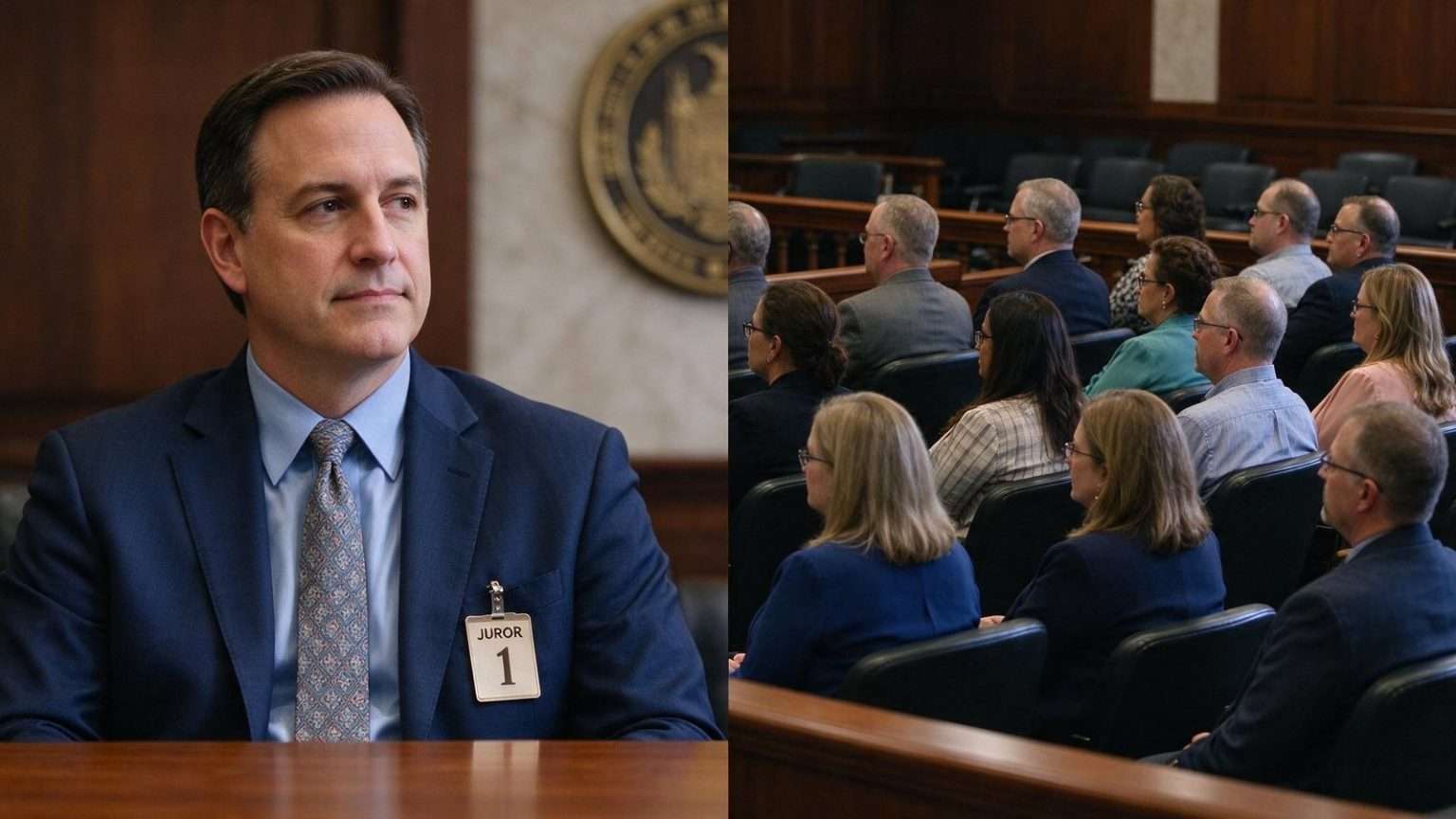
The verdict came at about 11:30 a.m., after nearly four hours of deliberation spread over two days. The jury’s foreman was Chris Galanos, the former Mobile County district attorney and former circuit judge — a man who has spent much of his professional life on the other side of the jury box.
In the long history of Mobile County public corruption fights, the case may be remembered less for its outcome than for its cast: an accused commissioner, a former district attorney wearing juror badge number one, and a courthouse full of lawyers arguing about whether leaving him on the panel was a stroke of genius or a catastrophic mistake.
A Grand Jury’s Nine Allegations
The proceeding grew out of a local grand jury’s call, weeks earlier, for Thomas to be impeached. The grand jury cited nine allegations against the commissioner. The most widely discussed was the charging of $9,033 in Mardi Gras throws to the Mobile County school system — an expense that, in a county where Carnival is close to a civic religion, proved impossible to explain away quietly.
Mardi Gras is Mobile’s signature cultural event — older than its New Orleans counterpart — and the throws that fly from floats to the crowds along Government Street are purchased by the millions of dollars every season, a few dollars’ worth of beads and moon pies at a time. School system money appearing in that ledger was the kind of detail that made the case common conversation in every part of the county, not just among court watchers.
Under Alabama law, certain local elected officials may be removed from office through an impeachment trial held in circuit court, with a jury sitting in judgment and a unanimous verdict required. The mechanism is a remnant of older Alabama government: rather than a recall election or a legislative removal, the county’s residents sit as the jury, deliberating like any other panel until all twelve agree.
The case was tried before Presiding Circuit Judge Charlie Graddick. Testimony began April 25. Thomas was represented by defense attorney Don Briskman. The state’s case was handled by the office of District Attorney John Tyson, with prosecutor Nicki Patterson — who once worked as an assistant district attorney under Galanos — taking a leading role.
That web of connections defined the trial. A former district attorney in the jury box; a prosecutor who had once worked under him handling the state’s case; a defense lawyer whose every strike during jury selection would be second-guessed by colleagues in the gallery. Mobile’s legal community is small enough that everyone on the panel had worked with, against, or opposite nearly everyone in the courtroom.
The Juror Everybody Was Talking About
The panel began as fourteen. Two members, both women, were excused, reportedly after remarking on the likelihood of a hung jury. Their departure left exactly the twelve needed to seat the body — and it lifted Galanos from what had been widely assumed to be an alternate’s chair into a deciding vote.
That elevation set off days of speculation among attorneys and political operatives, who could not agree on which side had blundered by leaving him on the panel. The conventional wisdom in jury selection holds that lawyers, paralegals and others steeped in the courts make risky jurors, because their colleagues in the jury room may simply defer to them. Galanos was not merely a lawyer. He was a former prosecutor, a former judge and a public figure whose opinions had been aired in Mobile for decades.
Opinions ran in every direction. Federal prosecutor Gloria Bedwell, once an assistant district attorney under Galanos, called it a two-edged sword: “Either each side thought he would be more inclined toward their particular view of the evidence, or each side thought the other would strike him.” Because Galanos had represented the state, represented defendants and served as a judge, she said, “it is difficult to predict what his natural inclination would be.”
Veteran attorney Tommy Boller reasoned that the technical burdens of an impeachment case “may be more readily appreciated (and respected) by a lawyer,” and predicted the defense had made the better choice. Attorney Ronnie Williams agreed, arguing that with Galanos seated, the state would be forced to prove that Thomas intended to commit a wrongful act rather than simply show sloppy bookkeeping that the board and staff, including Superintendent Harold Dodge, might have caught before the money went out the door.
Others thought the state had taken the greater risk. Defense attorney Dennis Knizley, who once ran against Galanos for district attorney, warned that a juror of such standing “could potentially dominate the deliberations and be in essence a one-man jury.”
Attorney Pete Burns predicted, accurately as it turned out, that Galanos “will probably be offered the foreman position.” Trial lawyer Pete Mackey offered the practitioner’s caution: a public figure on a jury always means somebody is taking a chance, but selection begins with a venire of nearly thirty people and turns on how they answer questions under voir dire. “Once it’s over, you may pause and consider everything and decide to leave a person on,” he said.
Attorney Willie Huntley, who has prosecuted, defended and served as a municipal judge, called it “a shrewd move by Briskman” — adding that just how shrewd remained to be seen.
The lawyering around the jury box was, in a sense, the real trial strategy session. If defense counsel believed Galanos would demand proof of intent before removing an elected official, keeping him was worth more than any strike. If the state believed his prosecutorial instincts would run against a commissioner with $9,033 of throws on the system’s tab, his presence was an asset no one wanted to forfeit. In the end, neither side tested its nerve enough to remove him, and the deliberations would settle the question.
How an Impeachment Trial Works
An impeachment trial in Alabama circuit court follows a form unfamiliar to most observers. The proceeding is civil in character even though it ends an elected term: the standard of proof is lower than in a criminal case, and the penalty is loss of office rather than jail. The grand jury’s allegations function like a civil complaint, the district attorney’s office acts for the state, and the jurors hear testimony, deliberate and vote exactly as in any other trial — except that their verdict unseats an official the voters placed in the chair.
The unanimity requirement gives the proceeding its drama. A single holdout juror can leave a commissioner in office, which is why the excusal of the two women who predicted a hung jury mattered as much as any witness. With twelve seated and no alternates remaining, every panelist’s vote was the whole margin between removal and survival.
The case also tested the unusual intimacy of Mobile’s bench and bar. The judge had spent decades in county politics; the foreman had held two of the most powerful legal offices in the county; the lead prosecutor had learned the trade in the foreman’s office; and the defense bar was stacked with men who had faced Galanos across courtrooms for years. In a larger jurisdiction, such a jury might have been unthinkable. In Mobile, it was the panel that answered the call.
The Answer
The jury supplied its own answer within days. Thomas was convicted, and the man whose presence had been debated in every courthouse hallway in Mobile signed the verdict as foreman.
The verdict removed Thomas from the Board of School Commissioners and closed a chapter that had run from the grand jury’s report, through weeks of headlines about Mardi Gras throws, to a unanimous vote on a spring Thursday. Deliberations totaling nearly four hours over two days were all the time twelve Mobile County residents needed to agree that the allegations had been proven.
For the lawyers who had wagered their predictions, the outcome offered its own quiet verdicts. Burns, who said the foreman’s gavel would find Galanos, was proved right. Huntley, who called Briskman’s decision shrewd but unresolved, could claim vindication — though whether the shrewdness ran in the defense’s favor would be argued over courthouse lunches for years. Knizley’s one-man-jury warning had come to mean something different than he intended: Galanos had not dominated against the defense, he had simply presided over a decision that twelve people reached together.
What remained was the institution. The school system moved past the removal, the board filled the vacated seat, and the Mardi Gras throws entered Mobile political folklore — the shorthand for a scandal remembered less for its dollar amount than for the day a former district attorney sat on a jury, and the county’s lawyers discovered they could not agree on whose side he was on until the foreman stood up to read the verdict.