Chris Galanos Weighs a Return to the Bench as McRae’s Seat Opens
Former District Attorney and Circuit Judge Chris Galanos was said to be weighing a run for the judgeship being vacated by Ferrill McRae, weeks after resolving a domestic violence charge.
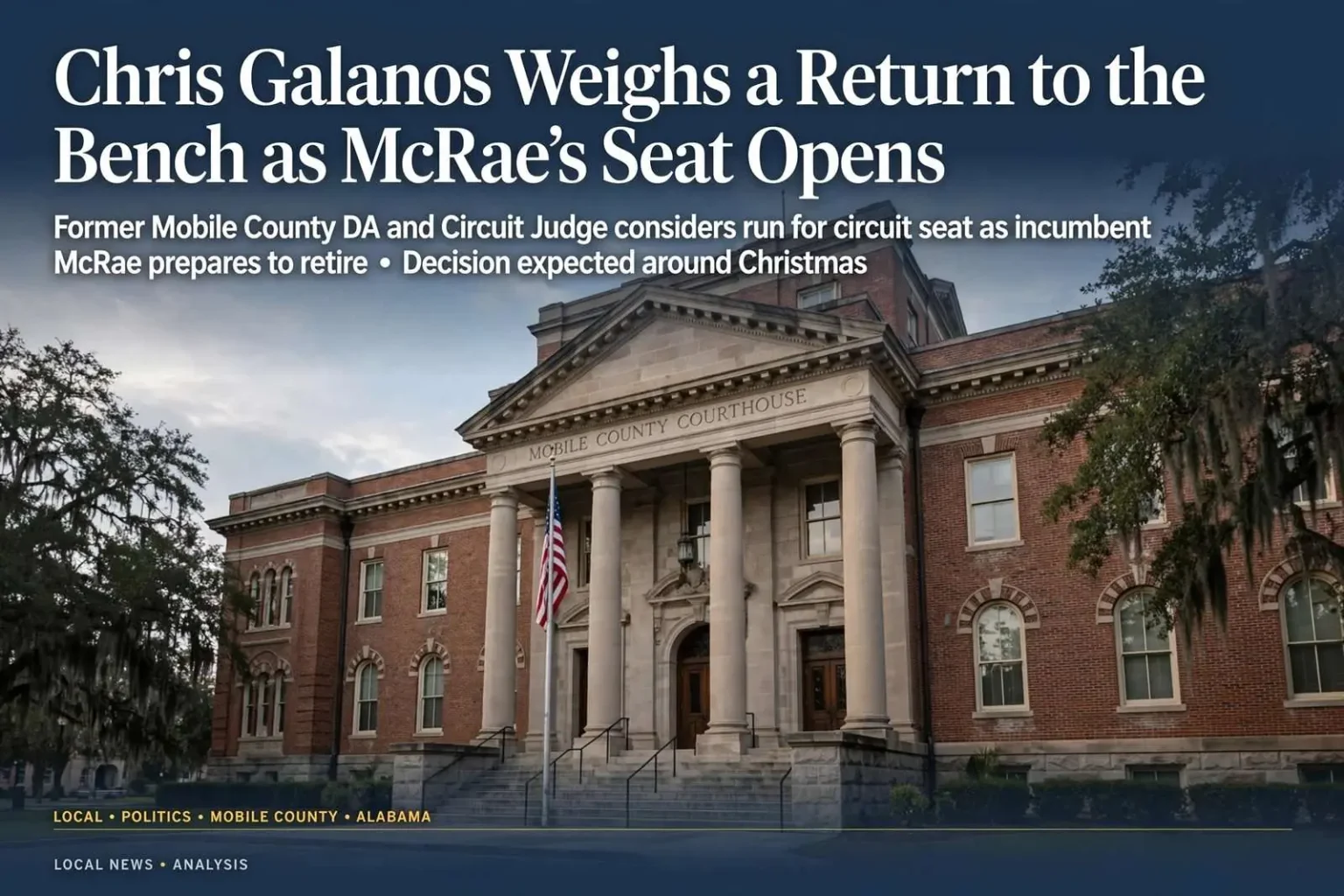
Former Mobile County District Attorney and Circuit Judge Chris Galanos planned to “search his heart” — and consult polling numbers — before deciding whether to seek the judgeship being vacated the following year by Circuit Judge Ferrill D. McRae, according to a person close to him.
Galanos hoped to decide “around Christmas time,” the source said. Galanos himself “respectfully declined to comment.”
If he ran, he would run as a Democrat, according to a longtime political confidant, who added that Galanos intended to do some “serious soul-searching” and to make sure suitable financial backing was in place before committing. The two conditions — personal readiness and campaign money — framed a decision that would determine whether one of Mobile’s most recognizable legal figures returned to public life after a stretch in which his name had surfaced for reasons no candidate would choose.
The seat in question would be open because McRae, a veteran of the Mobile County circuit bench, would leave it at the end of his term the following year. Open circuit judgeships in Mobile County reliably draw crowded fields on both sides of the ballot, and an opening vacated by a long-serving incumbent is the kind of opportunity a former DA and former judge does not get twice. The timing mattered: a decision deferred to Christmas would leave only a narrow window to assemble a campaign committee, line up financing and qualify before the party’s qualifying deadline in the spring.
Why the polling mattered
The confidant’s mention of polling numbers was a realistic assessment of the political terrain Galanos would have to cross. A decade and more after his years as the county’s top prosecutor, name recognition was not his problem — but the recognition was mixed. A judicial race is a strange campaign: judges run on experience and temperament rather than platforms, and voters evaluate candidates less by position papers than by whatever they last heard about them. For Galanos, the most recent headlines were the ones described below, and any pollster he hired would be measuring whether that record had faded enough, in the public’s memory, for a judicial campaign to be viable.
Financial backing was the other gate. Statewide and county judicial races in Alabama are expensive — media markets along the Gulf Coast, and Mobile County’s size, make a competitive race a six-figure undertaking — and Galanos had been out of elective politics long enough that his donor network would have to be rebuilt. The confidant’s description suggested he would not enter the race unless the money was demonstrably there, a discipline that has spared more than one Alabama politician an embarrassing mid-campaign withdrawal.
A charge, and how it was resolved
Most recently, Galanos had returned to public notice with a charge of domestic violence in the third degree. Known as a volatile prosecutor, Galanos was charged Sept. 17 with throwing a flower pot against the door of his ex-wife’s home and using abusive language toward his former spouse and their adult daughter.
According to Officer Eric Gallichant, Galanos was taken into custody at the Schwaemmle Drive home of his ex-wife, Gwen Weed. Weed told police that Galanos broke a glass door and shouted threats at her and their daughter. Neither was physically harmed. Galanos left, Weed called police, and officers were still at the scene when he returned and surrendered himself.
The case was resolved Dec. 15 through a deferred prosecution agreement. It required Galanos to be tested for substance abuse — results showed no evidence of it — and to complete anger management classes. He was placed on probation for one year, with the charges to be dismissed if he satisfied every term.
Deferred prosecution is a mechanism that sits between dismissal and conviction. The defendant does not plead guilty, and no conviction is entered, but he accepts a set of supervised conditions — here, testing, counseling and a year of probation — under which the charges are held in abeyance. Complete the terms and the case ends without a record of conviction; fail them and the prosecution proceeds. For a man weighing a return to public office, the structure mattered in a practical way: a dismissed case, unlike a conviction, would not automatically disqualify him or appear as a criminal record, though the underlying events remained public and available to any opponent.
The resolution also gave the episode a defined shape for the campaign that might follow. A candidate’s opponent could point to the arrest; Galanos could point to the outcome — no evidence of substance abuse, completed counseling, charges dismissed upon full compliance. How voters weighed that balance would be among the things his polling was designed to find out.
The record behind the name
Few figures in Mobile’s legal history have been as prominent, or as complicated. Galanos’s political career was a roller coaster of success and controversy, and the controversy followed him into private practice.
Galanos, 58, was a Mobile native and the son of the late Mr. and Mrs. Nicholas Galanos. His rise through the county’s legal and political establishment was rapid, and his tenure as district attorney made him one of the most visible public officials in southwest Alabama. The office he held is among the most powerful county offices in the state: the district attorney sets charging policy for felony and misdemeanor cases across Mobile County, supervises a large staff of prosecutors, and answers to the electorate every six years. Mobile’s DAs have historically been figures of real political consequence — the office has been a launching point for judgeships and higher office alike.
His style in that office was the source of both his strength and his reputation. Colleagues and defense attorneys alike described a prosecutor of unusual intensity, one willing to take unpopular positions and press cases hard, and “volatile” became the adjective attached to his professional personality as reliably as “prominent” did. That intensity built a record of aggressive prosecution that appealed to law-and-order voters; it also generated the friction, and occasional controversy, that trailed him out of office and into private practice.
His service as a circuit judge gave him the other credential a McRae-seat candidacy would rest on. Alabama’s trial judges are elected in partisan races, and the Mobile County bench includes some of the heaviest dockets in the state — civil and criminal calendars that run continuously through the year. A former DA who had also served on the bench could claim, uniquely among the field a McRae opening would attract, experience on both sides of the courtroom: charging and trying cases as a prosecutor, and ruling on them as a judge.
The seat he would seek
Circuit Judge Ferrill D. McRae’s decision to leave the bench at the end of his term created the opening, and the retirement of a long-tenured judge changes the arithmetic of an entire docket. Circuit seats in Mobile County carry six-year terms, and a vacancy draws candidates from the ranks of sitting district judges, prominent private attorneys and, occasionally, returning figures like Galanos. Because Alabama elects its judges in partisan races, the seat would first be contested in a Democratic primary, then in the general election — two separate campaigns, two fund-raising operations and two rounds of exposure to the voters’ current impressions.
The timing of Galanos’s self-imposed deadline fit that calendar. A decision around Christmas would leave the winter and early spring for assembling a campaign — qualifying, hiring staff, lining up endorsements — before the primary. Waiting longer than that would put him at a structural disadvantage against candidates who had begun organizing months earlier.
What a comeback would require
A judicial comeback would have to answer the same question every returning Alabama politician faces: whether the public’s memory has made room for redemption. Galanos’s record offered arguments on both sides — decades of public service at the top of the county’s legal establishment, alongside a recent arrest that had made the newspapers and a resolution that had made the outcome clear but not erased the event. His polling would tell him which of those facts dominated the electorate’s impression of his name.
The confidant’s framing — soul-searching first, money second, polling third — suggested a deliberate rather than an impulsive candidacy. Galanos had spent his career at the center of the county’s legal politics and knew precisely what a judicial race cost, what it required and what an opponent would do with his recent history. The decision he was weighing was less whether he could run than whether he should: whether the appetite for the work, the finances to sustain a campaign and the public’s willingness to look past the autumn’s headlines all lined up at once.
Whatever he decided, the McRae opening would be filled, and Mobile County’s circuit bench would gain a new member — by election or appointment — with or without the return of one of its most prominent former occupants. For the county’s legal community, the more consequential question was which name would appear on the qualifying list when the deadline arrived. The Christmas deadline Galanos set for himself was, in effect, the first date on that calendar.