Judge Dismisses Buskey Bid to Bar Independent Challenger From November Ballot
A Mobile County judge threw out state Rep. James Buskey's lawsuit seeking to strip independent challenger RaShawn Figures from the November ballot, ruling his court lacked jurisdiction over a pre-election contest.
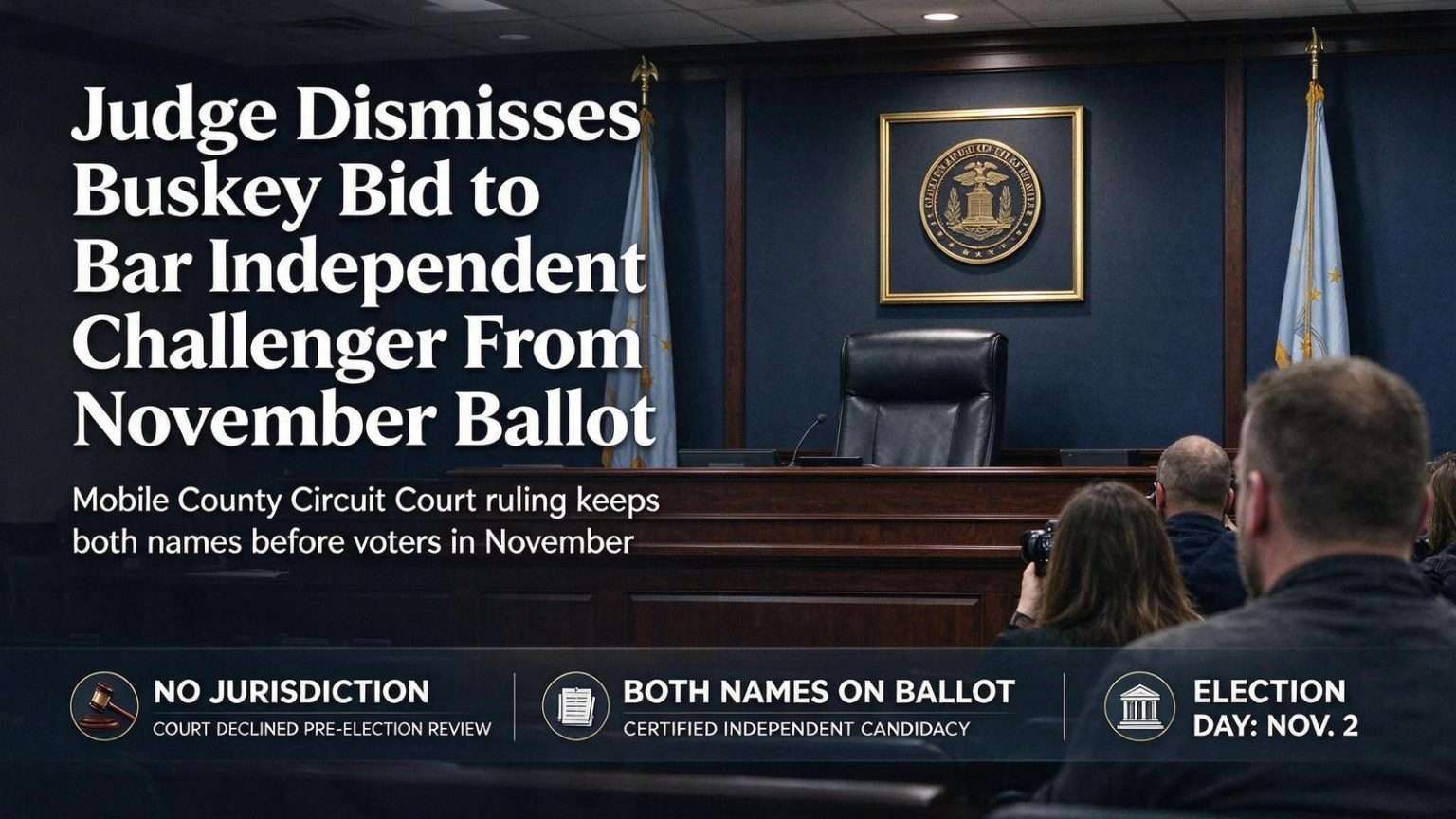
A Mobile County circuit judge this week dismissed a lawsuit filed by veteran state Rep. James Buskey that sought to keep independent challenger RaShawn Figures off the Nov. 2 general election ballot, ruling that the court had no authority to referee a candidate’s qualifications before voters ever went to the polls. Circuit Judge Rick Stout, a Democrat, ruled Tuesday that his court lacked jurisdiction to consider Buskey’s plea that Figures’ name be stricken from the ballot. The ruling ended, at least for now, a pre-election legal fight between the long-serving incumbent and the young challenger hoping to unseat him in the Mobile-area House district Buskey has represented for decades.
Buskey, 73, had argued that Figures, a 28-year-old Mobile businessman, did not meet the residency requirements to run for the seat and asked the court for an order excluding him from the contest. Residency is one of the foundational qualifications for legislative office in Alabama, and disputes over whether a candidate truly lives in the district are among the most common pre-election challenges mounted in the state. Buskey’s complaint rested on the claim that Figures’ connection to the district was insufficient under the law, a question that the state Democratic Party had already weighed once before during the primary season.
Stout leaned on a recent Alabama Supreme Court ruling that sharply limits when courts may intervene in elections. “No jurisdiction exists in or shall be exercised by any judge or court to entertain any proceeding for ascertaining the legality, conduct, or results of any elections, except so far as authority to do so shall be specially and specifically enumerated and set down by statute,” the high court had held. That language, drawn from the state’s long-settled election jurisprudence, reflects a deliberate policy choice by the Alabama Legislature: courts stay out of the mechanics of elections unless a statute expressly invites them in, in part to keep judges from becoming referees of political disputes in the weeks before voters cast ballots.
The limits of judicial power over elections
The law, Stout noted, allows for an election contest only after the balloting, when charges that a winner lacks the legal qualifications for office may be weighed. In other words, Alabama’s framework treats questions about a candidate’s eligibility as something to be tested after the people have spoken, not beforehand. A losing voter or rival candidate can contest the result in the circuit court of the county where the election was held, but the window opens only once the votes have been counted and certified. Until then, the courthouse door is largely closed.
That structure explains why the outcome was almost predetermined once Stout reached the jurisdictional question. However strongly Buskey felt about the residency issue, the statute simply did not authorize a judge to remove a candidate’s name from a general election ballot in advance of the vote. The judge’s role, under the controlling precedent, was to decline the invitation to referee, leaving the merits of the residency question for another day — potentially after the November election, if Figures won and the issue was raised in a contest.
The decision carried practical consequences beyond one district. Pre-election challenges to ballot access have become a recurring feature of Alabama politics, with incumbents and party organizations frequently using residency claims, filing deadlines and qualification paperwork to knock rivals off the ballot. Stout’s ruling is a reminder that such challenges face a steep legal hurdle once a candidate has been certified by the secretary of state, and that the state’s courts are reluctant to serve as the first stop in a political fight.
How the dispute reached the bench
The clash between the long-serving incumbent and his young rival had already traveled a winding road before it arrived in Stout’s courtroom. The state Democratic Party earlier upheld Buskey’s complaint that Figures failed to meet residency requirements, and Figures’ candidacy in the Democratic primary was barred. The party’s candidate challenge process, run through its state executive committee, gives the organization authority to review whether aspirants meet the legal qualifications for the offices they seek, and in Figures’ case the committee sided with the incumbent and blocked his primary bid.
Figures then set out to qualify as an independent for the general election. Independent candidates in Alabama follow a different path than party nominees: instead of paying a qualifying fee to a party, they gather signatures on a petition from voters in their district, and the Alabama secretary of state reviews and certifies petitions that meet the statutory threshold. After Figures gathered enough signatures on a petition, the secretary of state certified his independent candidacy, placing him on the November ballot alongside Buskey and setting up the unusual spectacle of a candidate the party had rejected in the spring returning as a general-election opponent.
Buskey contended that the independent bid was illegitimate, both on residency grounds and under a state “sore loser” law meant to stop a defeated primary candidate from re-entering the same race as an independent. Alabama is one of a number of states that bar candidates who lose or are disqualified from a party primary from immediately turning around and running in the same race without a party nomination, a rule designed to prevent candidates from shopping for a second chance after their party’s voters have spoken.
Stout was unpersuaded on both points before turning to the jurisdiction question. He held that Figures did not voluntarily abandon the primary as a political strategy, and therefore was not a “sore loser” as the Legislature intended. That distinction mattered: a candidate who is barred from the ballot by his own party is in a different position from one who loses a vote of the electorate, and Stout concluded that Figures’ removal from the primary was imposed on him rather than chosen by him.
The judge also ruled that although the state party had disqualified Figures over residency, the court was not bound by that decision and was free to conduct its own inquiry. Party determinations, in other words, carry political weight but do not amount to a judicial finding of fact. That opened the door for Stout to examine the residency claim independently — but before reaching the merits, he located the controlling opinion from the state’s highest court and dismissed the suit for lack of jurisdiction, leaving the underlying dispute unresolved.
What happens next on the ballot
With the ruling in hand, Probate Judge Don Davis planned to deliver the ballot to the printer, clearing the way for both names to appear before district voters in November. The probate office, which serves as the county’s chief election official, assembles the ballot once challenges are resolved, and Stout’s dismissal removed the last legal obstacle standing between the certified candidate list and the printing house.
Buskey’s attorney, Allison Kahalley, said an appeal of Stout’s decision was under consideration. An appeal to the Alabama Supreme Court would face long odds on the timeline available before a general election, but the option keeps the residency question alive in principle, even if the practical effect of any ruling arrives after the ballots have been cast.
The case underscored the generational contrast at the heart of the race. Buskey was already serving in the Alabama House when Figures was a small child, and the incumbent’s long tenure had made him a fixture in Mobile politics. Buskey has chaired committees, carried legislation affecting the port city’s schools and neighborhoods, and built the kind of seniority that only decades in Montgomery can produce. His challenger, a businessman a generation younger, was pressing to turn the November ballot into a genuine contest despite the party machinery that had blocked his path in the spring.
For Figures, the ruling preserved the opportunity he had sought since the party rejected his primary candidacy: a November campaign in which voters, not committees or judges, decide the question. Independent candidacies in Alabama rarely succeed against entrenched incumbents, but they occasionally force races that would otherwise go uncontested, and they give disaffected voters a place to park a protest. Whether Figures can convert ballot access into votes is now a matter for the campaign trail rather than the courthouse.
For Buskey, the dismissal is a procedural victory that stops short of vindication. The judge declined to rule that the residency claim was wrong; he ruled only that the claim could not be heard now. If the incumbent wins in November, the question is likely to stay closed, because a defeated candidate has little to gain from a contest. If the challenger wins, the issue could return in a post-election contest, where the statute expressly permits a court to examine whether the victor holds the legal qualifications for the office.
Why Alabama courts stay out of pre-election fights
The legal principle at work in Stout’s ruling has deep roots in Alabama law. The state’s courts have long held that election administration belongs to the executive and legislative branches unless the Legislature has specifically granted judges a role, an approach meant to prevent the judiciary from being drawn into every last-minute dispute over paperwork, signatures and residency. The exceptions the Legislature has carved out — post-election contests, mandamus actions in narrow circumstances, and specific statutory procedures for candidate qualification — are the only avenues for judicial intervention.
That framework puts Alabama among the majority of states that channel candidate-qualification disputes into either the party system before the primary or the contest system after the general election, with little room in between. The design favors finality: ballots get printed, elections get held, and grievances get heard afterward, under tighter deadlines and clearer rules. The cost is that flawed candidates may stand for election unchallenged in court, as Stout’s ruling effectively acknowledged when it left the residency merits for another day.
For the moment, the courtroom skirmish is over and the decision rests where Judge Stout said the law placed it: with the voters, whose verdict in November can still be tested afterward if questions about qualifications linger. Until then, the district’s electorate will see both names on the ballot — the 73-year-old incumbent who has represented Mobile for decades, and the 28-year-old challenger who fought his way back from party disqualification to a certified independent candidacy — and November will supply the answer that a Mobile courtroom declined to give.