Mint Juleps at Oakleigh: A Toast to Garfield and the Coming Antiques Roadshow
The Historic Mobile Preservation Society's fourth annual Bravery and Beauty Mint Julep Party was set for June 8 at Oakleigh, blending a fundraiser with a nod to James Garfield's 1877 visit and the coming Antiques Roadshow.
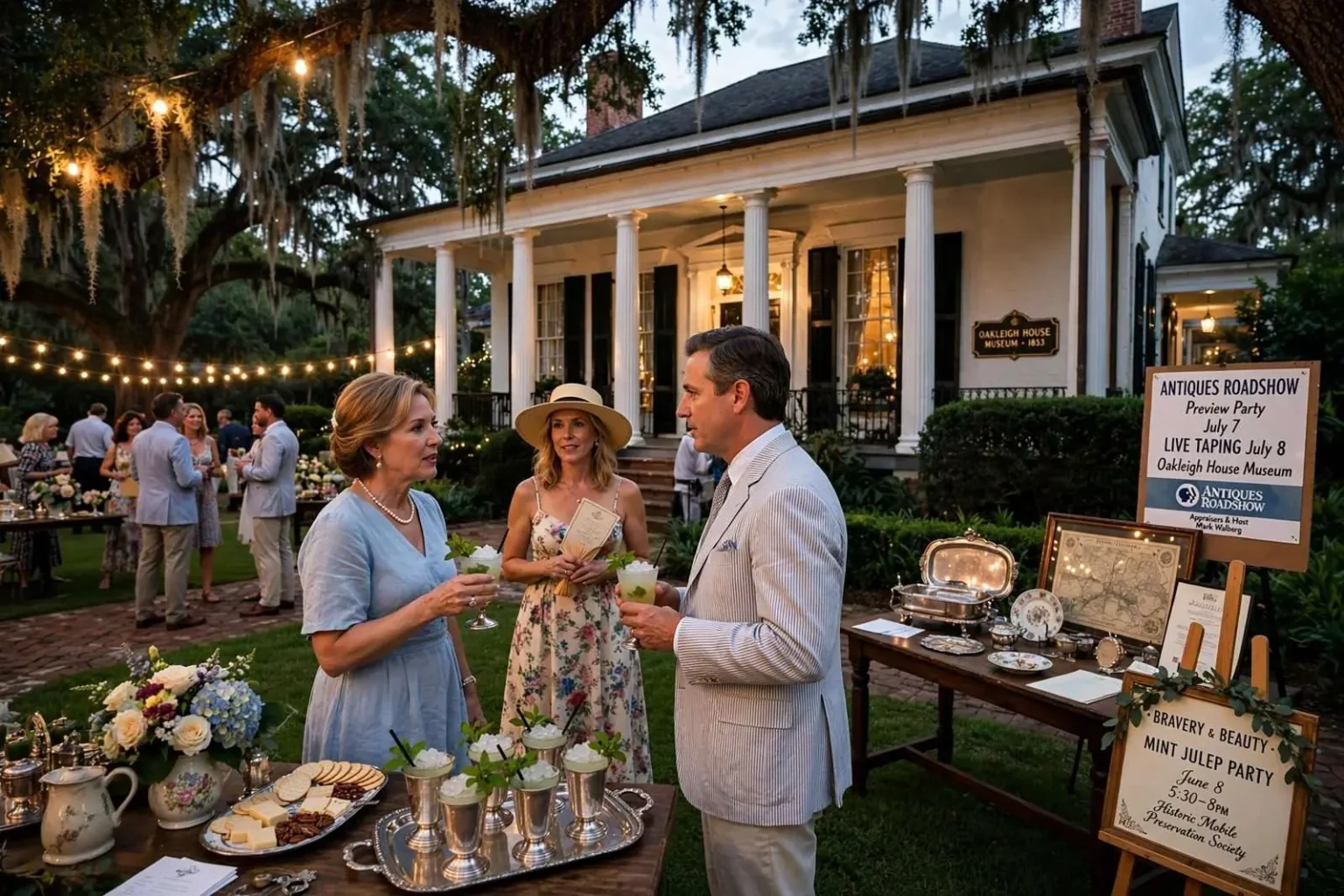
History, hospitality and a little friendly competition were set to converge at the Oakleigh House Museum on the evening of June 8, when the Historic Mobile Preservation Society hosted the fourth annual Bravery and Beauty Mint Julep Party. The event, scheduled from 5:30 to 8 p.m., blended a fundraiser for the society with a nod to one of the more charming footnotes in the antebellum home’s storied past, and it drew the city’s preservation-minded community onto the grounds of one of Mobile’s most recognizable historic houses for an evening built around an old recipe and an older compliment.
By its fourth year, the mint julep party had become a fixture on Mobile’s spring calendar, the kind of benefit that lets a preservation organization do its quiet work of maintenance, education and advocacy in full public view. Events of this sort carry more than festive weight for a house museum: ticket sales, auctions and prize drawings underwrite the roof repairs, archival work and school programs that keep a historic property alive between the headline anniversaries, and they give donors a social occasion worth dressing for.
A president’s compliment
The party takes its name from a visit in June 1877 by James Garfield, then a congressman and not yet president of the United States. Gen. T.K. Irwin, Oakleigh’s owner at the time, served his guest a mint julep, and Garfield later wrote fondly of the occasion, remarking that the bravery and beauty of Mobile had been in attendance. It was a throwaway line of Victorian courtesy, the sort of thing a traveling statesman writes to a hospitable host, but it proved durable enough that a preservation society would be printing it on invitations more than 130 years later.
The visit’s timing gave it a poignancy the 1877 partygoers could not have known. Garfield would be elected president in 1880 and would die the following autumn from an assassin’s wound, leaving behind a presidency of barely six months. His stop in Mobile, between a railroad journey’s legs, became one of the small recorded moments in the city’s long acquaintance with national figures passing through — and one of the very few preserved in the guest’s own handwriting.
Oakleigh itself anchors Mobile’s Historic Preservation District, a neighborhood of oak-shaded streets where the city’s antebellum prosperity remains visible in columned porches and wrought iron. The house, built in the 1830s for a cotton factor, has spent the past half century as the headquarters and showpiece of the Historic Mobile Preservation Society, which has filled it with period furnishings and opened it to the streams of tourists and schoolchildren who pass through Mobile’s historic districts each year.
An evening of auctions and prizes
Guests could expect heavy hors d’oeuvres and, naturally, mint juleps, along with a live auction of antiques, accessories and home-decorating items. The auction format suited the audience: a room full of people who volunteer in historic house museums and fill their own homes with the artifacts of earlier eras is, by definition, a room full of bidders. Auctions at preservation benefits routinely turn into competitions between neighbors, and every paddle that rises adds to the society’s operating budget for the year.
A prize drawing headlined the evening, with attendees needing to be present to win. The rule is the oldest lever in benefit-event logistics, ensuring that ticket holders arrive rather than simply donate from a distance, and it guaranteed a full lawn at the appointed hour. Among the offerings were a Cozumel cruise for two aboard Carnival’s Holiday, a ship then sailing regularly from the Port of Mobile, whose cruise terminal had become one of the city’s signature economic development wins of the preceding years.
The other prizes were more parochial and, to the crowd in the garden, considerably more coveted: a pair of tickets tied to an event Mobile had been buzzing about. Local businesses had supplied the drawing’s prizes as they do for such benefits, trading modest donations for visibility before exactly the demographic — established, civic-minded, historically minded households — that any Gulf Coast destination hopes to court.
The Roadshow comes to town
That event was the arrival of the Antiques Roadshow, the popular public-television program, which was bringing its appraisers to Mobile. The program’s format — ordinary people carrying family heirlooms past a gauntlet of experts who reveal, with varying theatrical restraint, what their attics have been harboring — had made it one of public television’s most-watched series, and its touring appraisals had become minor civic events in the cities it visited each summer.
Prizes in the drawing included two tickets to a Roadshow preview party at Oakleigh on July 7, with host Mark Walberg and appraisers expected to attend, and tickets to the taping itself on July 8. For the society, hosting the preview party at Oakleigh was a publicity coup of the first order: a national television program’s entourage, and the collectors who follow it, spending an evening on the society’s lawn and seeing the house, perhaps for the first time, in the background of a broadcast seen by millions.
The pairing made sense beyond convenience. A city’s oldest possessions and a television show about their hidden values are natural companions, and Mobile has more of both than nearly any city its size in the South. The Roadshow’s visit promised a day when the attics of the Gulf Coast would be emptied onto appraisal tables — Civil War letters, carnival memorabilia, furniture carried down from New England generations ago — in a civic pageant of family history.
For a preservation society devoted to Mobile’s material history, a national showcase of heirlooms and their hidden values could hardly have been better timed. The pairing of a genteel garden party with a television crew’s visit captured something of Mobile’s self-image, a city proud of its antiques and eager, in the manner of old towns everywhere, to see its inheritance noticed by the wider world. Preservation, after all, is a form of civic vanity pursued by honorable means: the conviction that a community’s objects — its houses, its papers, its furniture — deserve to survive its generations.
The society’s work extends well beyond one museum. The Historic Mobile Preservation Society operates archives and periodic programs documenting the city’s buildings and families, and its advocacy has shaped the fortunes of the historic districts that now anchor the city’s tourism economy. Every brick cottage restored on a side street and every guest room filled downtown traces, in some measure, to the decades of volunteer effort that organizations like the society invested when preservation was a cause rather than an industry.
The mint julep, for its part, occupies its own place in the culture of the antebellum South, a drink of bourbon, mint, sugar and crushed ice that survives as the region’s most literary cocktail. Served on a porch built for the cotton economy and sipped by guests raising money to keep that porch standing, the julep at Oakleigh manages to be at once authentic and self-aware — an event that knows exactly what it is commemorating, down to the wording of a congressman’s thank-you note.
The drawing itself carried the evening’s suspense. Prize drawings at benefits follow their own small ritual — tickets sold in bunches, a committee member drawing the winning stub, an audible groan from whoever stepped out of the room at the wrong moment — and the presence-to-win rule ensured that the lawn stayed full until the final name was called. The cruise tickets and the Roadshow passes bracketed the prize table nicely, one offering an escape from Mobile and the other a celebration of staying put.
Why the little details matter
House museums live or die on occasions like this one. Admission fees from walk-in tours rarely cover the costs of maintaining a 175-year-old building, and endowments large enough to fund maintenance outright are rarer still in cities of Mobile’s size. The gap is filled by the membership rolls, benefit auctions and prize drawings that turn preservation into a social season, and by volunteers who staff the docent rotations and sit on the committees that plan each June’s party.
The Garfield anecdote that gives the event its name illustrates how such institutions sustain themselves narratively. A house museum without stories is just an old building; with them, it becomes a stage on which a city keeps performing its memory of itself. Oakleigh’s stories — the cotton factor who built it, the general who owned it, the future president who drank on its lawn — have been retold at every one of these parties, each retelling a small act of preservation as real as any roof repair.
By the time the last guests left the grounds that evening, the society had done the several things at once that its calendar demands: raised operating money, reminded the city’s influential families that the institution depends on them, and connected one summer’s benefit to the arrival, a month later, of a television program that would put Mobile’s heirlooms — and its hospitality — in front of a national audience. The bravery and beauty of Mobile had been in attendance, just as the compliment promised, and the house they gathered around was the better for it.