
Banks, Condos and a Facelift on Bienville Square: Downtown Mobile’s Spring Ledger
A bank taking space in the Athelstan Club, condominiums nearing completion on Dauphin Street and two buildings being restored on Bienville Square marked downtown Mobile's revival in spring 2008.
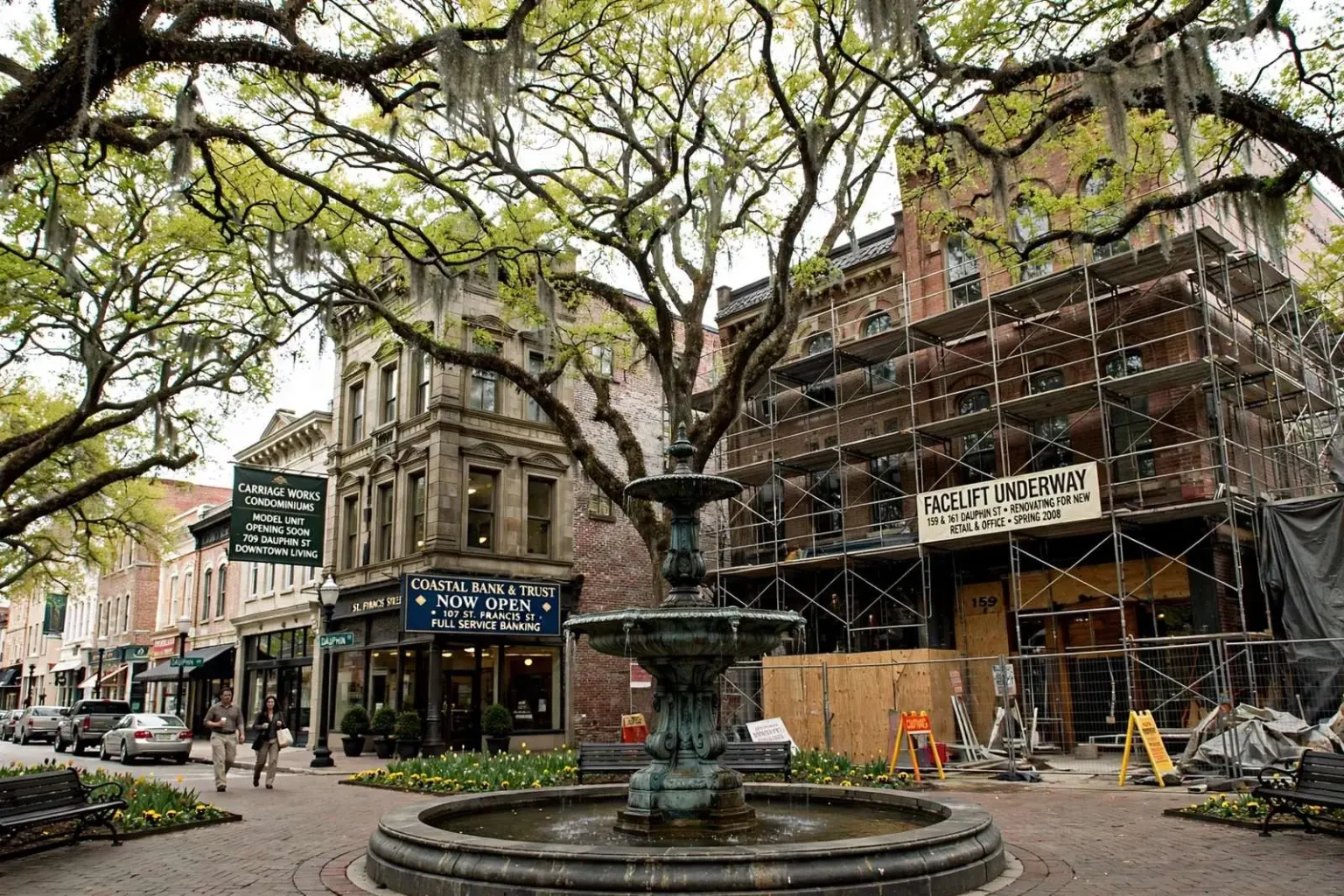
Downtown revivals do not announce themselves. They accumulate, one lease and one scaffold at a time, until one morning the street looks different. In late April 2008, the Downtown Mobile Alliance’s Carol Hunter supplied a ledger of what was accumulating in the heart of the city, and the entries — a bank, a condominium project, two renovated storefronts and a full social calendar — added up to a case that downtown Mobile was quietly turning a corner.
The Alliance, the business improvement organization that tracks investment across the central business district, had spent years making that accumulation visible. Its spring update was not a press release about any single deal. It was a snapshot of a district in motion, compiled block by block.
A Bank in the Athelstan Club
Coastal Bank and Trust was moving into 3,100 square feet on the first floor of the Athelstan Club at 107 St. Francis Street. The transaction was modest by the standards of commercial real estate, but the address carried weight.
The Athelstan Club, founded in the nineteenth century, is among the oldest private clubs in the South, and its building has long been a fixture of the downtown business district near the waterfront. Generations of Mobile’s business leadership have passed through its rooms, and the club’s name alone signals the establishment politics and commerce that shaped the city.
A bank taking ground-floor space in such a building was the kind of transaction that says, more persuasively than any press release, that a financial institution expects foot traffic and commerce on that block. Banks are conservative tenants. They do not lease street-level space on a hunch, and they do not put a branch where customers are not expected to walk.
For a street grid that had watched offices migrate to the suburbs for decades, the lease read as a bet on people coming back downtown — not just to work, but to transact business on foot, the way Mobile’s central business district functioned in its mid-century prime.
Condominiums on Dauphin
The Carriage Works condominiums at 709 Dauphin Street were nearing completion, with a model unit expected to be ready to view within a couple of weeks. The project was part of a wave of conversions turning older commercial buildings into downtown housing, and it stood within walking distance of the restaurants and bars that had begun to reanimate Dauphin Street after dark.
Residential conversion was the central bet of downtown Mobile’s revitalization in this period, and it was not a small one. For decades the district emptied at five o’clock, as office workers drove west to Spring Hill and west Mobile, leaving the streets to parking garages and security lights.
The theory behind projects like Carriage Works was that a downtown with residents would sustain the restaurants, groceries and shops that a downtown of offices alone cannot. Residents do not leave at the end of the business day. They need pharmacies, dry cleaners and coffee within walking distance, and their presence makes streets feel safe after dark, which in turn draws visitors.
The timing, in the spring of 2008, was uncomfortable. The national housing market was already deteriorating, and the condominium market along the Gulf Coast, which had run hot for years, was among the first sectors to feel it. Anyone completing a condo conversion that spring was doing so against a national current running distinctly the other way.
A Facelift on Bienville Square
A major renovation continued at 159 and 161 Dauphin Street, two buildings overlooking Bienville Square. Each contained about 3,300 square feet, well suited to retail and office space, and both were expected to be ready in a few months.
Bienville Square, with its live oaks and its cast-iron fountain, is the historic center of the city, and the buildings that face it are among the most visible in Mobile. Named for the French colonial founder of the city, the square has served for more than a century as a gathering place for public ceremonies, picnics and everyday shade-seeking, and any building that addresses it inherits a kind of frontage that no new construction can manufacture.
Restoring rather than replacing the two buildings reflected a preservation-minded approach to downtown redevelopment that has largely defined Mobile’s efforts since the 1970s, when the city began to recognize that its surviving nineteenth- and early twentieth-century commercial fabric was an asset rather than an obstacle. Cities across the country spent those same decades demolishing their old cores and replacing them with parking structures; Mobile, by and large, did not.
The practical calculation was straightforward. rehabilitated storefronts near a public square offer tenants character, high ceilings and walkable address, features that suburban office parks cannot copy. The risk, which the spring of 2008 was about to test, was whether the financing environment for such work would survive the year.
A Calendar at the Bienville Club
The Bienville Club, meanwhile, had a season of public events scheduled, a reminder that downtown’s recovery was social as much as commercial. The lineup included a Cinco de Mayo Buffet Lunch and Happy Hour on Monday, May 5; a Murder Mystery Dinner Theatre presentation of “Murder at the Music Hall” on Saturday, May 10, from 7 to 10 p.m.; an Armed Forces Day Lunch on Friday, May 16, from 11:30 a.m. to 2 p.m.; and a Women’s Wine Tour on Tuesday, May 20, from 6 to 8 p.m.
Lists like that one do more than fill a club’s function rooms. Each event draws people downtown in the evening or on a weekend, hours when the district’s recovery is hardest to sustain, and gives them a reason to arrive early, stay late and notice what has changed on the surrounding blocks.
The social infrastructure of downtown — clubs, churches, theaters and organizations that keep regular evening schedules — has always mattered as much as the real estate. A district can be restored brick by brick and still fail if nothing ever happens in it after dark. The spring calendar suggested that part of the equation was, at least in May 2008, working.
It also reflected the mixed economy of a recovering district. Some of the events were private-club traditions opened to the public; others were civic observances like Armed Forces Day, a holiday with deep roots in Mobile, which has long hosted one of the country’s oldest celebrations of it. The variety mattered. Different events pulled different crowds downtown — lunch professionals, families, young couples — and a healthy district needs all of them.
The Larger Picture
The Downtown Mobile Alliance, the business improvement organization that compiled these notes, existed precisely to make this kind of accumulation visible. Funded in large part by assessments on downtown property owners, such organizations work in increments: recruiting tenants, cleaning streets, marketing the district and nagging on behalf of anyone willing to invest in it. The work is slow, largely invisible and impossible to summarize in a headline.
A single bank lease is not news. A bank lease plus a condominium project plus two restored storefronts plus a full events calendar, reported together, is an argument: that money was moving back toward the center of the city, and that private actors were making independent decisions that pointed the same direction at the same time.
Seventeen years later, the argument looks largely vindicated. Dauphin Street is a functioning entertainment and dining district, with restaurants and music venues drawing crowds well past midnight. Downtown residential occupancy grew, as conversions like the Carriage Works filled with residents who wanted to walk to dinner. The historic building stock that Mobile chose to restore rather than demolish became one of the city’s genuine competitive advantages — a streetscape of ornament and brick that newer Sun Belt cities cannot replicate at any price.
What the Spring of 2008 Could Not See
But it is worth remembering what the people compiling that ledger in April 2008 did not know. Within months, the credit markets would seize, construction lending would evaporate, and the recovery they were charting would slow to a crawl for several years. Projects that looked timely in May would stall mid-renovation, and condo conversions across the Gulf Coast would struggle against a housing glut that deepened into the worst national downturn since the Depression.
Downtown Mobile’s revival was real, but it was not linear. The years after 2008 tested every assumption on that spring list — that banks would keep leasing, that buyers would keep converting, that tenants would keep filling storefronts. Progress resumed, but slowly, and only after the economy itself stopped contracting.
The buildings on Bienville Square got their facelift, and they still stand, occupied and lit, a short walk from the fountain. The wider revival took longer than anyone reading that spring’s update would have guessed, which is perhaps the most durable lesson the ledger offers: downtowns do come back, but almost never on the schedule their boosters circulate in April.