Jack Burrell Kicks Off a Fairhope Mayoral Campaign at the Pier
Jack Burrell launched his campaign for mayor of Fairhope with a kickoff party at the Yardarm Restaurant at the Fairhope Pier, opening a municipal season that would run to the August ballot.
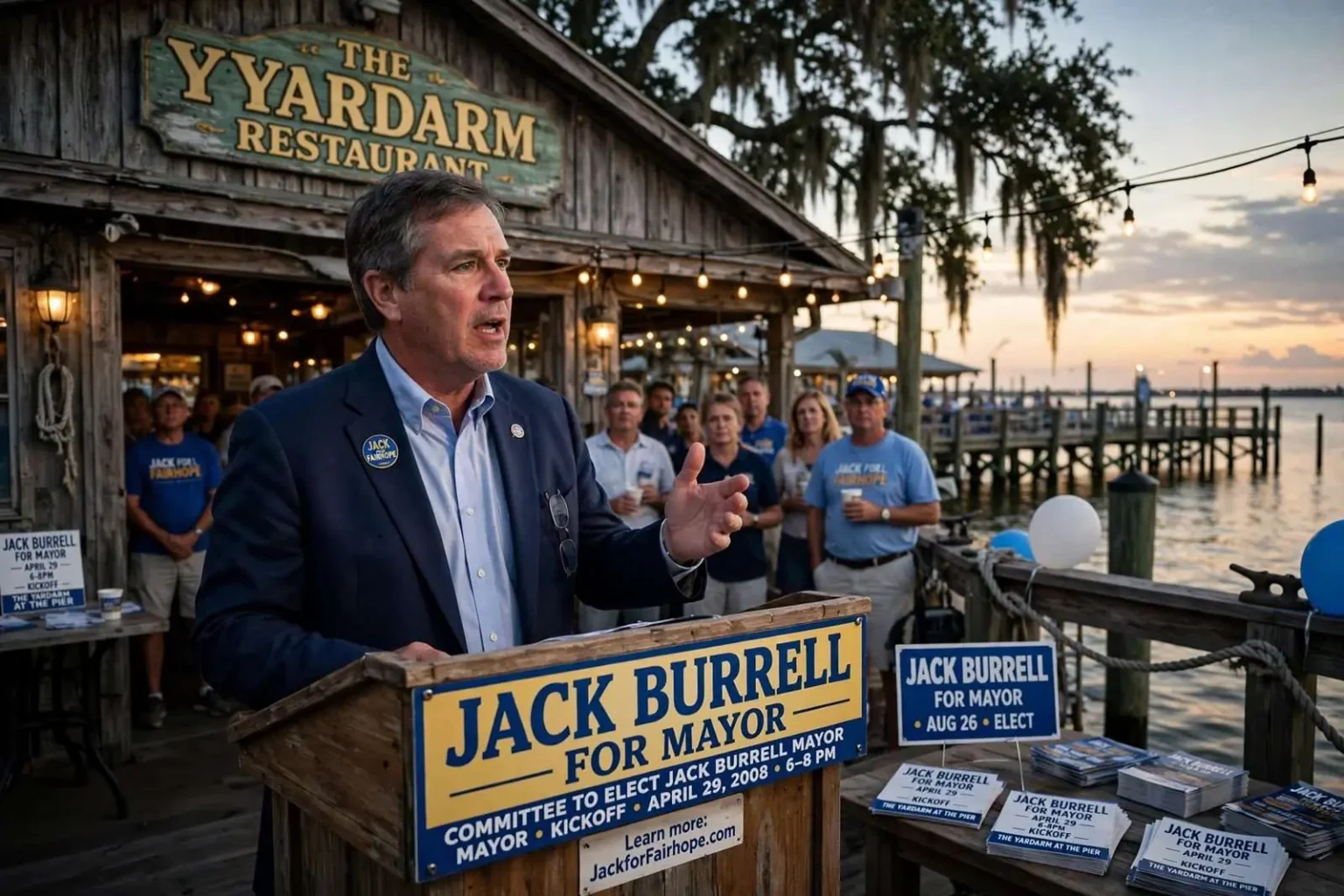
Jack Burrell officially launched his campaign to become mayor of Fairhope with a kickoff party on Tuesday, April 29, 2008, from 6 to 8 p.m. at the Yardarm Restaurant at the Fairhope Pier. The host was The Committee to Elect Jack Burrell Mayor, and the campaign directed supporters seeking more information to its website, Jack for Fairhope.
The venue was not an accident. The Fairhope Pier, jutting into Mobile Bay at the foot of the bluff, is the city’s front porch and its emblem, the place where residents watch the sun go down over the water and where, periodically, they gather to argue about what is happening to their town.
The Yardarm itself carries the city’s civic history — a long-running restaurant and gathering spot at the pier’s base, where fundraising events, club meetings and campaign kickoffs have found their audience for decades. Launching a mayoral race there, in sight of the water and the downtown it overlooks, announced the campaign’s frame: Fairhope itself, and what it was becoming.
An office worth wanting
The mayor of Fairhope runs a city that is unusual among Alabama municipalities of its size, and the job carries responsibilities that go well beyond ribbon cuttings. Fairhope owns and operates its own utilities. The city sells electricity, natural gas, water and sewer service to its residents, an arrangement that gives the municipal government a substantial enterprise to manage and a revenue stream that most towns of comparable population simply do not have.
The mayor sits atop that operation, which means Fairhope’s elections are, among other things, referenda on how a small city runs a utility company. Rate-setting, capital improvements to the water and sewer systems, and the reinvestment of utility revenue into city services are all decisions the mayor and council make directly — with every ratepayer a voter.
Layered on top of that is the city’s history. Fairhope was founded in 1894 as a single-tax colony, an experiment in the economic theories of Henry George, and the Fairhope Single Tax Corporation still holds land within the city. That inheritance, along with the flower baskets, the independent bookstores and the bluff over the bay, has given Fairhope an identity its residents guard with real intensity.
Burrell’s own résumé suited the job he was seeking. A Fairhope native with years in local government service, he entered the race known to the city’s civic circles rather than as an outsider, and his committee’s early organization — a named campaign committee, a website and a scheduled kickoff — followed the playbook that winning municipal campaigns in Baldwin County had settled into by 2008. Websites were becoming standard for Eastern Shore candidates that cycle, a small but telling sign of how even small-town races had moved onto the internet.
The mayor’s office in Fairhope also functions as the city’s face in county and regional bodies — the Baldwin County Commission’s coordination on roads, the regional water and sewer planning, and the Eastern Shore chambers’ development conversations all route through City Hall. A mayor’s ability to negotiate with the county and the state, over everything from Highway 98 traffic to school siting, shapes the growth questions no ordinance can answer alone.
The single-tax legacy remains visible in the city’s layout and its institutions — the corporation’s leasehold lands downtown, the streets planned by the original colonists, and the public spaces, including the pier and the parkland along the bluff, that the founders reserved for common use. Mayoral candidates in Fairhope have always had to speak to that history, because the city’s residents treat it as the measure of every change proposed.
The municipal utility, too, has a longer history than most residents realize. Cities across Alabama ceded their electric systems to private utilities in the mid-20th century; Fairhope held onto its gas, water and sewer operations, and the enterprise fund those systems generate remains a cornerstone of the city budget. Managing it well is the unglamorous core of the mayor’s job, and it rarely makes campaign speeches.
The pressure the candidates faced
By the spring of 2008, that identity was under strain. Baldwin County had spent a decade as one of the fastest-growing counties in Alabama, and the growth had arrived on the Eastern Shore in the form of subdivisions, traffic and rising property values. The debate over how much development Fairhope should absorb, at what pace and at whose expense, ran through nearly every question a city government touched: zoning, drainage, sewer capacity, school crowding, the budget and the city’s debt.
Fairhope’s politics in this period were also, by the standards of a town of that size, notably contentious. Public meetings drew crowds. Positions hardened. Candidates for city office found that a campaign in Fairhope was rarely a genteel affair, whatever the flower baskets suggested.
The growth pressures were not abstract. Sewer capacity on the bluff and the flats, drainage through the city’s ravines, and the school enrollment carried by the county system all tightened as rooftops multiplied along the city’s northern and eastern edges. Property values, meanwhile, raised both the tax base and the anxiety of longtime residents watching assessments climb — a tension every candidate for mayor would have to navigate in public.
The contested politics of those years had concrete roots. Zoning fights over commercial development along the Highway 98 corridor, annexation debates on the city’s edges, and recurring disputes over the pace of subdivision approvals kept council chambers full and letters to the editor flowing. Candidates for mayor inherited a public already engaged — an advantage for turnout, and a warning that every position taken on growth would be tested in the open.
The calendar
Alabama held its municipal elections in that era on the fourth Tuesday in August, which in 2008 fell on Aug. 26. That gave candidates who launched in late April roughly four months to raise money, knock on doors and make their case, a compressed season that rewarded early organization and name recognition.
Burrell’s April kickoff placed him among the first out of the gate. Other candidates would follow over the spring and early summer, and the mayor’s race developed into one of the more closely watched contests on the Eastern Shore.
The four-month window is the defining constraint of Alabama municipal politics. Without runoffs between general elections in most small cities, a candidate’s entire campaign fits inside one summer — a stretch that demands early fundraising, an organized volunteer corps and a message that can survive the slow news weeks of June and July. Candidates who wait until mid-summer to organize find the yard-sign and church-luncheon circuit already claimed.
What the race was really about
Strip away the particulars and Fairhope’s 2008 municipal election posed the question that fast-growing small cities across the Gulf Coast were being forced to answer. A town becomes desirable. People arrive because it is charming. Their arrival threatens the charm. The city government is left to manage the contradiction with zoning ordinances, utility rates and sewer bonds, instruments poorly suited to the preservation of a feeling.
Candidates promised, in various formulations, to keep Fairhope the way it was. The voters would decide in August which of them they believed.
The same dilemma was playing out across Baldwin County that year — in Daphne, Spanish Fort, Gulf Shores and Orange Beach — but Fairhope’s version carried an extra charge because the town’s brand is the thing at stake. A city that markets its flower baskets, its bluff, its bookstore-and-bakery downtown cannot pave its way to growth without eroding the asset the growth depends on. That circular problem is the enduring puzzle of Fairhope politics, and every administration since has wrestled with a version of it.
Burrell remained a durable figure in Fairhope city government in the years that followed, and the arguments aired in that campaign season, over growth, over spending, over the character of the place, have never entirely subsided. They resurface, reliably, every four years, usually within sight of the pier.
The campaign season ahead
From the Yardarm kickoff through the August election, the race would move through the venues that make up Fairhope’s civic circuit — the civic center associations, the church suppers, the downtown merchants’ gatherings and the packed council chambers where growth disputes are aired in person. Campaign literature in a town of Fairhope’s size travels by hand, and candidates measure their progress as much by the conversations on the pier as by the totals on a finance report.
By the time voters went to the polls on Aug. 26, the choice they faced was the one the 2008 season had framed from the first kickoff: how a small city with big utility books, a famous history and a beloved waterfront manages to keep being itself while the county around it changes faster than any ordinance can follow.