‘Where’s Waldo?’ Alabama Republicans Dispute Whether Jill Simpson Was Ever a Player
As the Siegelman prosecution became a national controversy, Alabama Republicans mocked the idea that Jill Simpson, the operative at the center of it, had ever been a figure in state GOP circles.
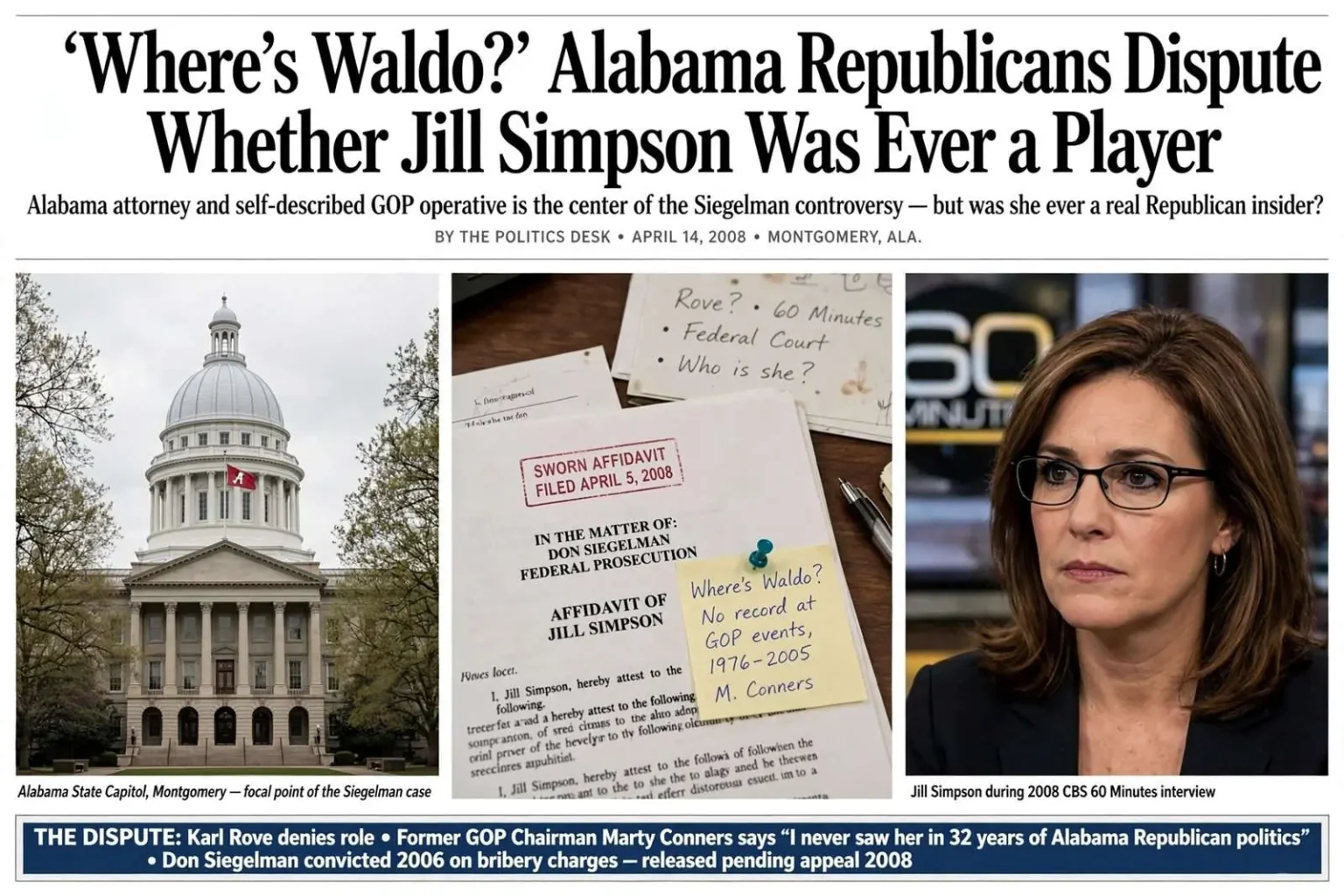
By the spring of 2008, the prosecution of former Alabama Gov. Don Siegelman had stopped being a state story. It was on “60 Minutes,” it was before congressional committees, and it had become a proxy for a national argument about whether the Bush administration’s Justice Department had been used against political opponents. At the center of it stood Jill Simpson, an Alabama attorney and self-described Republican political operative whose sworn statements had given the controversy its charge.
The allegation
Siegelman’s defenders charged that Karl Rove, then President Bush’s chief political adviser, had orchestrated the federal prosecution of the Democratic governor in order to clear a path for Republican Gov. Bob Riley. In the account that circulated, Rove had enlisted Simpson, whom he was said to know from earlier Alabama campaigns, to trail Siegelman and gather damaging information about him. The claim — that the machinery of the federal government had been pointed at a sitting political rival by the White House’s political shop — was explosive enough to summon congressional investigators, national reporters and a permanent cast of Alabama partisans to the story.
Siegelman was convicted in 2006 on bribery and conspiracy charges arising from his appointment of a health care executive to a state regulatory board after the executive contributed to a lottery campaign the governor championed. He served time, was released pending appeal in 2008, and fought the conviction for years. Rove denied the allegations. The dispute has never been settled to anyone’s satisfaction, and it remains one of the most contested episodes in modern Alabama political history.
What made the case unusually durable was its cast. Siegelman was the most accomplished vote-getter of his generation of Alabama Democrats; Riley was his Republican successor and former congressional colleague; and the prosecution had been assembled by federal prosecutors in a district where the lines between Alabama’s political factions ran through every courthouse. When Simpson’s affidavits entered the record, they supplied the connective tissue that turned a legal proceeding into a conspiracy narrative — or, depending on one’s view, into a baseless theory draped over an ordinary corruption case.
The Republican response: who?
What Alabama Republicans disputed, in April 2008, was not merely the substance of Simpson’s account. It was her standing to give one. Rove and others, including former state GOP chairman Marty Conners, chortled at any description of Simpson as “a player” in Alabama Republican political circles. Conners made the case with a résumé and a punchline. “I’ve been around Alabama Republican politics for 32 years, in some official capacity of some type, from College Republicans back at the University of Alabama in 1976 to Chairman up to 2005, including the Riley election of 2002,” he said. “That translates to hundreds, if not thousands, of receptions, fund raisers, committee meetings, candidate recruitment, litigation, ballot security sessions, rallies and presidential visits. The first time I saw the lady featured as a GOP ‘player’ was when she appeared on ’60 Minutes.’”
Then he twisted the knife, invoking the CBS anchor whose career had ended over a discredited story about President Bush’s National Guard service: “Perhaps Dan Rather did the research on this one.”
The Rather jab did double duty. It mocked Simpson’s most famous appearance — the “60 Minutes” segment that had carried the Siegelman story nationwide — by associating it with the most famous broadcast failure of the era, and it signaled to Republican audiences that the whole controversy was a media construction rather than a legal one. For Conners, the argument’s foundation was arithmetic: three decades in the state’s Republican politics, thousands of events, and not one sighting of the woman at the center of the national scandal.
The argument beneath the argument
The exchange is a small masterpiece of a particular political technique. Conners did not have to prove that Simpson’s account was false. He had only to establish that she was nobody, that a man who had attended thousands of Republican events across three decades had never laid eyes on her, and to leave the audience to draw the obvious inference. The technique — attacking the witness rather than the testimony — is old, and it works because audiences rarely have the time or the documents to adjudicate a stranger’s biography.
Simpson’s defenders had an answer, of course. Operatives who do the kind of work she described are not, by design, the people standing at the front of the room at fundraisers. Obscurity is not disqualifying; in some accounts it is the qualification. A party chairman greets donors; an operative trails a governor. The two resumes do not overlap, and the absence of one from the other proves nothing about the work the second performs.
Which is precisely why the dispute could not be resolved by argument. Every fact in it was contested, and each side’s account was internally coherent. Either a well-connected operative was recruited quietly by a national political adviser, or a marginal figure with a story to tell found a national audience eager to hear it. The evidence that would settle it — phone records, meeting logs, sworn testimony under cross-examination — existed only in fragments, and each side read the same fragments its own way.
Why it mattered in Mobile
South Alabama had a direct stake in the fight. Siegelman had been a statewide officeholder for a generation, elected secretary of state, attorney general, lieutenant governor and governor. His prosecution divided the state’s political class along lines that did not run neatly by party, and it made the U.S. attorneys’ offices, the federal courts and the state’s political establishment objects of sustained public suspicion. In Mobile, where the federal courthouse sat at the center of a legal community that knew the case’s players personally, the argument followed lawyers into their offices and their dinner tables.
The episode’s ultimate legacy was corrosive. A significant portion of Alabama Democrats came to believe that a governor had been imprisoned for politics. A significant portion of Alabama Republicans came to believe that a discredited witness had been elevated by a hostile national press. Both convictions outlived the case, and both hardened into the assumption, now widely shared across American politics, that prosecutions of politicians are political acts.
That dual belief changed how the state’s politics functioned. Candidates learned to expect that any indictment could be reframed as a plot, and prosecutors learned that their work would be tried twice — once in court and once in the national argument over who ordered it. Alabama’s experience with the Siegelman case became a template cited far beyond its borders whenever a prosecution of a prominent politician drew partisan fire.
Marty Conners’s joke about Dan Rather was, in that sense, the whole controversy in miniature. Nobody was arguing about evidence anymore. They were arguing about who could be believed — a fight in which every participant was a witness, every witness was a partisan, and the truth had long since become a matter of whose team had picked it up.
The “60 Minutes” moment
The CBS segment in the winter of that season did more than any congressional hearing to move the Siegelman case out of Alabama. Scott Pelley’s interview with the imprisoned governor, and the questions it raised about the prosecution’s origins, turned Alabama’s strangest legal saga into national water-cooler material. Simpson’s appearance in the segment was the moment her name became nationally recognizable — and, in the eyes of Alabama Republicans, the moment she acquired a stature her in-state résumé had never earned. That gap between her television prominence and her political footprint became the ground on which the “Where’s Waldo?” argument was fought.
For Democrats, the broadcast validated years of complaints that had gone nowhere in Alabama’s own press corps. For Republicans, it was a national network treating an accusation they regarded as fantasy as established fact. The case now had two parallel lives: one in the federal courts of Montgomery, governed by rules of evidence, and one on television and in congressional hearing rooms, governed by narrative. Simpson stood in both, and each side needed her to be a different kind of person.
The congressional angle added its own escalation. House Judiciary Committee members demanded documents from the Justice Department about the prosecution’s origins, and the department’s inspector general eventually examined aspects of the matter. The requests gave the “Rove did it” narrative a procedural anchor, and gave Republicans a fresh target: they argued that Congress was investigating a conviction that juries had returned, based on the word of a witness whose credibility was untested anywhere that actually counted.
A state divided by a courtroom
Inside Alabama, the case reorganized friendships as much as it reorganized politics. Lawyers, journalists and former officeholders took sides with a passion that outlasted the legal proceedings themselves, and the divide showed up in bar association discussions, in newspaper columns and in the primary fights of every office from district attorney to governor. A person’s view of the Siegelman case became a reliable marker of their broader politics — more reliable, in many circles, than party registration itself.
The federal judiciary, ordinarily the state’s most insular institution, found itself publicly debated. Critics pointed to recusal questions and to the participation of attorneys with political ties; defenders answered that the case had gone through juries, appeals and independent review. Either way, the public had been taught to look at Alabama’s federal courts as combatants rather than referees, an impression that persisted long after the appeals were done.
In the end, the fight over Jill Simpson’s standing was never really about her. It was about whether the Siegelman prosecution would be remembered as justice or as a hit — and because that question could not be answered by any court or committee, it was answered instead by whichever version each Alabamian found more believable. Conners’s punchline and Simpson’s affidavits were, in the final accounting, the same kind of document: an argument addressed not to a jury, but to the state’s permanent political audience.