Reggie Copeland, at 79, Says His Political Career Is Going to Overtime
Three years after calling his sixth campaign his last, Mobile City Council President Reggie Copeland said in April 2008 he would seek a record seventh term, and talked up a soccer complex at Bates Field.
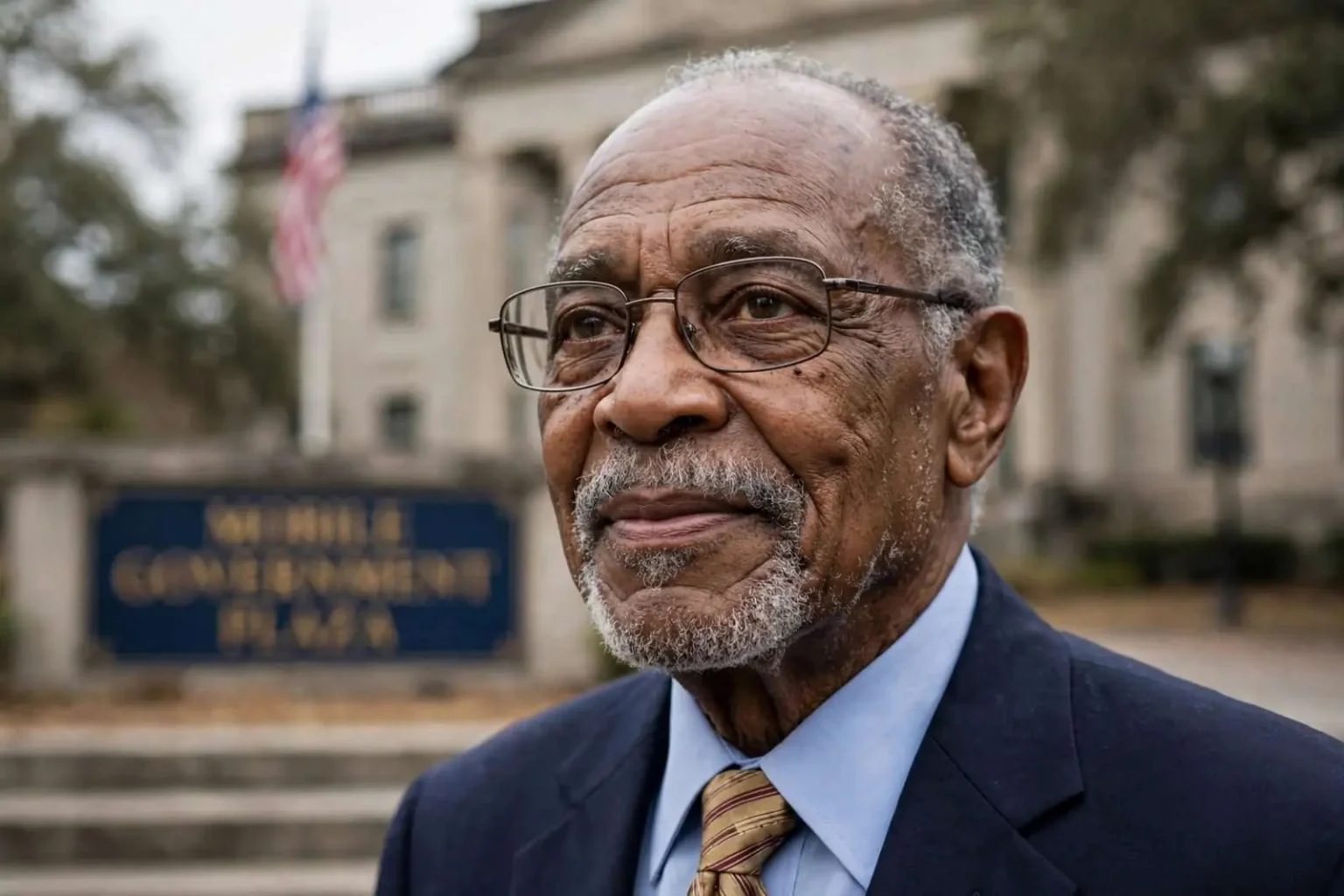
Reggie Copeland spent a working lifetime blowing the whistle on other people’s overtime. In April 2008, the Mobile City Council president announced that his own political career was headed there. The announcement, delivered with the dry humor of a man who had spent decades as a basketball referee, set up one of the more striking reversals in recent Mobile political history: a veteran officeholder who had already told voters he was finished deciding, four years later, to keep going.
Copeland, then 79 and retired from a long run as a basketball referee, said he intended to amble toward a record-setting seventh term in the city elections scheduled for the following year. It was a reversal, and he said so plainly. In 2005, campaigning for a sixth term, Copeland had described that race as his last, which would have closed out his service at 24 years in public office — a figure that, on its own, would have ranked among the longest careers in the history of Mobile city government.
Why he changed his mind
His explanation was disarmingly simple. His health was good. He still enjoyed the work. There was no grand strategy behind the decision, no pending appointment or higher office in the offing — just an active man, still sharp, still engaged with the daily business of a growing city, unwilling to declare an end to something that still gave him purpose.
“I think it’s good for me and I hope it’s good for the community that I love,” Copeland said. “I don’t know what else I would do.” The second sentence, as much as the first, explained the reversal: after nearly a quarter-century of council meetings, budget hearings, zoning disputes, and constituent calls, the routine of public service had become the structure of his life.
He said he had conferred recently about his plans with Mayor Sam Jones, who would also seek re-election in 2009. Jones, who had become Mobile’s first Black mayor in 2005, went on to win a second term, and the partnership between the mayor’s office and the council president remained a defining feature of city government through that period. Copeland won his seventh council term as well, and remained council president, extending one of the longest continuous runs in the history of Mobile city government.
The only man District 5 has known
Copeland’s tenure was a product of a particular moment in Mobile’s civic history. The city adopted its current mayor-council form of government in 1985 following a federal voting rights case that replaced the old three-member commission with seven single-member council districts, a change that made Black representation possible on the council for the first time. The new structure was the product of years of litigation over how Mobile elected its leaders, and it redraw the map of power in the city: every neighborhood now had its own council member, accountable directly to a defined slice of the city.
Copeland was elected from District 5 that year and, as of 2008, was the only representative the district had ever known. For more than two decades, west Mobile voters had gone to the polls and pulled the lever for the same man, returning him term after term in races that rarely grew competitive. By the time of his seventh campaign, an entire generation of constituents had grown up knowing no other voice for the district at Government Plaza.
He was not the only member of that founding class still serving. District 3 Councilman Clinton Johnson also traced his political career to 1985 and was expected to seek re-election, though he had been battling health issues for several years. Johnson did not immediately return a call seeking confirmation of his plans, leaving open the question of whether the 2009 elections would finally thin the original council’s ranks.
The durability of that founding class reflected the way the 1985 changes had redrawn Mobile’s political geography. Single-member districts gave incumbents a constituency that was specific and personal: a council member who attended the ribbon cuttings, answered the pothole calls, and showed up at the neighborhood association meetings became, over time, difficult to dislodge regardless of citywide political winds. In Copeland’s District 5, that accumulation of small services across west Mobile subdivisions had hardened into a political advantage no challenger had yet found a way to breach.
Soccer at Bates Field
By 2008, Copeland’s position atop the council was more than ceremonial. The council president sets the agenda, presides over meetings, and serves as the balancing voice between seven districts with very different needs, and Copeland’s long tenure in the role meant that debates over budgets and zoning often began and ended with his gavel. Colleagues and city hall observers alike treated the presidency as inseparable from District 5’s seniority; the two had risen together since 1985 and showed no signs of separating.
The item Copeland seemed most eager to discuss was not his own future but a proposal to establish a soccer complex at Bates Field, the airfield on the west side of Mobile. For a council president weighing another four-year term, the enthusiasm was telling: Copeland had built his career on infrastructure and neighborhood-level improvements, and a playing field that could draw visiting families to west Mobile was exactly the kind of project he liked to champion.
The facility, as he described it, would not be permanent. It would not have lights or other expensive accessories. What it would have is the capacity to host youth soccer tournaments, the sort of events that fill hotel rooms and restaurants for a weekend and that cities across the Gulf Coast were beginning to compete for in earnest. The economics were straightforward and appealing: a tournament that draws a few hundred visiting players brings their parents, their coolers, and their per-diem spending with them, at a fraction of the cost of a permanent stadium.
Copeland said details were being worked out with the Mobile Airport Authority and that an agreement should be finalized within a few weeks. Using airport land for interim recreational purposes was a familiar arrangement in cities with underused general aviation fields, and the proposal suggested a pragmatic, low-cost approach to a trend the city could see coming.
The interest in youth sports tourism proved durable. In the years that followed, Mobile and Baldwin County both invested heavily in tournament-capable athletic facilities, an economic development strategy that has since become standard practice across the region. What Copeland was sketching at Bates Field in 2008 — borrowed land, minimal fixtures, maximum weekend traffic — anticipated a wave of public spending on amateur sports venues that would reshape how Gulf Coast cities measured the value of a playing field.
The long view
Looking toward the 2009 elections, the dynamics were unmistakable. The mayor and the council president both planned campaigns, the founding class of the mayor-council government could shrink, and the city’s political class understood that whichever way the contests broke, the era of the 1985 originals was entering its final chapters. For Copeland, though, the calculation was personal rather than strategic: the work still suited him, the district still wanted him, and the alternative — whatever it was — could wait.
What the announcement captured, more than any particular policy, was the peculiar stability of Mobile’s council politics in this era. Two of the seven districts had been represented by the same men since the council was created. Voters returned them, term after term, and the institutional memory that accumulated on the dais was considerable: budget cycles, capital projects, annexation disputes, and hurricane recoveries all carried the fingerprints of members who had been present for decades of the city’s history.
Stability of that kind cuts both ways, and the 2008 announcement put the question in human terms. Continuity meant relationships — with mayors, with the state legislative delegation, with the business community — that no newcomer could replicate in a single term. It also meant that the city’s seven districts were, in effect, the private preserves of their incumbents, where challengers faced not just an opponent but a quarter-century of accumulated goodwill.
Copeland’s own framing of it was characteristically modest. He had been a referee, and referees do not stop when the clock runs out if the score is tied. They keep working until somebody wins. It was a referee’s explanation for a record-setting seventh campaign, offered by a man who had spent his life on gym floors and council daises making sure the game reached a fair conclusion — and who, at 79, saw no reason yet to hand over the whistle.
The cities that Mobile compares itself to — from the Gulf Coast’s resort boomtowns to the river capitals upstate — have all watched similar long-tenured figures decide, one announcement at a time, when their era ends. In April 2008, Mobile learned that in at least one district, the ending would not come yet.