Mama’s on Dauphin, Where the Lunch Special Is the Only Order Worth Making
A downtown Mobile lunchroom in the 200 block of Dauphin Street drew steady praise in April 2008 for its fried chicken, its baked chicken and a banana pudding that stopped the conversation.
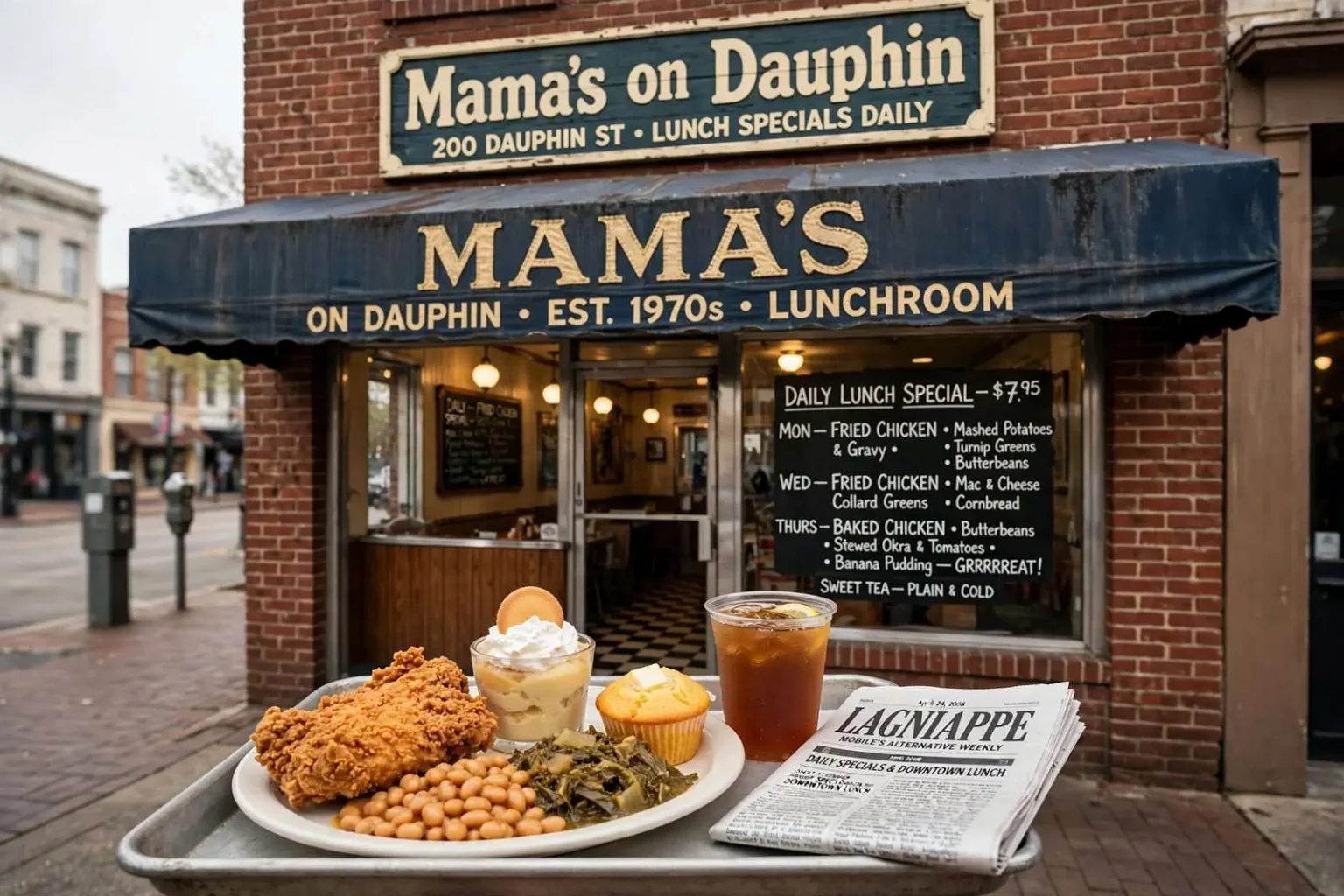
Downtown Mobile has never lacked for places to eat lunch. What it has sometimes lacked is a place where the food arrives without ceremony, tastes the way a grandmother would have made it, and costs about what a working lunch ought to cost. In April 2008, a Mobile dining critic writing under a pen name made the case that Mama’s on Dauphin was exactly that place. His affection was plain. The location was convenient. The serving staff was friendly. The food was very good. It was, in his phrase, a “down home” place, and he treated it less as a restaurant to be evaluated than as a routine to be defended.
Restaurant criticism usually works in superlatives, ranking a meal against the best in a city or a career. The review of Mama’s took the opposite approach. It read like the record of a habit — a place the critic went when he wanted to eat well without thinking about it, defended the way a regular defends his table. That framing made it unusual among reviews, and it is why the piece has outlived most of the restaurants it mentioned.
Two rules for eating at Mama’s
He had a system, and he shared it. Always order the lunch special of the day. He found the daily specials more appealing than anything else on the menu. Go on Monday, Wednesday or Thursday. Those were the days his favorite dishes came around.
The advice reflects how a Southern meat-and-three lunchroom actually operates. The printed menu is a formality; the blackboard of specials is the real menu, and regulars learn the rotation by heart. A diner who knows that fried chicken appears on certain days plans the week around it, and the critic was doing exactly that — publishing his own calendar to anyone who would follow it.
Each day brought three lunch special choices. His favorites were the chicken dishes, though he allowed that the others were probably excellent too. He passed along one piece of intelligence without explanation: an insider had once whispered to him not to order the chicken and dumplings, and he never had. The warning, delivered without evidence or elaboration, is the kind of tip that circulates in any working restaurant — an employee’s knowledge, passed along in a whisper, that never quite becomes a review but shapes orders for years.
For downtown workers in 2008, a lunch rotation like Mama’s filled a real niche. The central business district offered plenty of sandwiches and plated lunches, but few places where a meal arrived fast, hot and recognizably home-cooked at a price a working week could absorb. A critic who defended such a place was defending the category as much as the kitchen.
The fried chicken, and a higher standard
Fried chicken turned up as a Monday and Wednesday special, and he found it fried and seasoned quite well. It was, he wrote, the best fried chicken he had eaten in Mobile. It was not, however, the best he had eaten anywhere, and the review paused for a moment of memory that will be familiar to a great many Southern readers. The finest fried chicken of his life was his father’s, made on a gas stove in a black cast iron skillet with just enough oil to cover half the chicken at a time.
The method he described is a whole inherited technique in a sentence: a shallow skillet rather than a deep fryer, oil only halfway up the pieces, and the patience to fry in batches and turn each one until every side takes on its color. It is how generations of Southern home cooks did it, and it produced a crust and a texture that restaurant equipment rarely matches. Mama’s, he said, came close behind. That is about as much as any restaurant can hope for.
Behind Mama’s he ranked Dick Russell’s, the Mobile institution, as the next best fried chicken in town, with the Sunday special at Cracker Barrel a distant third. The ranking placed a small downtown lunchroom ahead of two names any Mobile diner would know, and it captured the review’s quiet argument: the best versions of a dish often come from the smallest kitchens, where a single cook makes the same decisions every day.
Thursday, and the baked chicken
Thursday brought his other order: the baked chicken, which he judged the equal of the fried and suspected was rather better for him. It was prepared and seasoned just right and was usually tender enough to fall off the bone.
Baked chicken is the harder dish to praise in a lunchroom because it gives the kitchen nowhere to hide. Fried chicken carries a seasoned crust that forgives a dry interior; baked chicken stands on its own moisture and seasoning, and a batch that sits too long in the warmer turns leathery in front of the customer. The critic’s note that it was “usually” tender enough carried that realism — high marks with a built-in allowance for the ordinary variability of a working kitchen.
For second-best baked chicken in Mobile, he again pointed to Dick Russell’s on the Sundays it was offered. The parallel with his fried chicken ranking was tidy: one restaurant earned his second-place nod twice, and in both cases behind the same lunchroom on Dauphin Street.
The side dishes drew similar approval. The selection was good, the seasoning was right, and the portions were adequate, which in this critic’s vocabulary was high praise rather than faint praise. A plate lunch lives or dies on its sides, and a cook who seasons the turnip greens and the butterbeans as carefully as the main dish is the exception rather than the rule. “Adequate” portions, for a lunch aimed at people returning to work, was exactly the right size — enough to satisfy without ending the afternoon.
The competition, and the pudding
He had tried the alternatives. From Mama’s position in the 200 block of Dauphin, there was a small place farther down toward Royal Street and a larger one up toward the square. Neither, in his estimation, compared. At the small place the buffet line was inconveniently arranged and the food, while acceptable, fell short. The larger spot he found popular but not to his taste, and he confessed a running objection to its flavored iced tea, a beverage he regarded as an affront to the whole institution of iced tea.
The tea objection deserves its moment. In the Alabama landscape of lunchrooms, sweet tea is not a beverage option but a baseline standard, and flavoring it with peach or raspberry is, to a certain kind of diner, an unnecessary improvement that misses the point. The critic’s view placed him firmly in that tradition: tea is tea, the plainer and colder the better, and a kitchen that gilds it signals a kitchen with priorities out of order.
The comparison also mapped downtown Mobile’s lunch geography as it stood in 2008. A handful of blocks around Dauphin held several lunch spots competing for the same office crowd, and each had its loyalists. Buffets offered variety; the larger sit-down spots offered comfort and speed. What the critic found at Mama’s was the combination the others lacked — a rotation worth following, sides worth eating and a plate that did not require a decision.
Then there was the banana pudding, which he introduced with a question and answered with a shout. It was, he said, borrowing from a certain cereal-box tiger, GRRRRREAT.
Dessert praise of that register, from a critic who spent paragraphs measuring words, was the review’s emotional high note. Banana pudding is the closing argument of a Southern plate lunch, and a version worth shouting about is the surest sign a kitchen takes the whole meal seriously, down to the last cup.
He closed by noting that Mama’s was also a good place to pick up a copy of the local alternative weekly, and by teasing his next assignment: one of the full-service restaurants out in west Mobile. He would let readers know.
Seventeen years on, the 200 block of Dauphin has turned over more than once, as downtown blocks do. Restaurants in a business district live short lives, opening on the energy of a founder and closing when the arithmetic finally fails, and a block that hosted a favorite lunchroom in 2008 has cycled through several tenants since. Downtown Mobile itself has kept changing around the block — lofts and breweries arriving, offices thinning, the lunch crowd reshaped every few years by who actually works in the central city at noon.
But the argument the review makes has not aged at all. A lunchroom that serves three specials a day, seasons its sides properly and gets the banana pudding right is doing something no larger menu can substitute for. The critique of the alternatives — the inconvenient buffet, the popular spot with the flavored tea — was really a statement about what a lunchroom owes its regulars: a predictable rotation, honest portions and tea that tastes like tea.
The review also preserved a portrait of a Mobile that lunchgoers of a certain generation remember firsthand: a downtown where the daily special was the day’s real schedule, where a fried chicken Monday was an appointment, and where a critic could defend a routine rather than chase a trend. Reading it again, the particular restaurant matters less than the standard it held — that a modest kitchen, doing a few things on schedule, can beat anything fancier on the same block.
That is why the piece still circulates among Mobile readers long after the block turned over. Good reviews expire with their subject. A review that explains why a down-home lunchroom mattered — and teaches its reader two rules for eating there — keeps its value as long as anyone wonders what a working lunch in Mobile used to taste like, and what it ought to taste like still.